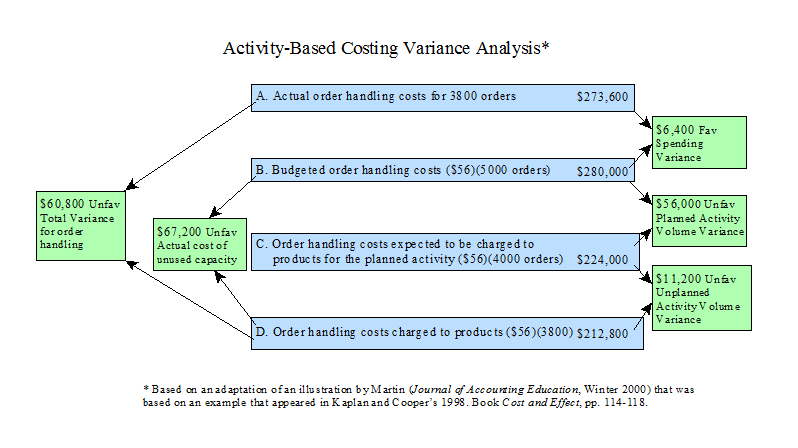
Example of Activity-Based Costing Variance Analysis
Provided by James R. Martin, Ph.D., CMA
Professor Emeritus, University of South Florida
Activity-Based Costing Main Page
| Accounting Variance
Analysis Main Page
This illustration from my article is based on an example from Kaplan and Cooper (1998, 114 -118)1.
Information Needed for ABC Analysis:
Activity - Handle customer orders
Measurement used to represent the activity cost driver - Number of customer orders
Practical capacity - 5,000 orders
Budgeted or planned activity for the period - 4,000 orders
Actual activity during the period - 3,800 orders
Budgeted costs of order handling - $280,000
Actual costs of order handling - $273,600
Cost Driver Rate - $280,000 ÷ 5,000 orders = $56 per order
The actual order handling activity volume variance of $67,200 (actual cost of unused capacity ) is separated into $56,000 which represents the cost of budgeted, or planned unused capacity (planned order handling activity volume variance) and $11,200 which represents the unexpected or unplanned cost of unused capacity (unplanned order handling activity volume variance).2 The key conceptual difference between traditional overhead variance analysis and ABC analysis is that a relevant activity volume (e.g., orders handled) is used as the basis for analyzing each activity in ABC rather than using production volume. In addition, practical capacity is used as the basis for calculating activity driver rates, rather than using the planned activity level or some other level of capacity. Using practical capacity prevents charging unused capacity costs to products and provides more accurate product costs and better information for capacity utilization decisions.
__________________________________________________
1 Kaplan, R. S. and R. Cooper. 1998. Cost and Effect: Using Integrated Cost Systems to Drive Profitability and Performance. Boston: Harvard Business School Press.
2 Kaplan and Cooper do not use the term volume variance. They refer to the $56,000 planned activity volume variance as the budgeted cost of unused capacity, and the $11,200 unfavorable unplanned activity volume variance as the unexpected cost of unused capacity utilization.
Related summaries:
Cooper, R. and R. S. Kaplan. 1992. Activity-based systems: Measuring the costs of resource usage. Accounting Horizons (September): 1-13. (Summary).
Kaplan, R. S. and S. R. Anderson. 2004. Time-driven activity-based costing. Harvard Business Review (November): 131-138. (Summary).
Martin, J. R. Not dated. Chapter 7: Activity Based Product Costing. Management Accounting: Concepts, Techniques & Controversial Issues. Management And Accounting Web. Chapter7.htm
Martin, J. R. Not dated. Chapter 10: Standard Full Absorption Costing. Management Accounting: Concepts, Techniques & Controversial Issues. Management And Accounting Web. Chapter10.htm
Ruhl, J. M. 1995. Activity-based variance analysis. Journal of Cost Management (Winter): 38-47. (Summary).
Stammerjohan, W. W. 2001. Better information through the marriage of ABC and traditional standard costing techniques. Management Accounting Quarterly (Fall): 15-21. (Summary).