Summary by Kelly Brummett
Master of Business Administration Program
University of South Florida, Fall 2003
Management Theory Main Page | Theories
Main Page | Research Methods Main Page
The formula for success at one company does not always translate into success for another company. Yet, consultants and managers all too frequently apply the same principles of success in every situation. It is imperative that the dynamics of the company be examined before applying any theory.
Management must first understand what a theory is and from where it is derived. “A theory is a statement predicting which actions will lead to what results and why” (p. 68). Actions are not just arbitrarily taken; rather they are the result of an expectation by a manager. Theories are important for two reasons:
1. Assist in helping individuals make decisions; and
2. Provide guidance for understanding what is happening in the present and why.
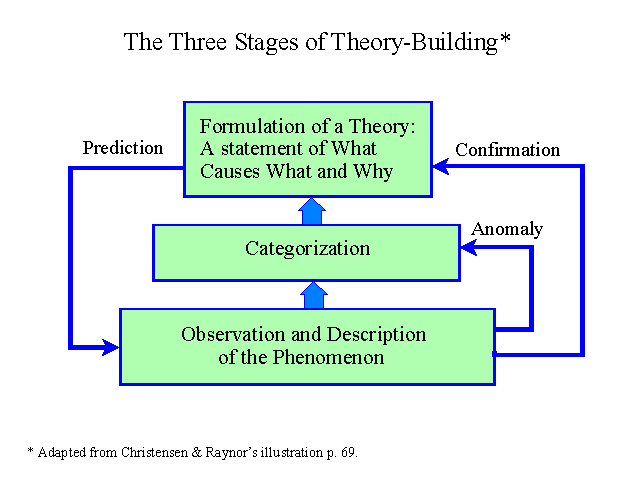
Theories are the product of a three-stage process. First, a phenomenon to be investigated must be described. The first stage is very important because the phenomenon needs to be carefully observed, taking note of its breadth and complexity. In the second stage, aspects of the phenomenon are classified into useful, relevant categories. This categorization allows researchers to organize complex information into meaningful distinctions. Finally, during stage three, researchers can develop a hypothesis of cause and effect relationships of the phenomenon.
The three stages of theories are constantly repeated until researchers are confident enough to make predictions about what should happen in similar circumstances. Frequently, while repeating the process, researchers observe something in the theory that cannot be explained or predicted, an anomaly that implies something different is occurring. It is then imperative to revert to the second stage to re-examine the categories defined. The presence of an anomaly allows researchers to more accurately explain how the phenomenon should work in a variety of situations.
For example, Michael Porter saw anomalies in the theory of comparative advantage that had for many years explained international trade. His research demonstrated that while the traditional theory on comparative advantage was valid, other factors played important roles in a country’s ability to increase its advantage in the global market. His theory of “clusters” explained how a country could exploit its natural resources, but another country lacking essential natural resources can create policies to build “process-based comparative advantage” (p. 69).
Typically, early in the research process, categories are defined according to the attributes that seem to be correlated with a particular outcome. However, categorization based on correlations is actually based on the researchers uncertainty. Stating that a casual relationship exists as a result of correlation implies that researchers do not fully understand what causes a given result. Unfortunately, many researchers use the correlation basis, incorrectly believing that they can increase their results using supercomputers and databases for number crunching and regression analysis to manufacture statistical significance.
Breakthroughs in determining causality do not come from number crunching, but from a careful, detailed inspection of the companies to view the processes in action. For example, it was superficially thought that Toyota’s success in manufacturing had to be related to Japan’s culture. However, after researchers visited a Japanese plant, they noticed more significant characteristics of the system, including minimum levels of inventory and kanban card scheduling systems. Sadly, the researchers then equated the attributes of the plant’s success with its results. Many wrote books and articles encouraging managers in manufacturing plants to adopt the Toyota philosophy to improve quality, increase efficiency, and reduce costs. More careful analysis of Toyota by Spear and Bowen revealed that the success of the company was attributed to “four specific rules that create automatic feedback loops, which repeatedly test the effectiveness of each new activity, pointing the way toward continual improvements” (p. 71).
In order to be predictable, researchers have to ask, “What will cause this theory to fail?” instead of asking, “What characteristics are associated with success?” Researchers need to not only identify causal mechanisms, but also need to explain which situations cause the mechanisms to fail or succeed. Elaborating on circumstances, known as circumstance contingent, allows managers to understand when theories should be adjusted to fit their particular environment. It also helps management recognize changes in their competitive environment and to begin shifting in efforts to sustain success in the new environment. Theories that are circumstance contingent help success become predictable and sustainable.
It is essential that researchers not only understand what factors lead to success, but also the factors that lead to failure. Simply following the “best practices” of successful companies very often ends with disastrous consequences. For example, in 1999, Lucent Technologies followed the management restructuring and reorganization fad. The company divided into 11 “hot businesses” with each operating independently. Much to top executive’s surprise, the division autonomy did not increase growth or profitability. Instead, the reorganization made Lucent less flexible, slower to respond to customer needs, and created new costs. The company fell victim to the remedy of the moment.
When researchers identify circumstance contingent theories, managers are better able to diagnose the situation that they are in, and conversely, not in. Studies conducted by the authors indicate that rarely are success theories bound by industry barriers such as product-based versus service-based. Therefore, theories should only be trusted when they explain how phenomenon leads to success as a company’s circumstances change.
It is important for managers to learn how to identify a good theory. Foremost, be skeptical of articles that merely describe a phenomenon. Researchers who have formulated circumstance contingent theories often build on descriptive accounts of causal relationships. Second, be careful not to trust an article with a solution that cures all business’s problems. It is very rare that new categorizations reshape established thinking. Third, if authors categorize a phenomenon based solely on attributes, just assume that it is a starting point for a circumstance contingent theory to be discovered. Fourth, “correlations that masquerade as causation often take the form of adjectives. . . a real theory should include a mechanism – a description of how something works” (p. 73). And lastly, remember that a researcher’s test results should not be considered final. Progress is a result of constant testing to understand which situations will lead to failure in efforts to refine the theories.
_________________________________________________
Related summaries:
Christensen, C. M. 1997. Making strategy: Learning by doing. Harvard Business Review (November-December): 141-142, 144, 146, 148, 150-154, 156. (Summary).
Clinton, B. D. and A. H. Graves. 1999. Product value analysis: Strategic analysis over the entire product life cycle. Journal of Cost Management (May/June): 22-29. (Summary).
De Geus, A. 1999. The living company. Harvard Business Review (March-April): 51-59. (Summary).
Fonvielle, W. and L. P. Carr. 2001. Gaining strategic alignment: Making scorecards work. Management Accounting Quarterly (Fall): 4-14. (Summary).
Gosselin, M. 1997. The effect of strategy and organizational structure on the adoption and implementation of activity-based costing. Accounting, Organizations and Society 22(2): 105-122. (Summary).
Iansiti, M. and R. Levien. 2004. Strategy as ecology. Harvard Business Review (March): 68-78. (Summary).
Kaplan, R. S. and D. P. Norton. 1996. Using the balanced scorecard as a strategic management system. Harvard Business Review (January-February): 75-85. (Summary).
Kaplan, R. S. and D. P. Norton. 2000. Having trouble with your strategy? Then map it. Harvard Business Review (September-October): 167-176. (Summary).
Kaplan, R. S. and D. P. Norton. 2001. Transforming the balanced scorecard from performance measurement to strategic management: Part I. Accounting Horizons (March): 87-104. (Summary).
Kaplan, R. S. and D. P. Norton. 2001. Transforming the balanced scorecard from performance measurement to strategic management: Part II. Accounting Horizons (June): 147-160. (Summary).
Kaplan, R. S. and D. P. Norton. 2004. Measuring the strategic readiness of intangible assets. Harvard Business Review (February): 52-63. (Summary).
Kim, W. C. and R. Mauborgne. 1997. Value innovation: The strategic logic of high growth. Harvard Business Review (January-February): 103-112. (Summary).
Kim, W. C. and R. Mauborgne. 1999. Creating new market space: A systematic approach to value innovation can help companies break free from the competitive pack. Harvard Business Review (January-February): 83-93. (Summary).
Kim, W. C. and R. Mauborgne. 2002. Charting your company's future. Harvard Business Review (June): 77-83. (Summary).
Langfield-Smith, K. 1997. Management control systems and strategy: A critical review. Accounting, Organizations and Society 22(2): 207-232. (Summary).
Luehrman, T. A. 1998. Strategy as a portfolio of real options. Harvard Business Review (September-October): 89-99. (Summary).
Martin, J. R. Not dated. The concept of validity. Management And Accounting Web. ValidityNotes.htm
O'Clock, P. and K. Devine. 2003. The role of strategy and culture in the performance evaluation of international strategic business units. Management Accounting Quarterly (Winter): 18-26. (Summary).
Porter, M. E. 1996. What is a strategy? Harvard Business Review (November-December): 61-78. (Summary).
Porter, M. E. 2001. Strategy and the internet. Harvard Business Review (March): 63-78. (Summary).
Simons, R. 1995. Control in an age of empowerment. Harvard Business Review (March-April): 80-88. (Summary).