Summary by Jae Johnson
Master of Accountancy Program
University of South Florida, Fall 2004
JIT Main Page | TOC Main Page
The purpose of this article is to introduce a method of production similar to the Just-In-Time (JIT) method. The author asserts that there are a few problems with JIT that can be overcome by the Drum-Buffer-Rope (DBR) method. The main problem with JIT is that implementation requires a number of production process changes. If these changes are not made, work-in-progress (WIP) will build to an unnecessary level which raises costs.
The DBR method works to overcome this problem by using the existing system and techniques to limit the release of “raw materials, or jobs, into the system, based on the capacity of a system constraint” in order to limit build up of WIP inventory (p. 37).
Just-In-Time Systems
Major changes to the production process mentioned above include:
Procurement activities will need to adapt by developing long-term stable relationships with less suppliers including agreements to supply high quality materials, respond rapidly, and make frequent deliveries.
An increase in quality of production is required to reduce the time and money spent making defective products.
Reduction in setup times will speed up production while saving money on storing inventory.
The most difficult to implement, a “balanced flow rate” requires workstations to maintain the same capacity and process time or else WIP inventory will build up.
The layout of the factory will need to be rearranged to restrict the amount of transporting materials around the plant allowing quicker movement along the production line.
Finally, reward systems will need to be redesigned to promote throughput (rate a company makes money through sales) and discourage excess inventory.
The Theory of Constraints
A constraint is anything that limits a system from achieving its goal or a level of performance desired. The theory of constraints (TOC) is a production process management technique that identifies and manages these constraints in the system. This theory has “three principles for production: increase throughput, decrease operating expenses, and decrease inventory” (p. 38).
Drum-Buffer-Rope Scheduling
Based on the theory of constraints, the Drum-Buffer-Rope method “recognizes that most companies operate with at least one constraint”(p. 38). It also considers that capacity and process time may not always be balanced throughout the workstations. Other changes that JIT requires may be supportive of DBR, such as: quality improvements, setup time reduction, layout reorganizations, and new performance measures. The definitions of DBR components include:
Drum - the constraint (a task that may operate slower than the rest of the processes).
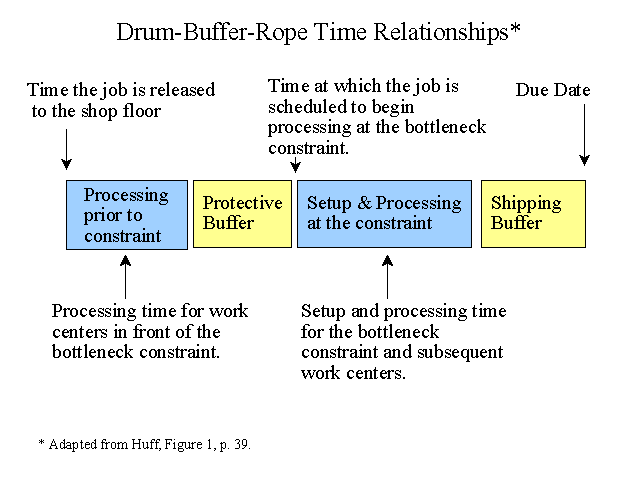
Buffer - time buffer used to protect the drum from disruptions in the preceding production steps.
Rope - schedule that coordinates the timing of the release of raw material, or jobs (designed to make all workstations perform at the pace of the drum).
Three steps are included in a process costing operation:
1. Constraint, or bottleneck is identified.
2. Buffer size is set to keep the constrained task busy at all times.
3. Schedule of release of raw material is established by working backward from the due date of the job. (See the graphic illustration below).
When a new job is admitted requiring processing through the constrained task, the buffer is checked to see how many jobs are already in the system. If the buffer is full, then the new job will not be released until at least one job is completed. This keeps the constrained task working and reduces the amount of WIP inventory.
A DBR Example
The author uses an example of how DBR can be used in a service organization. The organization is a surgery center. Before operation, patients have to have blood testing and x-rays taken. There are four stations for processing of patients: administrative intake, the blood lab, x-ray, and administrative discharge. The constrained department is x-ray because there is only one room available. Therefore, based on past experience a buffer of 3 patients in the x-ray waiting room was established in order to keep x-rays going at all times. When a patient initially arrives at administrative intake the x-ray buffer is checked. If the buffer is full, the new patient will not be admitted to administrative intake until a patient gets though x-rays. The surgery center has found that patients are less disruptive in administrative intake than in the x-ray waiting room. Eventually the surgery center could use this experience to make appointments for x-ray and blood work tests (p. 40).
A Comparison of JIT Production and DBR Scheduling
Two major differences (according to P. C. cook) between JIT and DBR are set forth in the table below (p. 40):
| JIT | DBR |
| JIT requires the plant to be balanced so each task has the same output level. | DBR uses a buffer in front of the constrained resource to reduce the buildup of unnecessary WIP inventory and allow for a continuous flow of products through the system. |
| JIT creates batches of equal size. | DBR allows different sized batches, making it better suited for use in a job order shop that takes custom orders of differing sizes. |
The author quotes a few studies that compare JIT to DBR to support her argument. DBR outperformed JIT in a number of categories (p. 40):
1. DBR required less inventory lowering manufacturing costs.
2. DBR had better customer requirement responsiveness.
3. DBR provided an opportunity for better product quality.
4. DBR produced more products with a lower standard deviation of flow time helping to determine when the product would be ready for shipment.
5. DBR results in lower WIP inventory which lowers investment in manufacturing costs.
For these reasons the author clearly thinks that DBR is the superior method.
_____________________________________________
Related summaries:
Corbett, T. 2000. Throughput accounting and activity-based costing: The driving factors behind each methodology. Journal of Cost Management (January/February): 37-45. (Summary).
Goldratt, E. M. 1990. The Haystack Syndrome: Sifting Information Out of the Data Ocean. New York: North River Press. (Summary).
Goldratt, E. M. 1990. What is this thing called Theory of Constraints. New York: North River Press. (Summary). (In Chapter 4 Goldratt says that the word "cost" is a dangerous and confusing multi-meaning word and that the word "product cost" is "an artificial, mathematical phantom" p. 49).
Goldratt, E. M. 1992. From Cost world to throughput world. Advances In Management Accounting (1): 35-53. (Summary).
Goldratt, E. M. and J. Cox. 1986. The Goal: A Process of Ongoing Improvement. New York: North River Press. (Summary).
Goldratt, E. M., E. Schragenheim and C. A. Ptak. 2000. Necessary But Not Sufficient. New York: North River Press. (Summary).
Hall, R., N. P. Galambos, and M. Karlsson. 1997. Constraint-based profitability analysis: Stepping beyond the Theory of Constraints. Journal of Cost Management (July/August): 6-10. (Summary).
Louderback, J. And J. W. Patterson. 1996. Theory of constraints versus traditional management accounting. Accounting Education 1(2): 189-196. (Summary).
Luther, R. and B. O’Donovan. 1998. Cost-volume-profit analysis and the theory of constraints. Journal of Cost Management (September/October): 16-21. (Summary).
Martin, J. R. Not dated. Comparing Dupont's ROI with Goldratt's ROI. Management And Accounting Web. Comparing Dupont Goldratt ROI
Martin, J. R. Not dated. Comparing Traditional Costing, ABC, JIT, and TOC. Management And Accounting Web. Trad ABC JIT TOC
Martin, J. R. Not dated. Drum-Buffer-Rope System. Management And Accounting Web. Drum Buffer Rope
Martin, J. R. Not dated. Global measurements of the theory of constraints. Management And Accounting Web. TOC Measurements
Martin, J. R. Not dated. Goldratt's dice game or match bowl experiment. Management And Accounting Web. Match Bowl Experiment
Martin, J. R. Not dated. Lean concepts and terms. Management And Accounting Web. Lean Concepts and Terms Summary
Martin, J. R. Not dated. Profit Beyond Measure graphics and notes. Management And Accounting Web. Johnson Broms Graphics Notes
Martin, J. R. Not dated. TOC problems and introduction to linear programming. Management And Accounting Web. TOC Problems Intro To LP
Martin, J. R. Not dated. What is lean accounting? Management And Accounting Web. Lean Accounting
Rezaee, Z. and R. C. Elmore. 1997. Synchronous manufacturing: Putting the goal to work. Journal of Cost Management (March/April): 6-15. (Summary).
Ruhl, J. M. 1996. An introduction to the theory of constraints. Journal of Cost Management (Summer): 43-48. (Summary).
Ruhl, J. M. 1997. The Theory of Constraints within a cost management framework. Journal of Cost Management (November/December): 16-24. (TOC Illustration).
Westra, D., M. L. Srikanth and M. Kane. 1996. Measuring operational performance in a throughput world. Management Accounting (April): 41-47. (Summary).