Summary by Velynda Wickerson
Master of Accountancy Program
University of South Florida, Fall 2004
Quality Related Main Page |
Small Business Main Page
Successful companies rate customer satisfaction as the number one priority. Customers have come to expect value. Small companies can achieve high quality at a low price by using nonfinancial measures to identify and monitor quality.
The simple no-cost procedures illustrated in this paper are similar to the total quality management (TQM) programs that larger firms have adopted. Small firms can increase product or service quality with minimum effort.
A company needs to understand quality costs before starting any quality improvement program. Quality costs include all costs involved in making a product or delivering a service that meets a customer’s specifications or expectations the first time. Costs of quality have two components that are separated into two subcategories:
1. Costs of conformance – costs incurred to make sure the product or service is right the first time.
Prevention costs – costs to prevent defects and failures initially.
Appraisal costs – costs to measure and evaluate products and services to ensure the quality standards are being met.
2. Costs of nonconformance – costs incurred to correct a problem or irregularity.
Internal failure costs – costs incurred when defects are discovered before the product is shipped or the service is delivered to the customer.
External failure costs – costs incurred after delivery of defective goods or services.
The costs of conformance and the costs of nonconformance are inversely related. Various studies have reported that these costs range from 25% for manufacturing firms to as high as 40% for service firms. Thus, quality can have a large impact on profits.
The principle of this no-cost approach to improving quality is to identify the activity that needs improvement and monitor the nonfinancial elements of the activity. A monetary amount should not be applied to the measures of the activity. This simple program for controlling quality is a three-step approach that can be used with any spreadsheet program. The steps are to:
identify the appropriate nonfinancial quality measures to monitor;
immediately record the measures in a spreadsheet; and
use the recorded data to prepare timely quality reports, including line or bar graphs.
The time interval selected will depend on the size and situation of the firm.
Sample Nonfinancial Quality Measures - (Adapted from Table 2, p. 17).
| Conformance Costs | |
| Prevention Costs | Appraisal Costs |
| Design review (number of hours) | Material inspection (number of inspections) |
| Preventive maintenance (number of hours) | WIP inspection (number of inspections) |
| Employee training (number of hours) | FG inspection (number of inspections) |
| Quality circles (number of hours) | Sample preparation (number of samples) |
| Quality engineering (number of hours) | Product simulation (number of simulations) |
| Nonconformance Costs | |
| Internal Failure Costs | External Failure Costs |
| Scrap (number of units) | Warranty claims (number of claims) |
| Rework (number of units) | Complaint processing (number of complaints) |
| Spoilage (number of units) | Loss of goodwill (return customers) |
| Quality-related downtime (number of hours) | Liability suits (number of suits) |
| Re-inspection of rework (number of units) | Product recalls (number of recalls) |
The simple principle is to report the nonfinancial data and look for trends in the measures. The measures that a manager or owner decides to monitor will be different for each firm and is selected after a careful analysis of the complete product or service cycle. Users must select those measures that will assist the company with its move toward producing a higher-quality product or service.
The more effort spent toward conformance measures usually reduces the effort spent toward fixing a problem or irregularity. The nonconformance measures are those that must be improved and will probably comprise most of a firm’s measures.
Illustrative Example - Small film processing establishment located in a mall.
The firm has the owner, three employees, and declining profits over the last few years. The owner maintains a price structure that is competitive with the area and has even lowered prices occasionally in an attempt to increase profits. He has noticed that he is spending a lot of time handling complaints about the quality of his service. After reading about the above no-cost program to increase quality, the owner decided to try it for 10 weeks.
Step 1 - The owner selected a combination of eight conformance and nonconformance measures and began recording the weekly results in a spreadsheet. He also decided not to make any changes during the first two weeks.
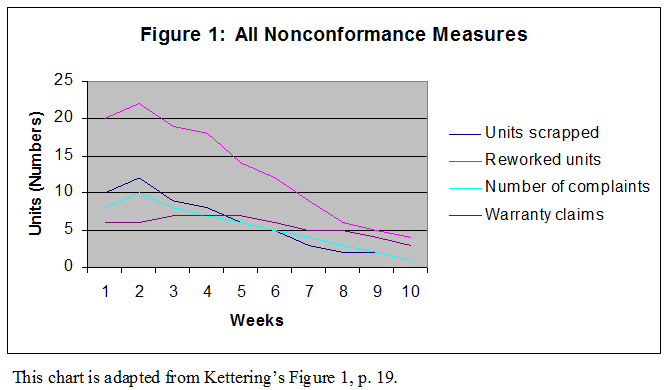
Step 2 - After two weeks of recording the data, and before printing the report, the owner saw that the number of units that were scrapped and reworked were higher than he realized. He was also surprised by the number of complaints and warranty claims that were submitted.
The owner made his first changes in the third week. He required an hour of maintenance on the machines and an hour of training for all employees. He also mandated that one shipment each of incoming material and outgoing products were to be inspected thoroughly. The owner noticed an almost instant decline in the number of scrapped and reworked units and complaints.
As the weeks stretched out, he increased maintenance, training and inspections. The nonconformance measures continued to improve until the measures were within his acceptable range. By week ten, he was able to reduce the required maintenance and training hours.
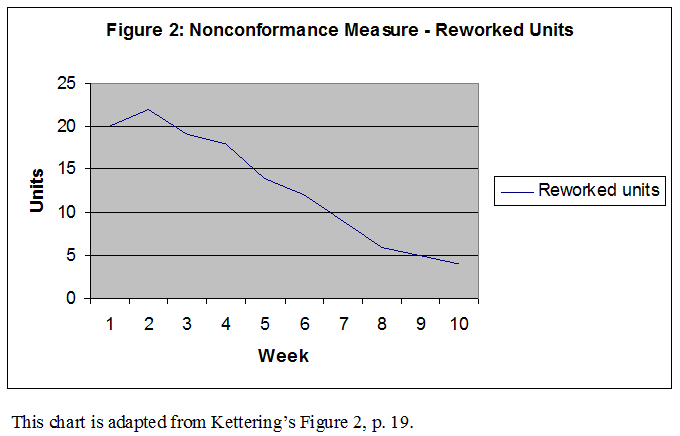
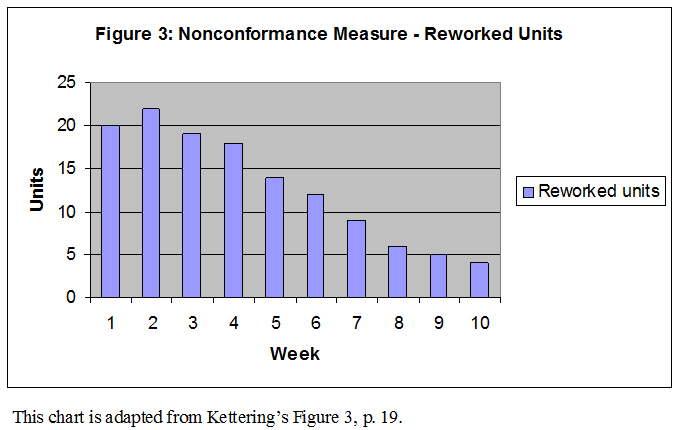
Step 3 - After the ten weeks were up, the owner printed the spreadsheet and defined four ranges of data. These four nonconformance measures were plotted on a line graph (Figure 1 below). Impressed with the decrease in the number of units that had to be reworked, the owner decided to print a line graph (Figure 2) and a bar graph for this data (Figure 3).
Conclusion
Product or service quality is the top priority of successful businesses. A business should direct all efforts at satisfying the customer. Customer satisfaction is the key to survival. Monitoring and striving to improve at least one measure, such as complaints or reworked units, will improve product or service quality. The main requirement is a desire and commitment to improve.
________________________________________________
Related summaries:
Albright, T. L. and H. Roth. 1992. The measurement of quality costs: An alternative paradigm. Accounting Horizons (June): 15-27. (Summary).
Albright, T. L. and H. Roth. 1993. Controlling quality on a multidimensional level. Journal of Cost Management (Spring): 29-37. (Summary).
Albright, T. L. and H. P. Roth. 1994. Managing quality through the quality loss function. Journal of Cost Management (Winter): 20-37. (Summary).
Anderson, S. W. and K. Sedatole. 1998. Designing quality into products: The use of accounting data in new product development. Accounting Horizons (September): 213-233. (Summary).
Carr, L. P. 1995. How Xerox sustains the cost of quality. Management Accounting (August): 26-32. (Summary).
Carr, L. P. and L. A. Ponemon. 1994. The behavior of quality costs: Clarifying the confusion. Journal of Cost Management (Summer): 26-34. (Summary).
Deming, W. E. 1993. The New Economics for Industry For Industry, Government & Education. Cambridge: Massachusetts Institute of Technology Center for Advanced Engineering Study. Chapter 10. (Summary).
Fargher, N. and D. Morse 1998. Quality costs: Planning the trade-off between prevention and appraisal activities. Journal of Cost Management (January/February): 14-22. (Summary).
Gabel, N. 1991. Is 99.9% good enough? Training Magazine (March). (Summary).
Hughes, S. B. and D. M. Willis. 1995. How quality control concepts can reduce environmental expenditures. Journal of Cost Management (Summer): 15-19. (Summary).
Kim, M. W. and W. M. Liao. 1994. Estimating hidden quality costs with quality loss functions. Accounting Horizons (March): 8-18. (Summary).
Lucier, G. T. and S. Seshadri. 2001. GE takes six sigma beyond the bottom line. Strategic Finance (May): 40-46. (Summary).
Martin, J. R. Not dated. Constrained optimization techniques. Management And Accounting Web. ConstrainoptTechs.htm
Martin, J. R. Not dated. Summary of the 1992 PBS Program Quality or Else. Management And Accounting Web. QualityOrElse.htm
Martin, J. R. Not dated. The quality cost conformance model. Management And Accounting Web. QualityCostConformanceModel.htm
Martin, J. R. Not dated. What is Six Sigma? Management And Accounting Web. SixSigmaSummary.htm
Morse, W. J. 1983. Measuring quality costs. Cost and Management (July-August): 16-20. (Summary).
Pasewark, W.R. 1991. The evolution of quality control costs in U.S. manufacturing. Journal of Cost Management (Spring): 46-52. (Summary).
Roehm, H. A., D. Klein and J. F. Castellano. 1995. Blending quality theories for continuous improvement. Management Accounting (February): 26-32. (Summary).
Roth, H. P. and T. L. Albright. 1994. What are the costs of variability? Management Accounting (June): 51- 55. (Summary).
Rust, K. G. 1995. Measuring the costs of quality. Management Accounting (August): 33-37. (Summary).
Sedatole, K. L. 2003. The effect of measurement alternatives on a nonfinancial quality measure's forward-looking properties. The Accounting Review (April): 555-580. (Summary) and
Shank, J. K. and V. Govindarajan. 1994. Measuring the "cost of quality": A strategic cost management perspective. Journal of Cost Management (Summer): 5-17. (Summary).
Sjoblom, L. M. 1998. Financial information and quality management - Is there a role for accountants? Accounting Horizons (December): 363-373. (Summary).
Taguchi, G. and D. Clausing. 1990. Robust quality. Harvard Business Review (January-February): 67-75. (Summary).