Summary by Kerry A. Martin
Master of Accountancy Program
University of South Florida, Summer 2002
Capital Budgeting Main Page |
Environmental Cost Main Page
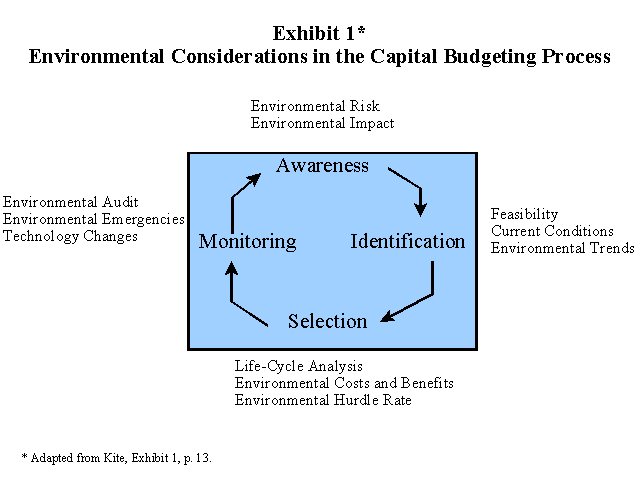
Product manufacturing often has negative affects on the environment. Pollution, waste disposal, recycling, insurance, and public relations associated with these effects have become a focus in the 21st century. Within the last two decades, the concern for these environmental effects has grown. Companies and upper management are being held financially responsibly for negative environmental impacts. his new financial responsibility must be incorporated into the tradition capital budgeting process. The author of this article, Devaun Kite, points out four stages in capital budgeting and presents considerations that management must make in the budgeting process.
Although some argue that environmental concerns are purely ethical, this article expresses that costs and liabilities faced by business today make it an economic issue that can not be ignored. The economic impact of environmental issues is crucial for management decision making.
Traditional Capital Budgeting
The traditional capital budgeting process is divided into four stages:
Awareness
Identification
Selection
Monitoring
The author proposes the following alterations to the process:
Awareness
During the awareness stage of capital budgeting, management must develop an understanding for the environment as a variable in the planning process. Decision makers must evaluate if there is risk of environmental impact. They must also consider how the potential impact can affect corporate goals and objectives.
If anyone or anything outside of the organization is affected by potential risk, it must be factored into the decision equation.
Identification
During the process of identifying feasible projects that support management’s plans, environmental considerations must now be made. There are several environmental laws that may have an impact on corporate decisions:
The Clean Air Act
The Clean Water Act
The Resource Conservation and Recovery Act of 1976
Comprehensive Environmental Response
Compensation and Liability Act of 1980 (Superfund)
Considerations must be made not only from an economic perspective, but a public relations view as well. These economic and public acceptance considerations should be viewed as long-term dynamic factors.
Selection
Discounted Cash Flow techniques are currently used.
Net Present Value method is widely practiced.
It requires estimates of: 1) economic life, 2) cash flows, and 3) a discount rate.
Economic Life – In traditional capital budgeting, the economic life of a project is estimated. In today’s reality, environmental costs that surpass the projects life need to be considered. A prime example is “clean-up costs” well after a project is complete. Useful life of projects should be expanded to adapt to this consideration.
Cash Flows – Cash flows are also affected by environmental issues. They alter direct costs, indirect costs, and also could have hidden costs and contingent liability costs. Direct costs can be hard to price. Indirect costs arise from monitoring, treating, and waste disposal. Hidden costs can originate from compliance with regulations. Contingent liability costs are very difficult to estimate and require companies to anticipate environmental risk. Unfortunately, experience and common sense may provide the best estimates of projected cash flows.
Discount Rate – The traditional NPV method of capital budgeting uses cost of capital or weighted average cost of capital as the discount rate. To incorporate environmental risk, this discount rate should be increased; the higher the risk, the higher the adjustment. This increase compensates for environmental risk by lowering the net present value of a project.
Monitoring
Once a project is selected and initiated, the work doesn’t end. Its performance and changing costs should be analyzed continuously. Assessments should be made on a scheduled basis due to ever changing laws, technology, and economics. This step is important in evaluating the economic and environmental justification of continuing a project.
___________________________________________
Related summaries:
Bayou, M. E. and J. B. Nachtman. 1992. Costing for manufacturing wastes. Journal of Cost Management (Summer): 53-62. (Summary).
Boer, G., M. Curtin and L. Hoyt. 1998. Environmental cost management. Management Accounting (September): 28-30, 32, 34, 36 and 38. (Summary).
English, D. M. and D. K. Schooley. 2014. The evolution of sustainability reporting. The CPA Journal (March): 26-35. (Summary).
Epstein, M. J. and S. D. Young. 1999. Greening with EVA. Management Accounting (January): 45-49. (Summary).
Esquire. 2015. America: These are your choices. Esquire (December/January): 149-153, 160-161, 164, 168. (Summary - This is a summary of ten questions related to the most critical choices for America based on information from the Brookings Institution).
Estes, R. 1992. Social accounting past and future: Should the profession lead, follow - or just get out of the way? Advances In Management Accounting (1): 97-108. (Summary).
Gleeson-White, J. 2015. Six Capitals, or Can Accountants Save the Planet?: Rethinking Capitalism for the Twenty-First Century. W. W. Norton & Company. (Note).
Hammer, B. and C. H. Stinson. 1995. Managerial accounting and environmental compliance costs. Journal of Cost Management (Summer): 4-10. (Summary).
Hughes, S. B. and D. M. Willis. 1995. How quality control concepts can reduce environmental expenditures. Journal of Cost Management (Summer): 15-19. (Summary).
Johnson, H. T. 2006. Sustainability and "Lean Operations". Cost Management (March/April): 40-45. (Summary).
Johnson, H. T. 2012. A global system growing itself to death - and what we can do about it. The Systems Thinker (May): 2-6. (Summary).
Jones, A. III. and G. A. Jonas. 2011. Corporate social responsibility reporting: The growing need for input from the accounting profession. The CPA Journal (February): 65-71. (Summary).
Lanen, W. N. 1999. Waste minimization at 3M Company: A field study of nonfinancial performance measurement. Journal of Management Accounting Research (11): 29-43. (Summary).
Lawrence, J. E. and D. Cerf. 1995. Management and reporting of environmental liabilities. Management Accounting (August): 48-54. (Summary).
Martin, J. R. Not dated. Investment management. Management And Accounting Web. InvestmentManageSum.htm
Reinhardt, F. L. 1999. Bringing the environment down to earth. Harvard Business Review (July-August): 149-157. (Summary).
Schooley, D. K. and D. M. English. 2015. SASB: A pathway to sustainability reporting in the United States. The CPA Journal (April): 22-27. (Summary).