Summary by Dorinda Martinez
Master of Accountancy Program
University of South Florida, Summer 2001
ABC Main Page | Contribution Margin Main Page | TOC
Main Page
This article contains a panel discussion about the relevance of contribution margin analysis. The speakers include Robert Kaplan, John Shank, Charles Horngren and Germain Boer.
Robert Kaplan's View
Kaplan argued that CM has lost most if not all of its relevance to management accounting; however, he believes that it remains useful for a limited set of purposes. In his view, CM ignores the relevance of “fixed costs”, and has been around for fifty or sixty years.
TOC – The Theory of Constraints advocates a more extreme view of direct costing. This approach recognizes only three critical measurements for organizations:
1. Throughput = sales price – purchases of materials & outside services.
2. Inventory = items that have been purchased that have not yet been consumed.
3. Operating Expenses = Overhead + Direct Labor expense.
This approach to costing is like direct costing in that it is a short-run, powerful optimization procedure. However, the authors of this theory did not attempt to analyze or allocate operating expenses; they are treated as a big blob.
Ignoring “Fixed Costs” – All expenses other than materials expense are assumed fixed in TOC. The problem with this is that fixed costs keep growing. Kaplan asserts that the “fixed costs” are the costs that vary the most. Traditional direct costing can predict short-run results in organizations because it focuses on the fluctuations in products’ volume and mix, keeping some expenses fixed (with respect to the short run). Kaplan believes that the direct costing approach is misleading for most other product related decisions.
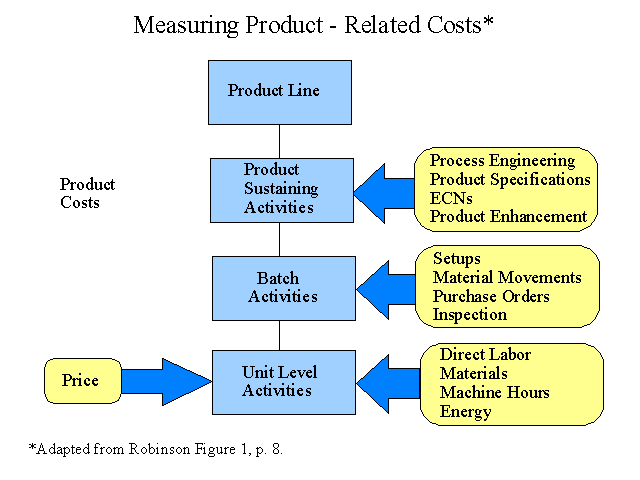
Remedy – According to Kaplan, the so-called fixed costs can be explained by the diversity of the company’s products, customers, distribution channels, and product lines. The activity-based approach attempts to penetrate the big blob of “fixed costs” and show that most if not all of these costs are really variable. Kaplan sites situations where many overhead resources are not consumed in proportion to the number of units produced (the cost driver in direct costing), but are consumed by product-related activities. Another way to look at operating expenses focuses on customers and distribution channels.
See the summary of Demmy and Talbott 1998 for a similar idea.
Charles T. Horngren disagrees
Horngren states that many managers believe that the more-accurate data is not worth collecting. He also states that direct labor performs as well as any other cost driver
Counter Argument by Kaplan
Kaplan counters by stating that activity-based systems do not make decisions, they illustrate principles for designing a general-purpose system. He continues to say that it would be technologically and economically infeasible to ascertain all possible combinations of products; instead what is needed is an “attention-directing” system.
Germain Boer’s perspective on ABC
Boer sites an article by Ray Marble where he developed a cost hierarchy for each of the two conceptual views: product segment view and market segment view. As you continue up the hierarchy a company will identify more and more fixed costs to product segments, until you reach the total company level, where all company costs are eventually traced. Boer also states that different methods are used to reach different decisions; such as: a make-buy decision requires a consideration of all cash flows and when preparing financial statements a different cost is needed.
John Shank's View
Shank believes that the contribution margin approach is “past its prime.” He continues with Kaplan’s claim that CM can only handle small short-run decisions; he adds that if the problem is small enough for CM to be relevant, then it will not make a big impact on a company.
Notable Failures – Shank notes examples of failures for contribution margin pricing in American steel firms such as: J & L, Wheeling Pittsburgh, and Youngstown Sheet & Tube. He denotes the demise of these large and once successful firms to CM because it leads you to keep everything and always make instead of buy.
CM is not favored – Boston Consulting, Bain, Booz-Allen, McKinsey, Monitor and Alliance do not advocate the contribution margin approach.
_________________________________________
Also see Robinson, M. A., ed. 1990. Contribution margin analysis: No longer relevant/strategic cost management: The new paradigm. Journal of Management Accounting Research (2): 1-32. Horngren and Boer arguments (Summary).
Related summaries:
Demmy, S. and J. Talbott. 1998. Improve internal reporting with ABC and TOC. Management Accounting (November): 18-20, 22 and 24. (Summary).
Hepworth, S. R. 1954. Direct costing - The case against. The Accounting Review (January): 94-99. (Summary).
Johnson, H. T. 1989. Professors, customers, and value: Bringing a global perspective to management accounting education. Proceedings of the Third Annual Management Accounting Symposium. Sarasota: American Accounting Association: 7-20. (Summary).
Kee, R. C. 2001. Implementing cost-volume-profit analysis using an activity-based costing system. Advances in Management Accounting (10): 77-94. (Summary).
Martin, J. R. Not dated. Conventional Linear Cost-Volume Profit Analysis. Chapter 11. Management Accounting: Concepts, Techniques & Controversial Issues. Chapter11.htm
Martin, J. R. Not dated. Contribution Margin Models. Management And Accounting Web. ContributionMarginModels.htm
Martin, J. R. Not dated. The contribution margin controversy. Management And Accounting Web. CMcontro.htm
Martin, J. R. Not dated. Comparing Dupont's ROI with Goldratt's ROI. Management And Accounting Web. ComparingDupontGoldrattROI.htm
Martin, J. R. Not dated. Goldratt's dice game or match bowl experiment. Management And Accounting Web. MatchBowlExperiment.htm
Martin, J. R. 1994. A controversial issues approach to enhance management accounting education. Journal of Accounting Education (Winter): 59-75. (Summary).
Martin, J. R. Not dated. Relationship between Cost-Volume-Profit and Return on Investment. Chapter 14. Management Accounting: Concepts, Techniques & Controversial Issues. (Chapter 14).