Summary by Adrienne Perez
Master of Accountancy Program
University of South Florida, Fall 2004
ABC Main Page | ABM Main Page |
CAM-I Main Page
The purpose of this article is to introduce a new approach to budgeting and planning developed by the CAM-I ABPB Interest Group. The new method places emphasis on achieving an operational balance first, and then a financial balance. This is more advantageous than traditional budgeting because it creates a flexible and dynamic budget model that easily adapts to organizational changes.
Activity-Based Planning and Budgeting (ABPB) Details
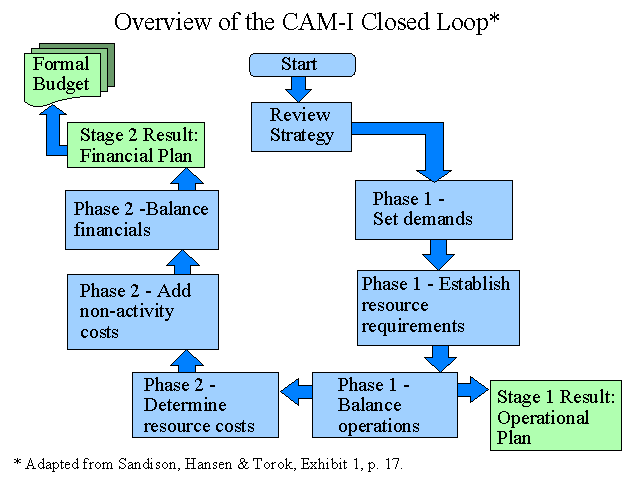
The key feature of the new approach is the Closed Loop Model. This model takes individual strategies from initial thought to the final product and allows manipulations of all variables within the process. The following graphic provides an overview of the CAM-I closed loop model.
Phase one of the Closed Loop Model attempts to achieve an operational balance. Operational balance is defined as “providing sufficient resource capacity to meet the sum of all demands placed on the organization with an acceptable level unused capacity. Unused capacity may often be considered as useful buffer capacity, as opposed to negative idle or excess capacity.” The first step in this phase is to identify a strategy that fits with the organizational goals. This strategy is then used to develop a feasible operational plan. The organization should identify the demand, constraints, resources, drivers, and outputs desired with the particular operational process. Once these requirements are known, the model tries to achieve an operational balance between the resources required to meet the demand and the available capacity of the resources. The key aspect of operational balance is that it is achieved strictly on nonfinancial terms.
The second phase is to develop a financial plan that works with the operational balance to achieve the desired financial balance. Financial balance means “generating a financial plan/budget that uses the quantities and rates defined in the operational plan to deliver the required financial results.” This phase is simple because all the factors have been established. Management must now determine the cost of resources, then trace these costs to the activity costs. The activity costs will ultimately arrive at the product costs.
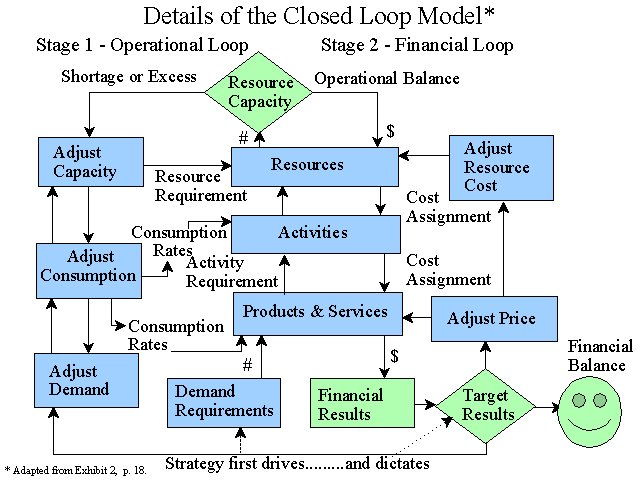
If any of these phases were to become imbalanced, the Closed Loop Model allows for an adjustment of the following five elements to reach the target budget:
Product demand quality
Activity and resource consumption
Resource capacity
Resource cost
Product/service price
The ability to alter the above elements makes this Model very beneficial for any organization. This more detailed view of the closed loop model is illustrated below.
Contrasting Traditional and ABPB Approaches
The following chart contrasts the two approaches:
| Traditional Approaches | ABPB Process |
| Financial view only | Operational and financial view |
| Lack of buy-in from all areas of management | All managers are involved on an on-going basis |
| Too detailed | Macro forward-looking approach with detail only when and where required |
| Lack of confidence in information | Uses "hard" operational and resource information to generate the model |
| Perceived "gaming" with budget numbers | Using an observational model reduces the amount of room for disagreement on operational and financial information |
| Too time consuming | Is part of an on-going means of proactively managing the organization |
| Too may iterations | Iterations are kept at a macro level and are more meaningful |
Integration with Traditional Budgeting Process and Other Performance Management Initiatives
ABPB can be used in conjunction with traditional budgeting process. The best way to obtain integration is to use the Closed Loop Model for the parts of the organization that produce identifiable products or services. The Model can also be used for the parts of the organization that have processes that can be easily mapped. The parts of the organization that can not be mapped or do not have easily identifiable products or service can be budgeted using the traditional process.
ABPB can also be used as a management performance system. The Model helps the employees to focus and clearly see the strategy and how to execute it. The most important part of using ABPA is to view the Model as a one of many management tools. It should not be viewed in isolation. As a management performance system, ABPA can be coupled with the balance scorecard. These two methods compliment each other because they both commence with a strategy.
Conclusion
The main benefit of this new approach to budgeting and planning is related to the flexibility and dynamic aspect of the model. This aspect allows for a better link to performance management and accountability. This approach is not too time consuming because of the proactive and flexible planning involved. The ABPB approach accommodates the dynamic business environment that the majority of organizations operate in today.
______________________________________________
Related summaries:
Berliner, C., and J. A. Brimson, eds. 1988. Cost Management for Today's Advanced Manufacturing: The CAM-I Conceptual Design. Boston: Harvard Business School Press. (Summary Chapters 1-3). (Summary Chapter 6).
Beynon, R. 1992. Change management as a platform for activity-based management. Journal of Cost Management (Summer): 24-30. (Summary).
Campi, J. P. 1992. It’s not as easy as ABC. Journal of Cost Management (Summer): 5-11. (Summary).
Coburn, S., H. Grove and C. Fukami. 1995. Benchmarking with ABCM. Management Accounting (January): 56-60. (Summary).
Cokins, G. 1999. Using ABC to become ABM. Journal of Cost Management (January/February): 29-35. (Summary).
Cooper, R. 1996. Activity-based management and the lean enterprise. Journal of Cost Management (Winter): 6-14. (Summary).
Cooper, R., and R. S. Kaplan. 1998. The promise - and peril - of integrated cost systems. Harvard Business Review (July-August): 109-119. (Summary 1, Summary 2).
Hope, J. and R. Frazer. 2003. Who needs budgets? Harvard Business Review (February): 108-115. (Summary).
Hughes, S. B. and K. A. Paulson Gjerde. 2003. Do different cost systems make a difference? Management Accounting Quarterly (Fall): 22-30. (Summary).
Keys, D. E. 1994. Tracing costs in the three stages of activity-based management. Journal of Cost Management (Winter): 30-37. (Summary).
Martin, J. R. Not dated. Activity based management models. Management And Accounting Web. ABMModels.htm
Martin, J. R. Not dated. Chapter 7: Activity Based Product Costing. Management Accounting: Concepts, Techniques & Controversial Issues. Management And Accounting Web. Chapter7.htm
Martin, J. R. Not dated. Chapter 8: Just-In-Time, Theory of Constraints, and Activity Based Management Concepts and Techniques. Management Accounting: Concepts, Techniques & Controversial Issues. Management And Accounting Web. Chapter8.htm
McGowan, A. 1999. Impacts of ABCM on job performance and environment. Journal of Cost Management (March/April): 32-36. (Summary).
Pryor, T. 1997. Making new things familiar and familiar things new. Journal of Cost Management (Winter): 38-42. (Summary).
Reeve, J. M. 1996. Projects, models, and systems -Where is ABM headed? Journal of Cost Management (Summer): 5-16. (Summary).
Shields, M. D. and S. M. Young. 1989. A behavioral model for implementing cost management systems. Journal of Cost Management (Winter): 17-27. (Summary).
Stammerjohan, W. W. 2001. Better information through the marriage of ABC and traditional standard costing techniques. Management Accounting Quarterly (Fall): 15-21. (Summary).
Sweeney, R. B. and J. W. Mays. 1997. ABM lifts bank's bottom line. Management Accounting (March): 20-22 and 24-26. (Summary).
Swenson, D. 1997. Best practices in activity-based management. Journal of Cost Management (November/December): 6-14. (Summary).
Swenson, D. W. 1998. Managing costs through complexity reduction at Carrier Corporation. Management Accounting (April): 20-22, 24, 26-28. (Summary).
Van der Stede, W. A. 2000. The relationship between two consequences of budgetary controls: Budgetary slack creation and managerial short-term orientation. Accounting, Organizations and Society 25(6): 609-622. (Summary).