Summary by Anita Reed
Ph.D. Program in Accounting
University of South Florida, Spring 2002
Research Methods Main Page |
Theories Main Page
The constructive approach to management accounting research (defined as "problem solving through the construction of organizational procedures or models"), is proposed and described. The authors find too little of this type of research is done, which contributes to the distance between academic research and practice and is partially to blame for the perception of reduced relevance of management accounting research.
Three main concepts are introduced:
1. Constructions refer to entities that produce solutions to explicit problems, create new reality and can be implemented,
2. Managerial constructions refer to entities that solve problems emergent in running business organizations and
3. The Constructive approach is a research procedure for producing constructions.
They base their arguments on Johnson and Kaplan’s (1987) charge to management accounting researchers "to design" (construct) new, more relevant management accounting systems and to be innovative in their approach.
They pose the question: "Should management accounting research be explicitly involved in solving practical accounting problems?" and suggest that constructive research, properly performed, meets the criteria for valid applied research.
The Idea of the Constructive Approach
The authors describe constructive research as "managerial problem solving through the construction of models, diagrams, plans, organizations, etc.". They identify creation of an artificial language as an example of a pure construction, and consider the language of accounting and development of new budgeting systems to be examples within the managerial accounting context.
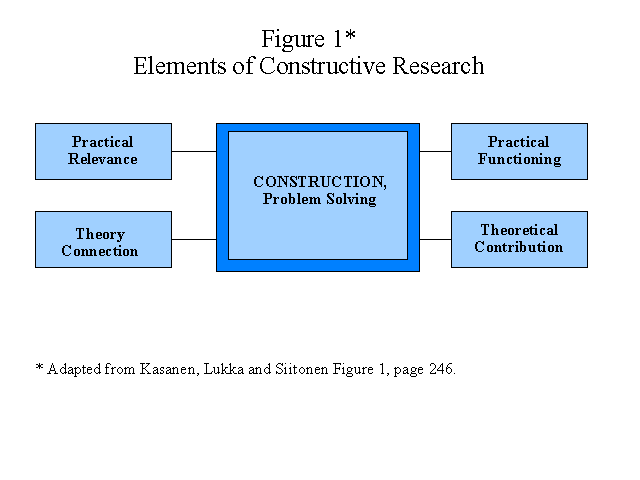
To be considered constructive research, the research must combine problem solving and theoretical knowledge, as illustrated in Figure 1.
The authors propose four phases of the constructive approach:
1. Find a practically relevant problem which also has research potential.
2. Obtain a general and comprehensive understanding of the topic.
3. Innovate, i.e., construct a solution idea.
4. Demonstrate that the solution works.
5. Show the theoretical connections and the research contribution of the solution concept.
6. Examine the scope of applicability of the solution.
Innovation is the core element of a successful constructive study, requiring creativity on the part of the researcher. The new construction must be innovative with regards to both practice and research. The authors contend that this element is the fundamental issue underlying the role of management accounting research, i.e., is the main objective of management accounting research to solve problems, or to observe and analyze or to do both.
The Scarcity of the Constructive Approach in Management Research
The authors analyzed the publications for four major journals from 1985 through 1991 and two more recent journals for 1989 through 1991 and found few examples of published research that met the criteria of the constructive approach.
Why is the Constructive Approach so Scarce?
The authors contend that constructive research is scarce in part due to the adoption of scientific philosophy and positivist research methods. The accounting discipline is seeking to establish a scientific identity. Another reason for scarcity of published constructive research is the dismissal of consulting as non-scientific and therefore not publishable in academic journals. In addition, if consulting is the context for the constructive research, nondisclosure agreements with the consulting client may preclude or delay publication in order to protect trade secrets or maintain competitive advantage.
Whatever the reason, the authors encourage constructive research to close the gap between practice and academia.
The Constructive Approach as a Methodology
Constructive research is viewed as an applied study that is distinguishable from basic studies, technique development, analytic model building or mere consulting. One of the primary criteria for constructive research is the demonstration of practical usefulness, including relevance, simplicity and ease of operation by the business community. The authors propose a market-based validation for assessing this aspect of a construction and have developed a market test based on the concept of innovation diffusion as follows:
Weak market test: Has any manager responsible for the financial results of his or her business unit been willing to apply the construction in question in his or her actual decision making?
Semi-strong market test: Has the construction become widely adopted by companies?
Strong market test: Have the business units applying the construction systematically produced better financial results that those are not using it?
Assessing the actual performance of a construction is a separate research question, to be analyzed using appropriate research methodology.
The authors contend that constructive research may be conducted using both quantitative and qualitative methods, or a combination, but most often implements a case study method. They also contend that it is normative in nature, as opposed to positivist, as it is "an inherently goal-directed problem solving activity".
The authors discuss the various research methodologies in order to identify the underlying issues of constructive research. Figure 4 illustrates the established accounting research approaches and the "location" of constructive research within the framework.
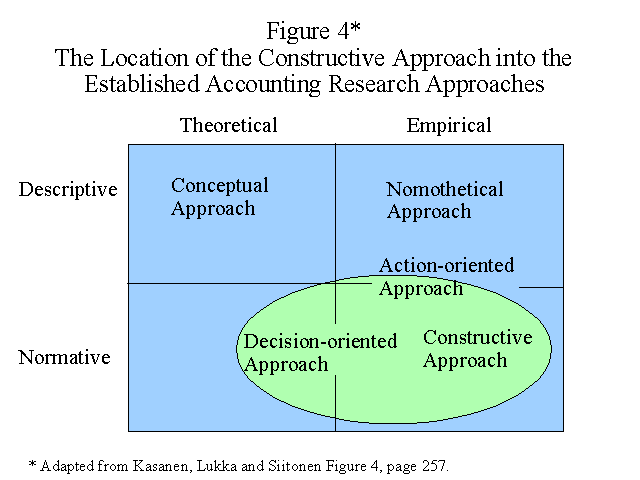
The constructive approach is seen as a normative approach having much in common with decision-oriented and action-oriented approaches.
Is the Constructive Approach Scientific?
To determine if the constructive approach is a scientific approach, the authors list the characteristics of the constructive approach as follows:
1. It is a step by step procedure, so that the nature of the steps is specified in the framework system, within which the method is applied.
2. The possibility exists to check every step, or every phase in the construction.
3. The procedure as a whole serves some definite purpose, thus building constructions is a goal-directed activity.
The scientific validity is based on how well the research solves problems or poses new problems and its inclusion of the following properties: objectivity, criticalness, autonomy and progressiveness. For constructions, the criteria of relevant, simple and ease of use are also required for the functioning application. As far as assessing the generalizability of constructive research, the analysis of diffusion of the application in practice may be a more useful method.
Conclusions
The authors reiterate their view that published constructive research is scarce, owing to the nature of the scientific principles adopted by the accounting research community and the emergence of managerial constructions through private consulting arrangements. They recommend the recognition of the constructive approach as a step in the growth of the management accounting discipline, with a view towards improving the communication between practice and academia and increasing the relevance of management accounting research. They contend that management accounting is "a practical field where theory without pragmatic implications is empty" and encourage the adoption of the methods used in other applied fields such as technical science and medicine to better inform constructive research.
____________________________________________
Related summaries:
Buckley, J. W., M. H. Buckley and H. Chiang. 1976. Research Methodology and Business Decisions. National Association of Accountants. (Summary).
Foster, G. and S. M. Young. 1997. Frontiers of management accounting research. Journal of Management Accounting Research (9): 63-77. (Summary).
Ittner, C. D. and D. F. Larcker. 2001. Assessing empirical research in managerial accounting: A value-based management perspective. Journal of Accounting and Economics (32): 349-410.
Jonsson, S. 1998. Relate management accounting research to managerial work! Accounting, Organizations and Society 23(4): 411-434. (Summary).
Jonsson, S. and N. B. Macintosh. 1997. CATS, RATS, and EARS: Making the case for ethnographic accounting research. Accounting, Organizations and Society 22(3-4): 367-386. (Summary).
Kaplan, R. S. 1993. Research opportunities in management accounting. Journal of Management Accounting Research (5): 1-14. (Summary).
Kaplan, R. S. 1998. Innovation action research: Creating new management theory and practice. Journal of Management Accounting Research (10): 89-118. (Summary).
Luft, J. and M. D. Shields. 2003. Mapping management accounting: Graphics and guidelines for theory-consistent empirical research. Accounting, Organizations and Society 28(2-3): 169-249. (Summary).
Lukka, K. and J. Mouritsen. 2002. Homogeneity or heterogeneity of research in management accounting? The European Accounting Review 11(4): 805-811. (Summary).
Otley, D. and A. Fakiolas. 2000. Reliance on accounting performance measures: Dead end or new beginning. Accounting, Organizations and Society 25(4-5): 497-510. (Summary).
Shields, M. D. 1997. Research in management accounting by North Americans in the 1990s. Journal of Management Accounting Research (9): 3-61. (Summary).
Zimmerman, J. L. 2001. Conjectures regarding empirical managerial accounting research. Journal of Accounting and Economics (December): 411-427. (Summary).