Summary by James R. Martin, Ph.D., CMA
Professor Emeritus, University of South Florida
Control and Controllership Main Page | Research
Methods Main Page | Theories Main Page
The purpose of this paper is to critically assess the theories of organizations derived from neo-classical economics collectively referred to as the orthodox control model, and to explore an alternative dialectical approach to control. The authors illustrate the alternative approach using content analysis of GM's annual reports to develop a socio-historical study of the company's strategies of internationalization over a 60 year (1916-1976) period.
Critical Analysis of the Orthodox Model
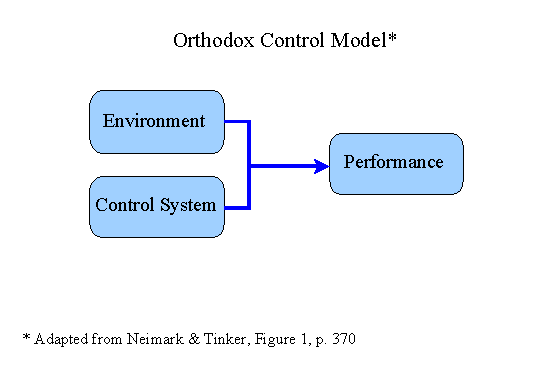
The orthodox model, illustrated in the graphic below, underlies various theories including transaction cost theory, agency theory, the inducement contribution model, and contingency theory.
Neimark and Tinker are critical of the orthodox model for the following reasons:
1. The various studies are situated within a timeless space and fail to recognize the social origins of control systems and how they evolve over time.
2. The dynamic feedback mechanisms are missing which reflects the unidirectional causal bias of these studies, i.e., one dependent variable and two independent variables. However, the relationships are multi-directional.
3. The environment and the organization are viewed as separate entities.
4. The environment is incompletely specified.
5. Performance is viewed as non-problematic. The assumption is that what is good for the capitalist is good for the worker, community and nation, but this ignores the social costs involved.
6. The orthodox model is grounded in a "positivistic" epistemology. These researchers have "overstated the 'scientific' and understated the social status of their theories" (p. 377).
In summary, the orthodox model either omits, or incompletely develops, a number of relationships related to the origins of corporate control systems.
The Dialectical Approach to Control
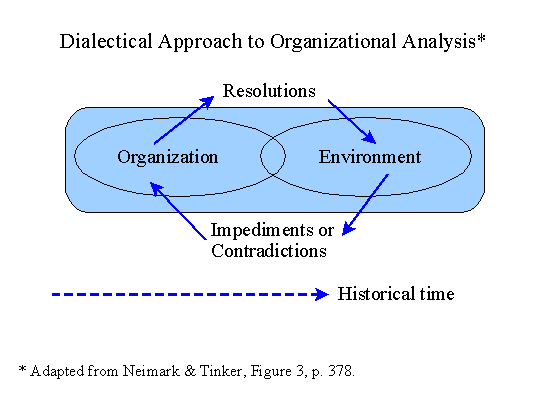
The dialectical approach has four elements.
1. The pervasiveness of social change.
2. The importance of contradictions as sources of social change. According to the authors, contradictions are created because of the unequal and antagonistic nature of social relations.
3. The relationship between the organization and its environment. Organization change can only be understood by understanding the changes in society.
4. The role of self-awareness in social change.
These elements are illustrated in the graphic below.
Control
Control has two reciprocal and interactive dimensions in the dialectical approach, i.e., societal and organizational. The societal dimension relates to the dominant patterns of power and appropriation, and the beliefs that tend to justify society's economic relationships. The organizational dimension relates to productivity.
Internationalization of Production and Distribution
This is a fairly long section that describes the development of GM's strategy of internationalization, showing how the company used internationalization to resolve the impediments to capital accumulation posed by market saturations and competition. These strategies reflect the dynamic interaction of the organizational and social control problems and emphasize the dialectical interplay of resolutions and impediments to capital accumulation.
Conclusion
The orthodox model, or conventional control theory, narrowly constructs the control problem and obscures the origins and consequences of corporate control systems. The dialectical approach, on the other hand, offers a form of self-awareness related to what accounting is and the part it plays in the process of change. Accounting theorizing should not mystify and reify the existence of structural inequality.
___________________________________________
Related summaries:
Chenhall, R. H. 2003. Management control system design within its organizational context: Findings from contingency-based research and directions for the future. Accounting, Organizations and Society 28(2-3): 127-168. (Summary).
Chenhall, R. H. and K. Langfield-Smith. 1998. The relationship between strategic priorities, management techniques and management accounting: An empirical investigation using a systems approach. Accounting, Organizations and Society 23(3): 243-264. (Summary).
English, D. M. and D. K. Schooley. 2014. The evolution of sustainability reporting. The CPA Journal (March): 26-35. (Summary).
Fullerton, R. R. and C. S. McWatters. 2002. The role of performance measures and incentive systems in relation to the degree of JIT implementation. Accounting, Organizations and Society 27(8): 711-735. (Summary).
Ittner, C. D. and D. F. Larcker. 1997. Quality strategy, strategic control systems, and organizational performance. Accounting, Organizations and Society 22(3-4): 293-314. (Note).
Kaplan, S. E. and J. T. Mackey. 1992. An examination of the association between organizational design factors and the use of accounting information for managerial performance evaluation. Journal of Management Accounting Research (4): 116-130. (Summary).
Libby, T. and J. H. Waterhouse. 1996. Predicting change in management accounting systems. Journal of Management Accounting Research (8): 137-150. (Summary).
Macy, G. and V. Arunachalam 1995. Management accounting systems and contingency theory: In Search of effective systems. Advances in Management Accounting (4): 63-86. (Summary).
Sim, K. L. and L. N. Killough. 1998. The performance effects of complementarities between manufacturing practices and management accounting systems. Journal of Management Accounting Research (10): 325-346. (Summary).
Schooley, D. K. and D. M. English. 2015. SASB: A pathway to sustainability reporting in the United States. The CPA Journal (April): 22-27. (Summary).
Spekle, R. F. 2001. Explaining management control structure variety: A transaction cost economics perspective. Accounting, Organizations and Society 26(4-5): 419-441. (Summary).
Tiessen, P. and J. H. Waterhouse. 1983. Towards a descriptive theory of management accounting. Accounting, Organizations and Society 8(2-3): 251-267. (Summary).