Summary by Neil Escalante
Master of Accountancy Program
University of South Florida, Summer 2003
JIT and Lean Enterprise Main Page | Lean
Accounting Main Page
The purpose of this article is to introduce the concept of “lean thinking.”1 Womack and Jones begin by stating that lean thinking is a fairly new manufacturing strategy that is not well understood in the Western World. Then they explain the five main steps involved in implementing a lean system, and how Lantech (a stretch-wrapping machine producing company) used the lean concept successfully. The authors also provide a less detailed example of how Pratt & Whitney (a turbine blade producing company) implemented a lean thinking production approach.
The five steps in developing and implementing a lean system include: (from page 141)
1. Define value precisely from the perspective of the end customer in terms of a specific product with specific capabilities offered at a specific price and time - The authors tell us that different departments in a production line may have different goals that they want to achieve. For example, their workers might be working in a manner they feel might help them advance in their jobs. Also, a department might want to make full use of all its materials available. This could lead to producing items that are not marketable in an efficient way. This is waste (or muda, the Japanese term).
2. Identify the entire value stream for each product or product family and eliminate waste - According to the authors, there are three “critical” activities that make up a value stream. These are product definition (from design to launching), information management (from order taking to delivery), and physical transformation (from raw materials to finished goods). Identifying these activities will highlight other processes in the production line that do not add value to the finished good and are wasteful.
3. Make the remaining value-creating steps flow - It appears that this is the most difficult step in developing a lean system. The common batch-and-queue mentality makes it hard to create a production line that flows To be consistent with the lean thinking concept, there should be no waiting, downtime or scrap within or between the steps of production.
4. Design and provide what the customer wants only when the customer wants it - To produce what the customer wants, the production process must be flexible enough to allow for necessary modifications. Flexibility allows customized products to be created on the same production line.
5. Pursue perfection - Once the production process starts to flow, any barriers in the cycle will become more apparent. In reality, a production process can never be flawless, but through constant reevaluation and upgrading, optimization is achieved.
The Lantech Story
Lantech is a company in Louisville, Kentucky that produces machines that stretch-wrap pallets of goods with plastic film. For over ten years, Lantech enjoyed a monopoly, provided by very general patents, and was free to produce machines at low quality and high prices. However, in 1989 when Lantech lost a patent-infringement suit, the company had to revolutionize its production process.
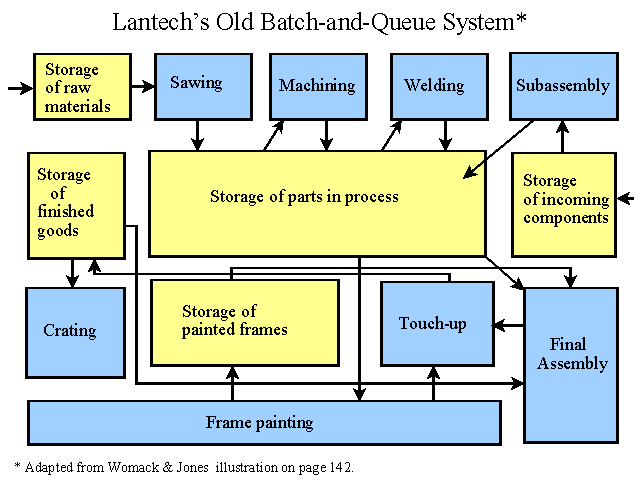
Batch-and-queue processing led to huge amounts of inventory which were expensive to maintain, required excessive amounts of energy to move from one department in the production line to the other, and, due to independent production of each component, often lacked key parts that severely lengthened throughput. The batch-and-queue system also required component parts to be sent back and forth between departments during production. This proved to be quite inefficient. (See graphic illustration below).
In an effort to cut down on cost and cycle time, Lantech hired Ron Hicks who had learned the fundamentals of a lean organization while working for a manufacturer of automotive repair tools in Tennessee. Hicks instantly got to work on cutting down waste in the production process.
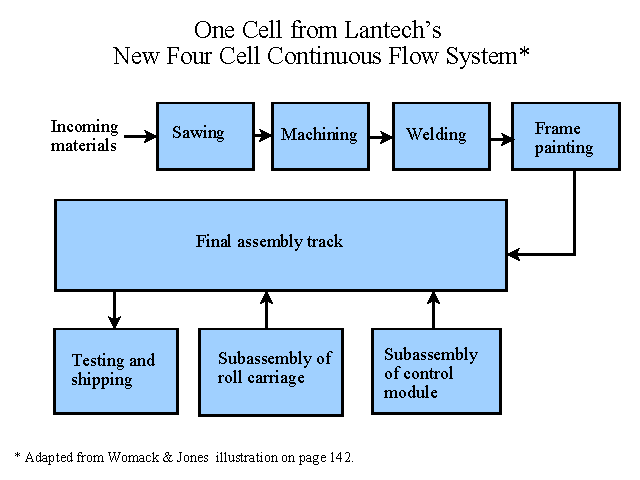
Hicks grouped the machines needed to create the four different product families into four separate cells. Smaller equipment replaced larger ones where necessary. Emphasis was placed on keeping the process flowing, regardless of whether the larger machines could produce components more quickly. When production began on Lantech’s Q Model, a frame was assembled and ready within one hour, this was moved three feet to a machining station. One hour after that, the work in process was moved four feet to the welding station. After a total of fourteen hours, the product was ready for shipment. This is a sharp contrast to the original sixteen weeks. No more will parts have to be moved to and from central storage and from department to department. This drastically cut cost and cycle time. (See the graphic illustration below).
The change from a batch-and-queue production system to a lean production system required that Lantech's thinking about work and how people work together change in three ways.
First, every task was standardized so that it would be performed correctly and take the same amount of time, every time. (See the Spear & Bowen summary for more on this point).
Second, Hicks introduced an idea that Toyota called takt time - the time it would take to produce the requested number of orders in a given time. For example, if the company needs to fulfill orders for sixteen machines in one day and the day is comprised of an eight hour shift, then takt time is one half hour for each machine. Keeping this concept in mind, emphasis is not placed on producing to full capacity but to produce only what is needed and still make efficient use of the day. When certain machines were not in demand, time could be spent on analyzing the process and trying to perfect it. Conversely, an increase in demand, shortening takt time, would provide an opportunity to augment production to use more hands to accomplish the job as fast and efficiently as possible.
Third, they developed quick changeovers so that all of the variations of their machines could be produced in a continuous flow with no stoppage.
Lantech was so successful with the lean thinking approach, the company applied the process-flow concept to the ordering, purchasing, and new product development activities. Other graphic illustrations in the article show the before and after views of these activities.
Lantech experienced the following increases in efficiency:
| Batch-and-queue | Constant Flow | |
| Development time for a new product family | 3 to 4 years | 1 year |
| Employee hours to make one machine | 160 | 80 |
| Manufacturing space per machine | 100 sq ft | 55 sq ft |
| Average number of defects per delivered machine | 8 | 0.8 |
| Value of in-process and finished goods inventory | $2.6 million | $1.9 million |
| Production throughput time | 16 weeks | 14 hrs to 5 days |
| Order to delivery time | 4-20 weeks | 1-4 weeks |
The Pratt & Whitney Story
The main idea behind this interjection in the article is how Pratt & Whitney substituted large machines which could cut there turbine blades in three minutes to smaller machines that can do the job in seventy-five minutes just to provide a constant flow in the production process. The blades had to be prepared by various non-value-adding processes for the larger machines, and although the smaller machines took longer to do the job, eliminating these wasteful processes proved to be greatly beneficial. Cost was cut to less than half per blade, and adjusting the machinery to produce different types of blades took a lot less time (from 480 minutes to 100 seconds).
The authors blame the misappropriation of modern technology and resources as the main causes of economic stagnation. They see lean thinking as the solution to this problem. However, they also claim that too many are uninformed about this new model, or lack the energy or the innovation to make the first move to create a lean enterprise.
___________________________________________
1 The "Lean Enterprise" is defined in an earlier paper. See Womack, J. P. and D. T. Jones. 1994. From lean production to the lean enterprise. Harvard Business Review (March-April): 93-103. (Summary).
Other related summaries:
Baggaley, B. and B. Maskell. 2003. Value stream management for lean companies, Part I. Journal of Cost Management (March/April): 23-27. (Summary).
Baggaley, B. and B. Maskell. 2003. Value stream management for lean companies, Part II. Journal of Cost Management (May/June): 24-30. (Summary).
Goodson, R. E. 2002. Read a plant - fast. Harvard Business Review (May): 105-113. (Summary).
Kapanowski, G. 2016. Lean fundamentals for accountants. Cost Management (January/February): 5-14. (Summary).
Martin, J. R. Not dated. Lean concepts and terms. Management And Accounting Web. LeanConceptsandTermsSummary.htm
Martin, J. R. Not dated. Profit Beyond Measure graphics and notes. Management And Accounting Web. JohnsonBromsGraphicsNotes.htm
Martin, J. R. Not dated. What is lean accounting? Management And Accounting Web. LeanAccounting.htm
Spear, S. and H. K. Bowen. 1999. Decoding the DNA of the Toyota production system. Harvard Business Review (September-October): 97-106. (Summary).
Spear, S. J. 2004. Learning to lead at Toyota. Harvard Business Review (May): 78-86. (Summary).
Staats, B. R. and D. M. Upton. 2011. Lean knowledge work: The "Toyota" principles can also be effective in operations involving judgment and expertise. Harvard Business Review (October): 100-110. (Summary).
Swank, C. K. 2003. The lean service machine. Harvard Business Review (October): 123-129. (Summary).
Toyota Public Affairs Division and Operations Management Consulting Division. 1998. The Toyota Production System: Leaner Manufacturing for a Greener Planet. The Toyota Motor Corporation. (Summary).