Provided by James R. Martin, Ph.D., CMA
Professor Emeritus, University of South Florida
Economics Related
Main Page | Framework for Management Accounting Main Page
Note: For a more recent report see my summary of the Global Competitiveness Report 2019.
The World Economic Forum's (WEF's) 2011 and 2012 Global Competitiveness Reports
The reports include two main parts. The following refers to the 2011 report.
Part 1: Measuring Competitiveness (pp. 1-2)
1.1 The Global Competitiveness Index 2011-2012: Setting the Foundations for Strong Productivity (pp. 3-50).
1.2 The Long-Term View: Developing a Framework for Assessing Sustainable Competitiveness (pp. 51-74).
1.3 The Executive Opinion Survey: An Indispensable Tool in the Assessment of National Competitiveness (pp. 75-84).
Part 2: Data Presentation (pp. 85-86)
2.1 Country/Economy Profiles (pp. 87-376)
2.2 Data Tables (pp. 377-520).
Technical Notes and sources (pp. 521-524)
About the Authors (pp. 525-526)
Acknowledgements (p. 527)
Notes on Part 1.1: The 2011 and 2012 Global Competitiveness Index including data for the U.S. from Part 2
The World Economic Forum (WEF) has based its competitiveness analysis on the Global Competitiveness Index (GCI) since 2005. The GCI measures the microeconomic and macroeconomic foundations of national competitiveness defined as the set of institutions, policies, and factors that determine the level of productivity of a country.
According to the WEG there are 12 pillars of competitiveness as indicated below. Although the pillars are aggregated into a single index, measures are reported for the 12 pillars separately to provide a sense of the specific areas in which a country needs to improve. The appendix describes the exact composition of the GCI and technical details of its construction." (p. 8 for the 2011 report).
1. Institutions - "The institutional environment is determined by the legal and administrative framework within which individuals, firms, and governments interact to generate wealth." (p. 4 for 2011). Indicators, values, and ranks for the U.S. are as follows: (p. 363 for 2011 and 361 for 2012). Note: Values in the tables below are on a 1-to-7 scale unless otherwise annotated with an asterisk (*). Ranks refer to the position of the U.S. in relation to the 142 countries included in the 2011 report and the 144 countries included in the 2012 report.
| Indicator | 2011 | 2012 | ||
| Value | Rank | Value | Rank | |
| Property rights | 5.1 | 39 | 5.0 | 42 |
| Intellectual property protection | 5.0 | 28 | 5.0 | 29 |
| Diversion of public funds | 4.6 | 36 | 4.6 | 34 |
| Public trust of politicians | 3.2 | 50 | 3.1 | 54 |
| Irregular payments and bribes | 4.9 | 42 | 4.8 | 42 |
| Judicial independence | 4.9 | 36 | 4.9 | 38 |
| Favoritism in decisions of government officials | 3.3 | 50 | 3.2 | 59 |
| Wastefulness of government spending | 3.2 | 66 | 3.2 | 76 |
| Burden of government regulation | 3.4 | 58 | 3.3 | 76 |
| Efficiency of legal framework in settling disputes | 4.5 | 36 | 4.5 | 35 |
| Efficiency of legal framework in challenging regs. | 4.2 | 39 | 4.2 | 37 |
| Transparency of government policymaking | 4.5 | 50 | 4.4 | 56 |
| Business costs of terrorism | 4.5 | 122 | 4.4 | 124 |
| Business costs of crime and violence | 4.5 | 81 | 4.5 | 86 |
| Organized crime | 4.9 | 86 | 4.9 | 87 |
| Reliability of police services | 5.6 | 30 | 5.5 | 30 |
| Ethical behavior of firms | 5.1 | 29 | 5.0 | 29 |
| Strength of auditing and reporting standards2 | 5.2 | 40 | 5.2 | 37 |
| Efficacy of corporate boards | 5.1 | 26 | 5.1 | 23 |
| Protection of minority shareholders’ interests | 4.8 | 32 | 4.8 | 33 |
| Strength of investor protection, 0–10 (best)* | 8.3 | 5 | 8.3 | 5 |
2. Infrastructure - A well developed transport (roads, railroads, and air) and communications infrastructure network (electricity and telecommunications). Indicators, values, and ranks for the U.S. are as follows: (p. 363).
| Indicator | 2011 | 2012 | ||
| Value | Rank | Value | Rank | |
| Quality of overall infrastructure | 5.7 | 24 | 5.6 | 26 |
| Quality of roads | 5.7 | 20 | 5.7 | 20 |
| Quality of railroad infrastructure | 4.8 | 20 | 4.8 | 18 |
| Quality of port infrastructure | 5.5 | 23 | 5.6 | 19 |
| Quality of air transport infrastructure | 5.7 | 31 | 5.8 | 30 |
| Available airline seat kms/week, millions* | 32,085.9 | 1 | 32,294.3 | 1 |
| Quality of electricity supply | 6.0 | 32 | 6.0 | 33 |
| Fixed telephone lines/100 pop.* | 48.7 | 14 | 47.9 | 15 |
| Mobile telephone subscriptions/100 pop.* | 89.9 | 87 | 105.9 | 72 |
3. Macroeconomic environment - "Running fiscal deficits limits the government's future ability to react to business cycles. "Indicators, values, and ranks for the U.S. are as follows: (p. 363).
| Indicator | 2011 | 2012 | ||
| Value | Rank | Value | Rank | |
| Government budget balance, % GDP* | -10.6 | 139 | -9.6 | 140 |
| Gross national savings, % GDP* | 11.6 | 121 | 12.9 | 114 |
| Inflation, annual % change* | 1.6 | 1 | 3.1 | 31 |
| Interest rate spread, %* | 2.9 | 26 | - | - |
| General government debt, % GDP* | 91.6 | 132 | 102.9 | 136 |
| Country credit rating, 0–100 (best)* | 91.4 | 9 | 89.4 | 11 |
The deficits in Europe, Japan, and the United States are mentioned as problems that could endanger the economic recovery worldwide.
| Table1: Public Debt Levels in G-7 Economies (p. 6) from the 2011 Report | |
| Country | Public debt as percent of GDP |
| Japan | 220.3 |
| Italy | 119.0 |
| United States | 91.6 |
| France | 84.3 |
| Canada | 84.0 |
| Germany | 80.0 |
| United Kingdom | 77.2 |
| Average | 101.3 |
4. Health and primary education - " For the longer term, it will be essential to avoid significant reductions in resource allocation to these critical areas, in spite of the fact that many government budgets will need to be cut to reduce the fiscal burden built up over the past years." (p. 5).
| Indicator | 2011 | 2012 | ||
| Value | Rank | Value | Rank | |
| Business impact of malaria. | N/Appl. | 1 | N/Appl. | 1 |
| Malaria cases/100,000 pop.* | (NE) | 1 | (NE) | 1 |
| Business impact of tuberculosis | 5.6 | 61 | 5.6 | 59 |
| Tuberculosis incidence/100,000 pop.* | 4.1 | 4 | 4.1 | 4 |
| Business impact of HIV/AIDS | 4.9 | 87 | 5.0 | 90 |
| HIV prevalence, % adult pop.* | 0.6 | 93 | 0.6 | 92 |
| Infant mortality, deaths/1,000 live births* | 6.8 | 41 | 6.5 | 41 |
| Life expectancy, years* | 78.7 | 32 | 78.2 | 34 |
| Quality of primary education | 4.6 | 37 | 4.6 | 38 |
| Primary education enrollment, net %* | 92.0 | 77 | 94.6 | 58 |
5. Higher education and training - This includes secondary and tertiary enrollment rates as well as the quality of education as evaluated by the business community. Vocational education and on-the-job training are also considered.
| Indicator | 2011 | 2012 | ||
| Value | Rank | Value | Rank | |
| Secondary education enrollment, gross %* | 94.1 | 50 | 96.0 | 47 |
| Tertiary education enrollment, gross %* | 82.9 | 6 | 94.8 | 2 |
| Quality of the educational system | 4.7 | 26 | 4.7 | 28 |
| Quality of math and science education | 4.3 | 51 | 4.3 | 47 |
| Quality of management schools | 5.4 | 12 | 5.4 | 12 |
| Internet access in schools | 5.8 | 24 | 5.7 | 24 |
| Availability of research and training services | 5.6 | 11 | 5.6 | 9 |
| Extent of staff training | 5.0 | 12 | 5.0 | 15 |
6. Goods market efficiency - "The best possible environment for the exchange of goods requires a minimum of impediments to business activity through government intervention." (p.7).
| Indicator | 2011 | 2012 | ||
| Value | Rank | Value | Rank | |
| Intensity of local competition | 5.6 | 18 | 5.6 | 18 |
| Extent of market dominance | 5.2 | 11 | 5.2 | 9 |
| Effectiveness of anti-monopoly policy | 5.0 | 17 | 4.9 | 17 |
| Extent and effect of taxation | 3.5 | 63 | 3.5 | 68 |
| Total tax rate, % profits* | 46.8 | 96 | 46.7 | 103 |
| No. procedures to start a business* | 6 | 34 | 6 | 47 |
| No. days to start a business* | 6 | 13 | 6 | 16 |
| Agricultural policy costs | 3.9 | 69 | 3.9 | 65 |
| Prevalence of trade barriers | 4.6 | 59 | 4.6 | 50 |
| Trade tariffs, % duty* | 1.5 | 32 | 1.4 | 35 |
| Prevalence of foreign ownership | 5.1 | 43 | 5.0 | 51 |
| Business impact of rules on FDI | 4.7 | 68 | 4.7 | 64 |
| Burden of customs procedures | 4.3 | 58 | 4.5 | 48 |
| Imports as a percentage of GDP* | 15.9 | 140 | 17.6 | 142 |
| Degree of customer orientation | 5.3 | 24 | 5.4 | 18 |
| Buyer sophistication | 4.6 | 12 | 4.6 | 10 |
7. Labor market efficiency - "Labor markets must therefore have the flexibility to shift workers from one economic activity to another rapidly and at low cost, and to allow for wage fluctuations without much social disruption." (p. 7).
| Indicator | 2011 | 2012 | ||
| Value | Rank | Value | Rank | |
| Cooperation in labor-employer relations | 4.8 | 36 | 4.7 | 42 |
| Flexibility of wage determination | 5.5 | 32 | 5.4 | 34 |
| Rigidity of employment index, 0-100 (worst)* | 0.0 | 1 | - | - |
| Hiring and firing practices | 5.1 | 8 | 5.0 | 8 |
| Redundancy costs, weeks of salary* | 0 | 1 | 0 | 1 |
| Pay and productivity | 4.9 | 8 | 4.8 | 12 |
| Reliance on professional management | 5.5 | 17 | 5.4 | 19 |
| Brain drain | 5.7 | 3 | 5.6 | 5 |
| Women in labor force, ratio to men* | 0.85 | 44 | 0.86 | 44 |
8. Financial market development - Financial markets channel resources to those entrepreneurial and investment projects with the highest expected rates of return. Financial markets need appropriate regulation.
| Indicator | 2011 | 2012 | ||
| Value | Rank | Value | Rank | |
| Availability of financial services | 6.0 | 13 | 6.0 | 12 |
| Affordability of financial services | 5.3 | 18 | 5.3 | 13 |
| Financing through local equity market | 4.3 | 28 | 4.6 | 18 |
| Ease of access to loans | 3.7 | 24 | 3.8 | 20 |
| Venture capital availability | 4.0 | 12 | 4.1 | 10 |
| Soundness of banks | 4.8 | 90 | 5.0 | 80 |
| Regulation of securities exchanges | 4.6 | 48 | 4.8 | 39 |
| Legal rights index, 0–10 (best)* | 8.0 | 20 | 9 | 11 |
9. Technological readiness - This pillar "measures the agility with which an economy adopts existing technologies to enhance the productivity of its industries, with specific emphasis on its capacity to fully leverage information and communication technologies (ICT) in daily activities and production processes for increased efficiency and competitiveness." (p. 7).
| Indicator | 2011 | 2012 | ||
| Value | Rank | Value | Rank | |
| Availability of latest technologies | 6.3 | 18 | 6.3 | 14 |
| Firm-level technology absorption | 5.9 | 18 | 5.9 | 14 |
| FDI and technology transfer | 4.9 | 49 | 4.9 | 43 |
| Internet users/100 pop.* | 79.0 | 18 | 77.9 | 20 |
| Broadband Internet subscriptions/100 pop.* | 26.3 | 18 | 28.7 | 17 |
| Internet bandwidth, kb/s/capita* | 29.0 | 26 | - | - |
| Int'l Internet bandwidth, kb/s per user* | - | - | 47.2 | 33 |
| Mobile broadband subscriptions/100 pop* | - | - | 65.5 | 8 |
10. Market size - Both domestic and foreign markets are included in the measure of market size, giving credit to export-driven economies and geographic areas.
| Indicator | 2011 | 2012 | ||
| Value | Rank | Value | Rank | |
| Domestic market size index, 1–7 (best)* | 7.0 | 1 | 7.0 | 1 |
| Foreign market size index, 1–7 (best)* | 6.7 | 2 | 6.7 | 2 |
11. Business sophistication - "Business sophistication concerns two elements that are intricately linked: the quality of a country’s overall business networks and the quality of individual firms’ operations and strategies." (p.8).
| Indicator | 2011 | 2012 | ||
| Value | Rank | Value | Rank | |
| Local supplier quantity | 5.5 | 12 | 5.4 | 14 |
| Local supplier quality | 5.5 | 5.5 | 5.5 | 14 |
| State of cluster development | 5.1 | 9 | 5.0 | 12 |
| Nature of competitive advantage | 5.2 | 20 | 5.2 | 18 |
| Value chain breadth | 5.1 | 14 | 5.1 | 13 |
| Control of international distribution | 5.1 | 9 | 5.1 | 10 |
| Production process sophistication | 5.6 | 15 | 5.7 | 11 |
| Extent of marketing | 5.9 | 3 | 5.9 | 3 |
| Willingness to delegate authority | 5.1 | 10 | 5.1 | 10 |
12. Technological innovation - This requires sufficient investment in research and development (R&D), especially by the private sector; the presence of high-quality scientific research institutions; extensive collaboration in research between universities and industry; and the protection of intellectual property. (p. 8).
| Indicator | 2011 | 2012 | ||
| Value | Rank | Value | Rank | |
| Capacity for innovation | 5.2 | 7 | 5.2 | 7 |
| Quality of scientific research institutions | 5.8 | 7 | 5.8 | 6 |
| Company spending on R&D | 5.3 | 6 | 5.3 | 7 |
| University-industry collaboration in R&D | 5.7 | 3 | 5.6 | 3 |
| Gov’t procurement of advanced tech products | 4.7 | 9 | 4.4 | 15 |
| Availability of scientists and engineers | 5.5 | 4 | 5.4 | 5 |
| Utility patents granted/million pop.* | 339.4 | 3 | 137.9 | 12 |
Relevant Pillars for Three Stages of Economic Development
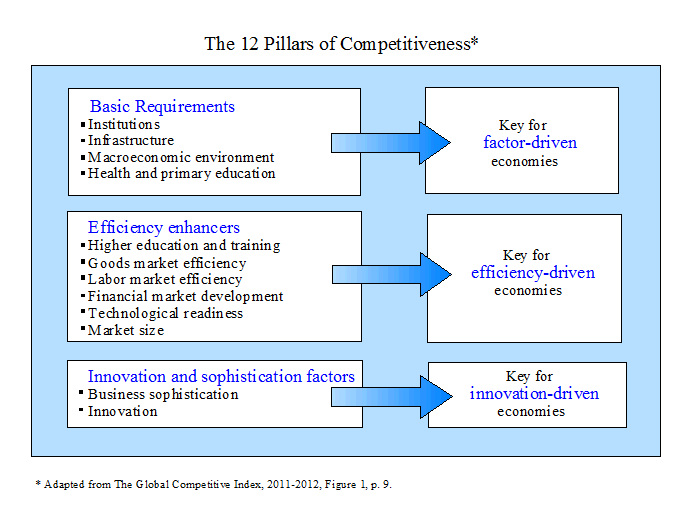
A different set of pillars are viewed as more important depending on a country's stage of economic develop. Factor driven economies compete on the basis of price for basic products and commodities. The first 4 pillars are referred to as Basic Requirements and are more important at this stage. Countries move into the efficiency-driven stage as their productivity increases and wages rise. Pillars 5-10, referred to as Efficiency Enhancers are more important at the efficiency-driven stage of economic development. Countries move from the efficiency-driven stage to the innovation-driven stage where the last two pillars become more important. These are referred to as Innovation and Sophistication Factors. The graphic below adapted from Figure 1 in the report conveys the idea. Table 1 on page 10 of the 2011 report shows how the pillars are weighted for countries at different stages of development.
Summary from Country/Economic Profiles - United States (Global Competitiveness Reports 2011-2012, p. 362, 2012-2013 p. 360)
| GCI and Pillars of Competitiveness | 2011 | 2012 | ||
| Value | Rank | Value | Rank | |
| Global Competitiveness Index | 5.4 | 5 | 5.5 | 7 |
| Basic requirements | 5.2 | 36 | 5.1 | 33 |
| Institutions | 4.6 | 39 | 4.6 | 41 |
| Infrastructure | 5.7 | 16 | 5.8 | 14 |
| Macroeconomic environment | 4.5 | 90 | 4.0 | 111 |
| Health and primary education | 6.1 | 42 | 6.1 | 34 |
| Efficiency enhancers | 5.5 | 3 | 5.6 | 2 |
| Higher education and training | 5.6 | 13 | 5.7 | 8 |
| Goods market efficiency | 4.8 | 24 | 4.9 | 23 |
| Labor market efficiency | 5.6 | 4 | 5.4 | 6 |
| Financial market development | 4.9 | 22 | 5.1 | 16 |
| Technological readiness | 5.2 | 20 | 5.8 | 11 |
| Market size | 6.9 | 1 | 6.9 | 1 |
| Innovation and sophistication factors | 5.5 | 6 | 5.4 | 7 |
| Business sophistication | 5.4 | 10 | 5.3 | 10 |
| Innovation | 5.6 | 5 | 5.5 | 6 |
Most Problematic Factors
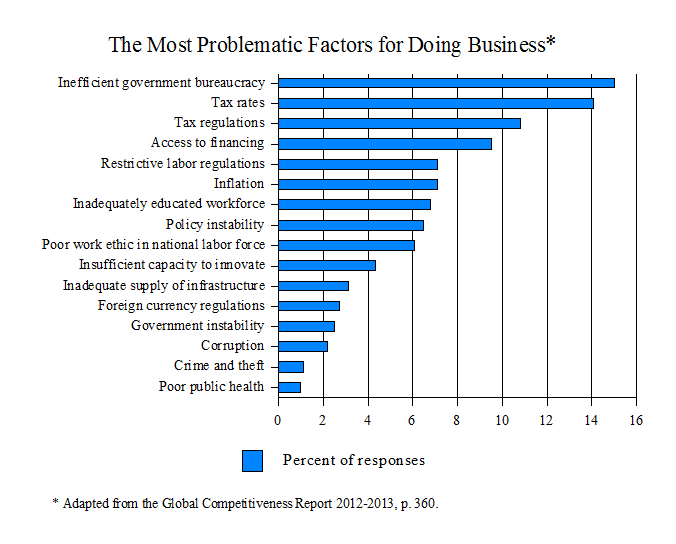
Respondents to the executive survey were given the following list of factors and asked to select the five most problematic for doing business in their country and to rank them between 1 and 5 with 1 being the most problematic. The bars in the original chart show the responses weighted according to their rankings. The chart below is a little different but conveys the main concerns of the U.S. respondents. Inefficient government bureaucracy, tax rates and tax regulations top the list of problems.
The Overall Rankings
The Global Competitiveness Index is an overall index and is based on the 113 indicators provided above for the U.S. as well as additional variables used to compute the countries' stages of development. The GPI is presented in Table 3 of the report. For example, the U.S. was ranked 5th in terms of overall competitiveness in 2011 and seventh in 2012. (See below). Table 4 provides three sub-indexes for basic requirements, efficiency enhancers, and innovation and sophistication factors. In 2011 the U.S. was ranked 36th in terms of basic requirements, 3rd in terms of efficiency enhancers, and 6th in terms of innovation and sophistication factors. In Tables 5, 6, and 7 countries are ranked in the three separate competitiveness levels, i.e., basic requirements for factor driven economies (Table 5), efficiency enhancers for efficiency-driven economies (Table 6), and innovation and sophistication factors for countries with innovation-driven economies (Table 7).
The 2011 report includes 142 countries. The 2012 report includes 144 countries.
| The Global Competitiveness Index Since 2005 (Order based on 1999) WEF Growth Competitiveness Index Rankings |
|||||||
| Country | 2006 | 2007 | 2008 | 2009 | 2010 | 2011 | 2012 |
| Singapore | 8 | 7 | 5 | 3 | 3 | 2 | 2 |
| U.S. | 1 | 1 | 1 | 2 | 4 | 5 | 7 |
| Hong Kong | 10 | 12 | 11 | 11 | 11 | 11 | 9 |
| Taiwan | 13 | 14 | 17 | 12 | 13 | 13 | 13 |
| Canada | 12 | 13 | 10 | 9 | 10 | 12 | 14 |
| Switzerland | 4 | 2 | 2 | 1 | 1 | 1 | 1 |
| Luxembourg | 25 | 25 | 25 | 21 | 20 | 23 | 22 |
| U.K. | 2 | 9 | 12 | 13 | 12 | 10 | 8 |
| Netherlands | 11 | 10 | 8 | 10 | 8 | 7 | 5 |
| Ireland | 22 | 22 | 22 | 25 | 29 | 29 | 27 |
| Finland | 6 | 6 | 6 | 6 | 7 | 4 | 3 |
| Australia | 16 | 19 | 18 | 15 | 16 | 20 | 20 |
| New Zealand | 21 | 24 | 24 | 20 | 23 | 25 | 23 |
| Japan | 5 | 8 | 9 | 8 | 6 | 9 | 10 |
| Norway | 17 | 16 | 15 | 14 | 16 | 15 | |
| Malaysia | 19 | 21 | 21 | 21 | 25 | ||
| Denmark | 3 | 3 | 3 | 5 | 8 | 12 | |
| Iceland | 20 | 23 | 20 | 30 | 30 | ||
| Sweden | 9 | 4 | 4 | 4 | 2 | 3 | 4 |
| Austria | 18 | 15 | 14 | 19 | 16 | ||
| Chile | 27 | 26 | 28 | 31 | 33 | ||
| Korea, Rep | 23 | 11 | 13 | 24 | 19 | ||
| France | 15 | 18 | 16 | 18 | 21 | ||
| Belgium | 24 | 20 | 19 | 15 | 17 | ||
| Germany | 7 | 5 | 7 | 7 | 5 | 6 | 6 |
| Spain | 29 | 29 | 29 | 36 | 36 | ||
| Portugal | 43 | 38 | 43 | 45 | 49 | ||
| Israel | 14 | 17 | 23 | 22 | 26 | ||
| Mauritius | 55 | 57 | 57 | 54 | 54 | ||
| Thailand | 28 | 28 | 34 | 39 | 38 | ||
| Mexico | 52 | 49 | 60 | 58 | 53 | ||
| Lithuania | 39 | 36 | 44 | 44 | 45 | ||
| China | 35 | 34 | 30 | 26 | 29 | ||
| Philippines | 75 | 67 | 71 | 75 | 65 | ||
| Costa Rica | 68 | 59 | 59 | 61 | 57 | ||
| Italy | 47 | 43 | 49 | 43 | 42 | ||
| Peru | 78 | 80 | 83 | 67 | 61 | ||
| Romania | 73 | 70 | ? | 77 | 78 | ||
| Indonesia | 54 | 51 | 55 | 46 | 50 | ||
| Hungary | 38 | 44 | 62 | 48 | 60 | ||
| Estonia | 26 | 27 | 32 | 33 | 34 | ||
| Slovenia | 40 | 37 | 42 | 57 | 56 | ||
| Czech Republic | 31 | 33 | 33 | 38 | 39 | ||
| Trinidad & Tobago | 76 | 78 | 92 | 81 | 84 | ||
| Jordan | 46 | 46 | 48 | 71 | 64 | ||
| Uruguay | 79 | 71 | 75 | 63 | 74 | ||
| Latvia | 48 | 40 | 54 | 64 | 55 | ||
| Greece | 61 | 61 | 67 | 90 | 96 | ||
| Argentina | 70 | 79 | 88 | 85 | 94 | ||
| Dominican Republic | 93 | 88 | 98 | 110 | 105 | ||
| Poland | 45 | 48 | 53 | 41 | 41 | ||
| Turkey | 58 | 50 | 63 | 59 | 43 | ||
| Slovak Republic | 37 | 39 | 46 | 69 | 71 | ||
| El Salvador | 53 | 63 | 79 | 91 | 101 | ||
| South Africa | 36 | 41 | 45 | 50 | 52 | ||
| Vietnam | 64 | 64 | 70 | 65 | 75 | ||
| Sri Lanka | 81 | 66 | 77 | 52 | 68 | ||
| Egypt | 71 | 73 | 81 | 94 | 107 | ||
| Jamaica | 67 | 74 | 86 | 107 | 97 | ||
| Panama | 60 | 56 | 58 | 49 | 40 | ||
| Venezuela | 85 | 90 | 105 | 124 | 126 | ||
| Brazil | 66 | 68 | 64 | 53 | 48 | ||
| India | 42 | 45 | 50 | 56 | 59 | ||
| Ecuador | 94 | 94 | 104 | 101 | 86 | ||
| Columbia | 63 | 65 | 74 | 68 | 69 | ||
| Guatemala | 91 | 81 | 84 | 84 | 83 | ||
| Bolivia | 100 | 96 | 118 | 103 | 104 | ||
| Bulgaria | 74 | 75 | 76 | 74 | 62 | ||
| Zimbabwe | 112 | 120 | 133 | 132 | 132 | ||
| Ukraine | 69 | 69 | 72 | 82 | 73 | ||
| Honduras | 90 | 77 | 82 | 86 | 90 | ||
| Bangladesh | 92 | 98 | 111 | 108 | 118 | ||
| Paraguay | 108 | 112 | 124 | 122 | 116 | ||
| Nicaragua | 101 | 102 | 120 | 115 | 108 | ||
| Nigeria | 95 | 87 | 94 | 127 | 115 | ||
| Russia | 59 | 55 | 51 | 66 | 67 | ||
| Croatia | 56 | 54 | 61 | 76 | 81 | ||
| Haiti | ? | ? | ? | 141 | 142 | ||
| Morocco | 65 | 60 | 73 | 73 | 70 | ||
| Namibia | 72 | 82 | 80 | 83 | 92 | ||
| Tunisia | 33 | 32 | 36 | 40 | ? | ||
| Botswana | 57 | 72 | 56 | 80 | 79 | ||
| Some of the recently listed countries | |||||||
| Country | 2006 | 2007 | 2008 | 2009 | 2010 | 2011 | 2012 |
| Kuwait | 30 | 30 | 35 | 34 | 37 | ||
| Qatar | 32 | 31 | 26 | 14 | 11 | ||
| UAB | 34 | 35 | 31 | 27 | 24 | ||
| Bahrain | 48 | 40 | 37 | 37 | 35 | ||
| Barbados | 41 | 47 | 47 | 42 | 44 | ||
| Cyprus | 49 | 52 | 40 | 47 | 58 | ||
| Malta | 51 | 53 | 52 | 51 | 47 | ||
| Kazakhstan | 50 | 58 | 66 | 72 | 51 | ||
| Azerbaijan | 62 | 62 | 69 | 55 | 46 | ||
| Brunei Darussalam | - | - | 39 | 28 | 28 | ||
| Puerto Rico | - | - | 41 | 35 | 31 | ||
| Syria | - | - | 78 | 98 | |||
| Oman | - | - | 38 | 32 | 32 | ||
| Macedonia, FYR | - | - | 89 | 79 | 80 | ||
| Georgia | - | - | 90 | 88 | 77 | ||
| Libya | - | - | 91 | ? | 113 | ||
| Kenya | - | - | 93 | 102 | 106 | ||
| Moldova | - | - | 95 | 93 | 87 | ||
| Senegal | - | - | 96 | 111 | 117 | ||
| Armenia | - | - | 97 | 92 | 82 | ||
| Algeria | - | - | 99 | 87 | 110 | ||
| Mongolia | - | - | 100 | 96 | 93 | ||
| Pakistan | - | - | 101 | 118 | 124 | ||
| Ghana | - | - | 102 | 109 | 103 | ||
| Suriname | - | - | 103 | 112 | 114 | ||
| Benin | - | - | 106 | 104 | 119 | ||
| Bosnia and Herzegovina | - | - | 107 | 100 | 88 | ||
| Albania | - | - | 108 | 78 | 89 | ||
| Cambodia | - | - | 109 | 97 | 85 | ||
| Cote d'Ivoire | - | - | 110 | 129 | 131 | ||
| Zambia | - | - | 112 | 113 | 102 | ||
| Tanzania | - | - | 113 | 120 | 120 | ||
| Cameroon | - | - | 114 | 116 | 112 | ||
| Guyana | - | - | 115 | 114 | 109 | ||
| Tajikistan | - | - | 116 | 105 | 100 | ||
| Mali | - | - | 117 | 128 | 128 | ||
| Ethiopia | - | - | 121 | 106 | 121 | ||
| Kyrgyz Republic | - | - | 122 | 126 | 127 | ||
| Lesotho | - | - | 123 | 135 | 137 | ||
| Madagascar | - | - | 125 | 130 | 130 | ||
| Nepal | - | - | 126 | 125 | 125 | ||
| Burkina Faso | - | - | 127 | 136 | 133 | ||
| Uganda | - | - | 128 | 121 | 123 | ||
| Timor-Leste | - | - | 129 | 131 | 136 | ||
| Mozambique | - | - | 130 | 133 | 138 | ||
| Mauritania | - | - | 131 | 137 | 134 | ||
| Burundi | - | - | 132 | 140 | 144 | ||
| Swaziland | - | - | - | 134 | 135 | ||
| Chad | - | - | 134 | 142 | 139 | ||
| Yemen | - | - | - | 138 | 140 | ||
| Slerra Leone | - | - | - | - | 143 | ||
| Liberia | - | - | - | - | 111 | ||
___________________________________________________
1 The concept of competitiveness has been a controversial topic for several years. Two organizations publish annual competitiveness reports. The World Economic Forum (WEF) has published The Global Competitiveness Report since 1979. The International Institute For Management Development (IMD), has published a similar report referred to as The World Competitiveness Yearbook since 1989. The Global Competitiveness Report was originally published jointly by the WEF and the IMD, but according to a note in the Economist3 differences over how to define and measure competitiveness (originally titled the competitiveness index) caused these organizations to split and produce separate reports. The World Economic Forum has defined competitiveness as "the ability of a country to achieve sustained high rates of growth in gross domestic product (GDP) per capita". On the other hand, the IMD defines competitiveness as "the ability of a country to create added value and thus increase national wealth by managing assets and processes, attractiveness and aggressiveness, globality and proximity, and by integrating these relationships into an economic and social model." Other differences include which factors to include in the competitiveness index and how to weight these factors.
2 Although the report does not compare countries on the basis of each indicator, it is possible to build tables like the one below based on the data in Part 2. I developed the following table for the strength of auditing and reporting standards indicator from pillar 1.
| Strength of Auditing and Reporting Standards 2011 |
|
| Country | Rank |
| South Africa | 1 |
| Sweden | 2 |
| Singapore | 3 |
| Canada | 4 |
| New Zealand | 5 |
| Babrain | 6 |
| Finland | 7 |
| Qatar | 8 |
| Norway | 9 |
| Malta | 10 |
| Israel | 11 |
| Hong Kong SAR | 12 |
| Australia | 13 |
| Barbados | 14 |
| United Kingdom | 15 |
| Netherlands | 16 |
| Puerto Rico | 17 |
| Belgium | 18 |
| Luxembourg | 19 |
| Denmark | 20 |
| Austria | 21 |
| Saudi Arabia | 22 |
| France | 23 |
| Switzerland | 24 |
| Malaysia | 25 |
| Chile | 26 |
| Estonia | 27 |
| Namibia | 28 |
| Oman | 29 |
| Taiwan, China | 30 |
| Mauritius | 31 |
| Cyprus | 32 |
| Hungary | 33 |
| Zimbabwe | 34 |
| Japan | 35 |
| Germany | 36 |
| Jamaica | 37 |
| United Arab Emirates | 38 |
| otswana | 39 |
| United States | 40 |
| Poland | 41 |
| Jordan | 42 |
| Swaziland | 43 |
| Sri Lanka | 44 |
| Peru | 45 |
| Gambia, The | 46 |
| Lithuania | 47 |
| Czech Republic | 48 |
| Brazil | 49 |
| Panama | 50 |
3 1996.The C-word strikes back. Economist (June 1): 76.