Chapter 1
Management Accounting: Information that Creates Value
Study Guide by James R. Martin, Ph.D., CMA
Professor Emeritus, University of South Florida
ABKY Main Page |
Martin's Textbook Main Page
1. Introduction
This chapter introduces the concept of management accounting. Atkinson, Banker, Kaplan and Young (AKBY) begin with a discussion of the differences between financial accounting and management accounting and the two main audiences for accounting information, i.e., external users and internal users. They discuss various types of internal users including employees and the different levels of management. They also discuss the functions of management accounting, the origins of management accounting control, and the behavioral implications of accounting information. This chapter also includes a section related to ethics and systems to encourage ethical behavior.
2. Broad View of the Accounting Discipline1
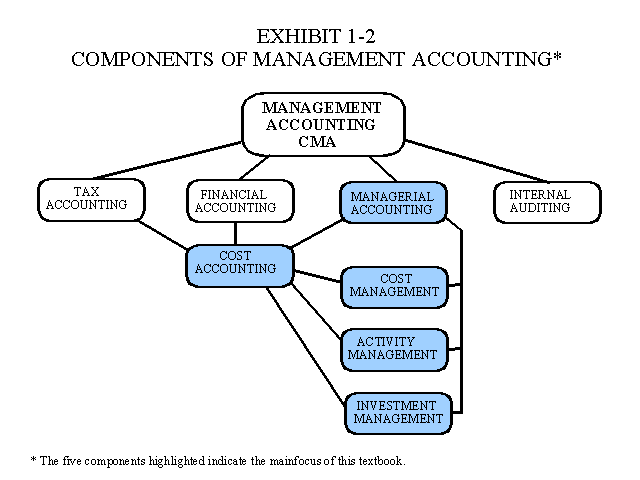
3. Where Managerial Accounting Fits in 2
4. Differences Between Financial and Managerial Accounting adapted from Exhibit 1-1 3
| Characteristic or Requirement | Financial Accounting 4 | Managerial Accounting |
| 1. Audience | External users including stockholders, creditors and SEC | Internal users including workers, managers and executives. |
| 2. Purpose | Report on past performance to external users, contracts with owners and lenders. | Provide information for internal decisions, feedback and control of operating performance. |
| 3. Timeliness | Delayed or historical. | Current and future oriented. |
| 4. Restrictions | GAAP - FASB and SEC. | GAAP does not apply, but information should be restricted to strategic and operational needs. |
| 5. Type of information | Financial measurements mainly included in GAAP general purpose financial statements, i.e., income statement, cash flow statement and balance sheet. | Financial measurements for internal financial statements, plus operational and physical measurements related to processes, technologies, suppliers, customers and competitors. |
| 6. Nature of information | Objective, auditable, reliable, consistent and precise. | More subjective and judgmental, valid, relevant and accurate. |
| 7. Scope | Highly aggregated information about the overall organization. | Disaggregated information to support local decisions. |
Comparing this table with the two exhibits above might be a little confusing since financial statements are used internally as well as by stockholders and others outside the company. Financial accounting is part of management accounting as indicated by the first exhibit above. One way to clear up the confusion is to use the term Generally Accepted Accounting Principles (GAAP) in place of the term financial accounting. So what we mean when we say financial accounting is for external users and management accounting is for internal users is that general purpose financial statements based on GAAP are for the external audiences and financial statements used internally do not have to conform to the GAAP rules. The National Association of Accountants (now the Institute of Management Accountants) defines management accounting very broadly. As Keller said in 1976, "All accounting is management accounting". See MAAW's Textbook Chapter 1 footnote 6 for the source of these viewpoints.
5. Characteristics and Requirements Related to the Four Functions of Information or Cost Accounting Systems 5|
Characteristics and Requirements Related to the Four Functions of Information or Cost Accounting Systems | ||||
| Characteristic or Requirement | External Financial Statements |
Planning & Controlling Activities or processes |
Short Term Strategic Decisions |
Long Term Strategic Decisions |
| Audience | 1. Outside investors, creditors, IRS and SEC. | 2. Plant, production and operating managers, and workers. | 3. Marketing, product, business and senior managers. | 4. Marketing, product, business and senior managers |
| Type of information required | Aggregated quantitative overall financial results. | Disaggregated quantitative and qualitative non-financial information on specific activities and processes. | Disaggregated quantitative and qualitative financial and non-financial information on specific products, services, customers and suppliers. | Disaggregated quantitative and qualitative financial and non-financial information on specific aspects of the company's competitive strategy. |
| Reporting interval required | Quarterly. | Real time, hourly or daily. | Annual or life cycle unless product design or process changes. | Special studies performed periodically. |
| Decision Examples | Should an investor purchase, or dispose of the stock or bonds of this company? | What resources are needed for the period? Are specific processes in control? | Should the company continue producing current products and services? What prices should be charged for products and services? | Should the company replace a machine, build a new plant, reengineer a product or process, convert to a JIT system? |
6. Functions of Management Accounting Information Adapted and Revised from ABKY Exhibit 1-2 6
|
Function |
Purpose |
Audience |
| Operational Control | Provide feedback about efficiency and quality of tasks performed. | Workers and operating managers. |
| Product and Customer Costing | Measure the cost of resources used to produce products and services and to deliver these to customers. | Marketing, product, business and senior managers who need to make strategic decisions related to product introduction and product discontinuance, pricing products and services, and whether to make or outsource components and services. |
| Management Control | Provide information about the performance of managers and operating units. | Marketing, product, business and senior managers who need to monitor the performance of various segments of the organization. |
| Strategic Control | Provide information related to whether the organization's is achieving its strategic objectives, e.g., financial, technological innovations, market share and customer satisfaction. This is the balanced scorecard concept discussed later. | Marketing, product, business and senior managers who need to develop monitor the organization's overall strategic performance. |
7. Management Control Using Return on Investment
| Measurement | How Calculated | Purpose |
| Profit margin or return on sales ratio (ROS) | Operating income ÷ Sales | Measures the spread between price and cost. |
| Asset or capital utilization or capital turnover ratio | Sales ÷ Investment | Measures how much revenue is generated with a given investment. |
| Return on Investment (ROI) | Operating income ÷ Investment or (Margin)(Turnover) | Combines the two main ways to make money into one overall profitability measurement. |
The ROI was developed by DuPont and used as a capital rationing device, i.e., to indicate where to place additional investments. (See Dupont's ROI calculation). Dupont's calculation shows the decomposition of ROI into the margin or return on sales ratio (ROS) and capital turnover ratio. This emphasizes the two main ways to make money. High margin or high turnover or some combination of the two measurements. The ROI measurement is discussed in more depth in ABKY Chapter 12. For more on ROI see MAAW's ROI topic.
8. Control Systems for Ethical Standards
| Type of System | Type of Information Stated | Purpose |
| Beliefs Systems | General, but explicit statements about basic values of the organization such as mission statements, vision statements. | Inspire and promote commitment to the organization's core values |
| Boundary Systems | More specific statements related to codes of conduct stated in negative terms. | Identify forbidden actions. |
The control systems in this table are discussed in Simons, R. 1995. Control in an age of empowerment. Harvard Business Review (March-April): 80-88. (Summary). Simons discusses diagnostic control systems and interactive control systems as well as belief systems and boundary systems.
_______________________________________________
0. What is the difference between Financial accounting and Management accounting? (See the broad view of accounting above and item 4).
1. Why do operators/workers, middle managers, and senior executives have different information needs? (See items 5 and 6 above).
2. Why do a company's operators/workers, managers, and executives have different information needs than shareholders and external suppliers of capital? (See items 4 and 5 above).
3. Why may financial information alone be insufficient for the ongoing information needs of operators/workers, managers, and executives? (See items 5 and 6 above).
4. Why might senior executives need measures besides financial ones to assess how well their business performed in the most recent period? (See item 5 above).
5. What forces have caused management accounting systems designed decades ago to become less relevant and less valuable for organizational employees in today's globally competitive environment? (See Relevance Loss question 109 and the CAM-I Chapter 2 summary to supplement the ABKY discussion).
6. How does the role of management accounting systems change as the environment becomes more competitive? (See the CAM-I Chapter 2 summary to supplement the ABKY discussion).
7. What is the impact of shifting the role of management accounting information from controlling workers and operators to informing the continuous improvement activities of these workers and operators? (See item 6 above and the summary of McGregor's theory for some ideas. Blake & Moulton's Managerial Grid and the Cooper summary are also relevant to this question).
8. What, if any, are the differences between the management accounting information needed in manufacturing organizations and that needed in service organizations? (For a quick idea see a manufacturer's income statement in MAAW's Chapter 2). (For a long answer read MAAW's Textbook Chapter 2).
9. Why is management accounting information important in government and nonprofit organizations?
10. What information do employees need about activities performed in the organization? (Items 5 and 6 above are relevant to this question).
11. How can managers use information on the cost of activities and business processes? (See audiences 2 and 3 in item 5).
12. What information might management accounting systems provide to managers and employees for each of the following strategies: operational excellence, product leadership, customer service? (Items 5 and 6 above are relevant to this question).
13. How can management accounting information produce behavioral and organizational reactions? Related questions: Should accounting measurements be neutral? Could accounting measurements be neutral?
14. How can beliefs systems and boundary systems foster high ethical standards among employees? (See item 8 above).
Extra Question
15. Dupont decomposed ROI into two parts. What are the two parts and what is the significance of this decomposition? (See item 7 above).
1
MAAW's Textbook Chapter 1, Exhibit 1-1
2
MAAW's
Textbook Chapter 1, Exhibit 1-2
3
Based on Atkinson, A. A., R. D. Banker, R. S. Kaplan and S. M. Young. 2001. Management
Accounting 3rd edition. Exhibit 1-1. Upper Saddle River: NJ: Prentice Hall.
4
Note that both internal and external audiences use financial accounting
statements. When Atkinson, Banker, Kaplan and Young refer to financial accounting in their Exhibit 1-1 they
mean external financial statements prepared in accordance with generally
accepted accounting principles (GAAP) as defined by the financial accounting
standards board and the SEC.
6 Based on Atkinson, A. A., R. D. Banker, R. S. Kaplan and S. M. Young. 2001. Management Accounting 3rd edition. Exhibit 1-2. Upper Saddle River, NJ: Prentice Hall.