Summary by Justin Gerber
Master of Accountancy Program
University of South Florida, Summer 2003
Chapter 4 Section on Spoilage |
Environmental Cost Main Page
The purpose of this article is to scrutinize various types of manufacturing waste and present a comprehensive cost system for recognizing and reporting waste costs (based on the automobile industry).
Need for new cost analysis and control
Management accounting has been sluggish in responding to waste problems, which has caused the need for new cost analysis and control techniques. The sluggishness of management accounting is attributed to three factors. First, waste costs are often considered immaterial by accountants and managers. The problem is blamed on traditional accounting systems that record and classify waste costs improperly. Second, waste and waste cleanup costs add no value to the product, so they are often not included. The third factor, is short-term focus of managers and accountants, however, problems of waste often show up in the long-term, such as environmental effects.
Components of manufacturing residuals
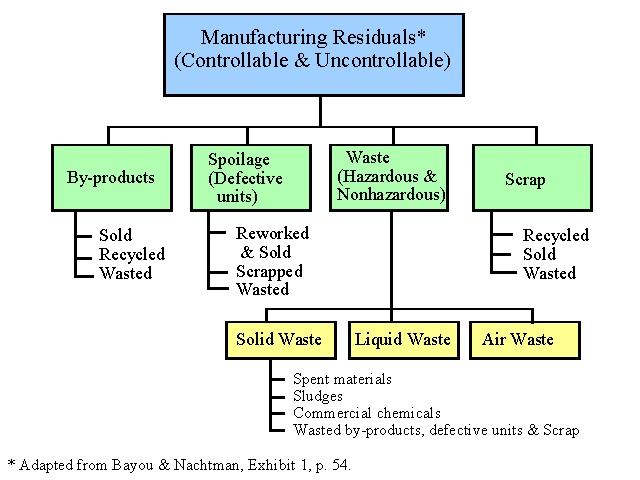
Manufacturing residuals are released during the manufacturing operations and include: by products; spoiled goods; scrap; and waste emissions (See the exhibit below). Many of these residuals can end up as waste for a couple reasons. First, the manager may believe that the costs and revenues of the residuals to be too small to recycle or rework. Second, managers may hide residuals from top management by treating them as waste. Managers tend to hide the residuals from top management because waste is seen as signs of inefficiency and poor performance.
Cost analysis of manufacturing wastes
To develop a control system for waste, costs of residuals must be identified and measured. The authors start with the total manufacturing residuals and proceed toward specific waste costs. The costs are broken up into four categories:
1. Waste minimization costs
2. Waste production costs
3.Waste disposition costs
4. Waste externality costs
The first two categories occur inside the plant, therefore they are grouped together as internal waste costs. The second two categories occur outside the plant, so they are classified as external waste costs.
Waste minimization costs
Minimization costs include maintenance and depreciation costs of pollution-reduction equipment, cost of seminars, and training employees on waste controls, and consulting fees paid for waste reduction systems.
Waste production (generation) costs
Production causes internal waste costs that cannot be prevented. Lost resources , including direct labor and materials, are internal waste costs. Managers are often held responsible for so-called controllable waste production. Uncontrollable waste, however, is not the manager’s responsibility, but it still causes the company a loss of resources. Cost accounting systems that use ideal cost standards would tend to minimize uncontrollable waste (See Note on terminology).Under current loose standards, managers are less responsible for waste. Ideal cost standards better fit with the idea of waste minimization.
Another waste that is generated internally is factory environmental costs. Because waste often disrupts operations and can affect the health of workers, costs include delays, idle time and overtime that are the result of contamination of the factory. The costs of health insurance, hospitalization, and disability compensation are also included in these internal costs.
Waste preparation-for-disposition costs is the third internal production cost. Costs spent to collect, load in drums, pack, store, and prepare waste for disposition are included in this category. The authors believe that waste production costs should be adjusted by the net costs and revenues from the on-site recycling system explained later.
Waste disposition costs
Waste disposition costs include:
Hauling waste to waste sites
Depreciation of waste sites
Monitoringv waste sites
Any other law or company policy required activities for disposition.
Waste externality costs
Externality costs include all other waste costs incurred outside the plant. The categories do have interdependencies. For instance, an increase in spending on waste minimization should lead to a decrease in the other three categories. Less spending on internal waste management will lead to an increase in the spending on external categories.
Automobile industry example
The authors developed a cost analysis of waste over a three-year period, with the third year divided into quarters (See Exhibit below). The analysis should help management identify trends and relationships between the categories of waste costs.
| Abbreviated Version of Exhibit 4 Plant Z Costs of Solid Waste | |||||||
| Cost Category | 1988 | 1989 | 1990 | 1990 Quarters | |||
| Internal Waste Costs:
1) Waste minimization costs Depreciation of waste equipment Maintenance of waste systems Employee training Consulting fees, etc. 2) Waste Production costs Losses of Resources Factory Environmental costs Preparation for disposal costs |
|||||||
| External Waste Costs: 3) Waste disposition cost net of off-site recycling Transportation Waste site depreciation City and state charges Payments to off-site recyclers Less scrap reclaimed 4) Waste Externality costs Involuntary costs: Superfund charges Lawyers and court fees Voluntary expenditures |
|||||||
| Total Waste Costs | |||||||
Exhibit 6 shows the disposal cost of solid waste net of the recycling cost. Costs spent on-site and off-site are classified as overhead. These costs are not allocated to various waste components. These costs are treated as common costs. The negative amounts shown for wood and cardboard mean that they contribute toward reducing common overhead costs.
|
Abbreviated Version of Exhibit 6 Plant Z Disposal Costs of Solid Waste Net of Recycling for 1990 |
||||||||
| Overhead | Wood | Cardboard | Cement | Plastic | Ash | Paint Sludge | Total Expenses | |
| Quantity produced Tons recycled Quantity after recycling Landfill charge per ton Total land fill charge |
||||||||
| On-site costs Off-site costs |
||||||||
| Revenue from
recycling Reusable scrap from recycling |
||||||||
| Net disposal costs | ||||||||
Conclusion
In conclusion, the authors believe that the control of waste is connected to important managerial and accounting issues like:
Measurements of performance inefficiencies
Poor product quality controls (resulting in spoilage)
Excessive scrap
Unsolicited by-products
Managers’ dysfunctional behavior (hiding problems from superiors).
Dealing with these issues, demands a clear understanding of waste costing and reporting for wastes. A costing system that accurately and clearly identifies and reports waste costs is needed for management decision-making.
___________________________________________
Note: The terms controllable and uncontrollable are based on statistical process control concepts, i.e., controllable residuals are abnormal to the system and involve assignable causes, while uncontrollable residuals are normal to the system and represent common cause variation. (See MAAW's Chapter 4 illustration for more on this point).
Related summaries:
Boer, G., M. Curtin and L. Hoyt. 1998. Environmental cost management. Management Accounting (September): 28-30, 32, 34, 36 and 38. (Summary).
Epstein, M. J. and S. D. Young. 1999. Greening with EVA. Management Accounting (January): 45-49. (Summary).
Hammer, B. and C. H. Stinson. 1995. Managerial accounting and environmental compliance costs. Journal of Cost Management (Summer): 4-10. (Summary).
Hughes, S. B. and D. M. Willis. 1995. How quality control concepts can reduce environmental expenditures. Journal of Cost Management (Summer): 15-19. (Summary).
Ignatius, A. 2021. "It will need to be the most amazing thing humankind has ever done": A conversation with Microsoft cofounder and philanthropist Bill Gates. Harvard Business Review (March/April): 124-129. (Discussion about Gates book, How to Avoid a Climate Disaster). (Summary).
Johnson, H. T. 2006. Sustainability and "Lean Operations". Cost Management (March/April): 40-45. (Summary).
Kaplan, R. S. and K. Ramanna. 2021. Accounting for climate change: The first rigorous approach to ESG reporting. Harvard Business Review (November/December): 120-131. (Summary).
Kite, D. 1995. Capital budgeting: Integrating environmental impact. Journal of Cost Management (Summer): 11-14. (Summary).
Lanen, W. N. 1999. Waste minimization at 3M Company: A field study of nonfinancial performance measurement. Journal of Management Accounting Research (11): 29-43. (Summary).
McKeon, A. and G. Ranney. 2013. Ongoing Discussion "Thought Piece". Thinking about management from a climate change perspective. Presentation at Aerojet Rocketdyne's InThinking Network. (September): 1-29. (Note).
Lawrence, J. E. and D. Cerf. 1995. Management and reporting of environmental liabilities. Management Accounting (August): 48-54. (Summary).
Reinhardt, F. L. 1999. Bringing the environment down to earth. Harvard Business Review (July-August): 149-157. (Summary).