Summary by Rosalyn Mansour
Ph.D. Program in Accounting
University of South Florida, Spring 2004
Accounting Theory Main Page | Financial
Reporting Main Page | Theories Main Page
Accounting is about relevant classification (assets, liabilities, revenue, etc…) that draws a picture of the business reality of an organization at a certain point in time. Intangibles don’t fall within accounting’s existing paradigm of classification and because of their prevalence, accounting needs to change its paradigm to incorporate the increasingly intangible business realities. Intangible related concepts that are not incorporated in the current accounting paradigm include immaterial assets as well as “hybrid and intellectual capital, allied concepts, virtual organizations, relation marketing, value stars, human resource costing and accounting, enablers and performance drivers (p. 695).” Part of the problem may be that intangibles, themselves, do not have a good classification. According to Grojer, the purpose of this article is “to formulate a strategy for classification of intangibles” by “mapping of properties of good classification” so that those properties they have in common can be “confronted”. The article is strong on philosophical concepts and it appears that the orientation is from an international or Swedish accounting standards viewpoint. I thought the article was difficult to understand; therefore, below is a summary of the key points as I see it, using the author’s headings and subheadings.
1. Why classify?
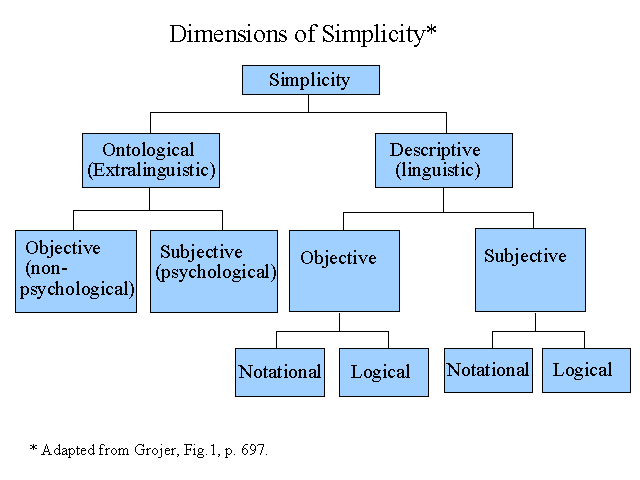
Classification is used because it brings order to disarray and works as a heuristics device so that the object of classification becomes easier to understand. It also allows us to focus our attention on what matters. The author says Rudner (1996) mentions six types of “simplicity” for primitive terms: ontological, descriptive, objective-notational, objective-logical, subjective-notational, and subjective-logical. Figure 1 shows their relationship to simplicity and each other.
The author limits his discussion to the descriptive side of the above diagram. These terms are summarized below.
Objective-Notational Logical Simplicity – has to do with letters and numbers classification, such as the chart of accounts.
Objective-Logical Simplicity – refers to the “logical structure of the predicates.”The author states, “full formalization about intangibles is unworkable, the question is whether partial formalization is enough to test this dimension of simplicity (p. 697).”
Subjective – Logical Simplicity – is explained as “how the total structure, i.e. the total classification, is perceived (p. 697).”
2. The nature of Classification
When something is described, it is attributed to a class and it is defined. Language is bound to culture; therefore, part of the classification problem is that different cultures attach different meanings to the word intangibles. The author gives an example of three views of knowledge: (1) that knowledge is separable from a person, (2) that knowledge is not separable from a person, and (3) that knowledge can be embedded in inanimate objects. As ideas, culture, and technology changes, language changes and as a consequence classification needs to change also. As a result, there are multiple definitions for intangibles. The author summarizes this section by saying “to classify/divide something means to describe, which implies to explain the nature or essential qualities of something. To classify or divide we need to construct properties/attributes that describe an object, event or state (p. 699).”
In search of a classification schemata or typology
A classification schema merely classifies things whereas a typology goes a step further and shows how similarly classified things are related to one another. The balance sheet is a typological schema. The balance sheet has classification, such as assets, but in addition shows relationships between assets, such as their liquidity, and these relationships allow us to order the assets according to these relationships (cash is more liquid than inventory). Also, there are polar opposites, such as how cash would relate to a building in regard to liquidity. In other words, a classification schema might go as far as classifying things as assets and liabilities, but the typology enables a deeper meaning of classification by incorporating relationships. Likewise, intangibles should not only be classified as to whether they are intellectual capital, R&D, or patents, but also need to be classified according to their relationships to one another.
4. Is there a universe of discourse (of intangibles) to classify?
The answer is yes, there is. Although only four, out of 21 countries surveyed, have a definition of intangibles, all but one have a list of intangibles (Stolowy & Jeny, 1999). Therefore, since there is a discourse, the next step is to attempt to divide and simplify it by “selecting attributes that help us to differentiate the objects, states, or events in our universe of discourse (p. 701).”
5. Different approaches to attribute identification
The author discusses Roberts (1995) five approaches to choice of attributes used to discriminate between classified objects. They follow:
(1) The essentialist approach – seeks to identify the essence of the object. Classifications based on this approach can be natural or artificial. The focus is on the function of the object.
(2) Overall similarity approach – uses all of the objects to try to identify similarities. The problem is that you don’t know what you’re looking for so there could be infinite similarities, which contradicts with what classifications are supposed to do – simplify things.
(3) Diachronic approach – emphasizes time relationships as attributes so that instead of focusing on what something is, it stresses how something came to be.
(4) Set Theory Approach – doesn’t choose an attribute of the object for purposes of classification, but uses some other criteria such as accounting uses “consistency, exhaustibility, mutual exclusivity, and hierarchical integrity (p. 702)”.
(5) Archetypal approach – Classifies objects according to the similarities of their relationships (transformation processes) rather than similarities of their attributes. The balanced scorecard is given as an example where performance drivers (typically intangibles) are linked to outcomes ending in a financial outcome.
6. How to test/validate classification schemata
A classification schema is not theoretical so it cannot be empirically tested. For example, you can test whether R&D should be a specific class of something. Therefore, the whole schemata and its logical practices have to be tested as well as investigation of whether it has been used. Rudner (1966) says a good classification is one where the classification scheme can be used to classify an exhaustive amount of objects as well as there is exclusivity in that objects cannot belong to more than one class. Additional qualities of good classification schemata are its consistency of an attribute across all objects within the same classification. Furthermore, hierarchical integrity is desired. Lazerfeld and Barton’s suggested criteria of: “(1) articulation, from the general to the specific, (2) logical correctness, exhaustive and mutually exclusive, (3) adaptation to situations, and (4) adaptation to the respondent’s frame of relevance was also mentioned as well as information economics.
7. Classification theory concepts meet accounting
In an accounting context, the requirements of simplicity and usefulness assume that one look for utility (potential of being used) instead of purpose. The authors believe that a new background, which doesn’t necessarily have to be relevant, should be developed for accounting. We know the existing background as the financial statements. The background gives a frame of reference from which investors can interpret and understand an event (See Fig. 2 below). A new background could include new accounting concepts or a reclassification of existing concepts.
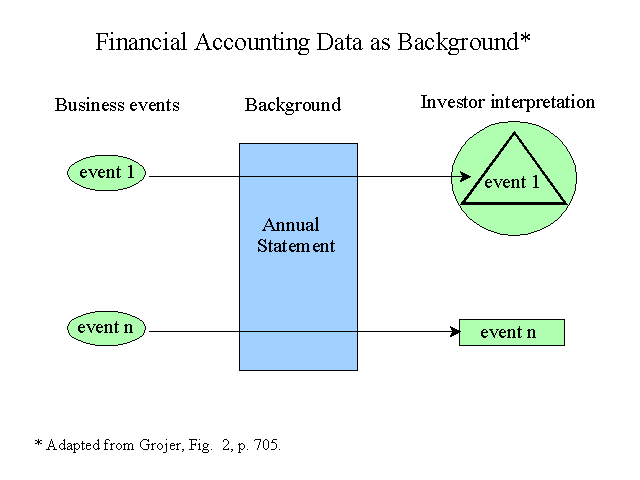
Much of accounting theory is based on the assumptions of concepts like comparability, going concern, and consistency. Uniformity across periods is another attribute of the current accounting classification system and it is often believed that uniformity will cause representational faithfulness. However, the author points out that if something relevant is left out because it lacks uniformity, then there can be no representational faithfulness. The author also states that accounting is based on an idea of separation, such as seen in the chart of accounts; therefore, to report intangibles, separation of the intangibles is necessary under the current system.
Separation leads to a residual, such as goodwill. Goodwill is basically just a way to get the numbers to add up, but makes no actual sense. Residual classes like goodwill are not good because their relation to other classes is cloudy.
8. IAS 38, BSC and IC from a classification viewpoint
The author discusses IAS 38 as it relates to the universe of discourse and the balanced scorecard (BSC) model and basically surmise, “The intellectual capital universe can be justified in the name of rhetoric (p. 708).” The BSC is a strategy to formulation of strategies and key ratios that can be linked to a cause-effect chain. Intellectual capital (IC) is basically the residuals between market and book value and is made up of either human or structure capital. The concepts in this section are summarized in an adaptation of Grojer's Table 1 below.
| Classification Concepts | Sub-concepts | IAS 38 | Balanced Scorecard | Intellectual Capital |
| General concepts |
Universe of discourse | As between two universes. | A set of four universes - i.e., four perspectives. | As a difference between two values- market vs. book value. |
| Attribute | Essential plus by listing. | Archetypal plus diachronic. | Overall similarity. | |
| Type of classification | Classification schema - no relations except sub-classes | Typology - assumes time relation between classes | Classification schema | |
| Good classification | Exhaustive | No (Yes) | No | No |
| Exclusive | No (Yes) | No | No | |
| Simplicity | Objective-notational | Unclear | No | Yes |
| Subjective-notational | Unclear | Yes | No | |
| Objective-logical | No | No | No | |
| Subjective-logical | No | Yes (No) | Yes (No) |
9. Conclusions: Towards a classification of intangibles
The value of classification is as an aid in the interpretation of phenomena. Classification of intangibles can begin with and empirical approach (e.g., the balanced scorecard), or a theoretical approach (e.g., equity theories). Confusion related to intangibles is caused by the use of different equity theories in describing and interpreting intangibles (e.g., entity theory, value co-production theory & enterprise theory), the transformation of intangibles into other forms (e.g., drivers linked to outcomes in the BSC), and the assumption that it is possible to separate the universe into tangibles and intangibles. A good classification scheme is difficult (perhaps impossible to attain in practice) because it has to meet requirements related to being exhaustive and exclusive. However, classification relates to "how we order the world, and accounting is expected to do the job."
There is an appendix that has some key information about IAS 38, the BSC, and intellectual capital.
_________________________________________
Roberts, A. 1995. The very idea of classification in international accounting. Accounting, Organizations and Society 20(7-8): 639-664.
Rudner, R. 1966. Philosophy of Social Science. Prentice-Hall.
Stolowy, H. and A. Jeny. 1999. How accounting standards approach and classify intangibles - An international survey. HEC School of Management (unpublished).
Related summaries:
Jeacle, I. 2022. The gendered nature of valuation: Valuing life in the Titanic compensation claims process. Accounting, Organizations and Society (99): 101309. (Summary).
Johanson, U., M. Martensson and M. Skoog. 2001. Mobilizing change through the management control of intangibles. Accounting, Organizations and Society 26(7-8): 715-733. (Note).
Kaplan, R. S. and D. P. Norton. 2004. Measuring the strategic readiness of intangible assets. Harvard Business Review (February): 52-63. (Summary).
Lev, B. 2004. Sharpening the intangibles edge. Harvard Business Review (June): 109-116. (Summary).
Martin, J. R. Not dated. What is a business valuation? Management And Accounting Web. BusinessValuation.htm
Ulrich, D. and N. Smallwood. 2004. Capitalizing on capabilities. Harvard Business Review (June): 119-127. (Summary).