Summary by James R. Martin, Ph.D., CMA
Professor Emeritus, University of South Florida
Change Management Main Page | Performance
Measures Main Page | Theories Main Page
The purpose of this article is to investigate how intangibles are managed and controlled. More specifically, case studies of three Swedish firms are used to address two questions:
1. "How are intangibles recognized, measured, reported, and evaluated?"
2. "How is organizational change mobilized through management control of intangibles?" (p.718).
The authors discuss various definitions or categories of intangibles such as: legal ownership versus non ownership; investments as R&D, software, marketing, and organization; human, market and structure capital; and facts vs. perceptions. Management control concepts mentioned include those developed by Anthony (management control systems vs. management control processes), Flamholtz (measures that control people to take actions, coordinate efforts, and provide information about results), Emmanuel, Otley and Merchant (result, action and personnel controls), Simons (systems to maintain or alter patterns of activity), and Machin (formal and informal controls). The authors view control as recognition, measurement, reporting, evaluation, and mobilizing change.
The three case studies are viewed in terms of evolution theory, theories of action, organizational learning, and structuration theory.
The first case study involved a consulting firm that placed emphasis on a variety of intangibles such as work models, bank of experience, knowledge in new areas, networks of present and old customers, training programs, flexible work force and company image. Using terminology from economic evolutionary theory, these intangibles are referred to as cognitive schemes or search rules that affect the evolutional change process. The idea is that measurements gradually evolve. The authors refer to this company's method as a balance sheet approach.
The second case relates to a telecommunication company that measures market capital, human capital and efficiency. Market capital was measured along several dimensions including image, product and customer, employee meetings with customers, and customer loyalty. Human capital was measured with a questionnaire in nine dimensions: culture and values, competence, motivation, responsibility and initiative, authority, cooperation and processes, organizational efficiency, employee awareness of goals and leadership. Economic efficiency is measured in four dimensions including: profit development, cost efficiency, results after depreciation, and increased revenues from new business.
The control process involved meetings, benchmarking, target setting, assigning ownership, salary bonus, and statistical analyses. These measurements and controls are discussed in terms of evolutionary theory where rules, or routines such recognition and measurement, evaluation, attention directing, motivation, and commitment are used to trigger desired short-term behavior. These systems are also discussed in terms of Giddens' structuration theory that relates to signification structure, legitimation structure, and domination structure.
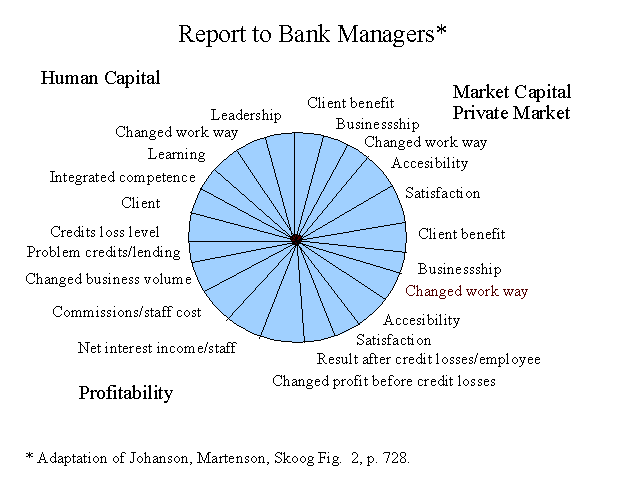
The third case involved a large banking company (made up of 139 local banks) that developed a measurement and reporting system based on human capital, market capital and profitability reported in the form of a wheel (See the graphic below for the general idea). These findings are also discussed in terms of evolutionary theory.
These cases suggest that the attention directing benefit of measurement routines is more important than the objective measurements themselves. In other words, the main benefit derives from explicitly communicating norms and activities to employees, customers, and analysts. Intangibles interact with tangibles and become the enablers or "feedstock of competitive advantage" (p. 730). In addition, these cases raise a question related to whether control systems are implemented, or simply evolve in a long transformation. A transformation seems to have been the case in the three companies studied.
_________________________________________
Related summaries:
Clinton, B. D. and S. Chen. 1998. Do new performance measures measure up? Management Accounting (October): 38, 40-43. (Summary).
Grojer, J. 2001. Intangibles and accounting classifications: In search of a classification strategy. Accounting, Organizations and Society 26(7-8): 695-713. (Summary).
Ittner, C. D. and D. F. Larcker. 1998. Innovations in performance measurement: Trends and research implications. Journal of Management Accounting Research (10): 205-238. (Summary).
Ittner, C. D. and D. F. Larcker. 2003. Coming up short on nonfinancial performance measurement. Harvard Business Review (November): 88-95. (Summary).
Kaplan, R. S. and D. P. Norton. 1992. The balanced scorecard - Measures that drive performance. Harvard Business Review (January/February): 71-79. (Summary).
Kaplan, R. S. and D. P. Norton. 2004. Measuring the strategic readiness of intangible assets. Harvard Business Review (February): 52-63. (Summary).
Kettering, R. C. 2001. Accounting for quality with nonfinancial measures: A simple no-cost program for the small company. Management Accounting Quarterly (Spring): 14-19. (Summary).
Kurtzman, J. 1997. Is your company off course? Now you can find out why. Fortune (February 17): 128-130. (Summary).
Lev, B. 2004. Sharpening the intangibles edge. Harvard Business Review (June): 109-116. (Summary).
Martin, J. R. Not dated. What is a business valuation? Management And Accounting Web. BusinessValuation.htm
Stivers, B. P., T. J. Covin, N. G. Hall and S. W. Smalt. 1998. How nonfinancial performance measures are used. Management Accounting (February): 44, 46-49. (Summary).
Tatikonda, L. U. and R. J. Tatikonda. 1998. We need dynamic performance measures. Management Accounting (September): 49-53. (Summary).
Ulrich, D. and N. Smallwood. 2004. Capitalizing on capabilities. Harvard Business Review (June): 119-127. (Summary).