Summary by Rosalyn Mansour
Ph.D. Program in Accounting
University of South Florida, Spring 2004
History and Development Main Page | Research
Methods Main Page
Purpose: To categorize and summarize management accounting studies thru the lens of the Value-Based Management Accounting Framework. This is a rather lengthy literature review. It is limited to organizational-level research that has used archival or survey research methods. The authors state that no compensation literature is to be discussed (although there is some discussion) nor are there any studies involving behavioral or qualitative research methods.
The Evolution of Managerial Accounting Practices
| Rough Time Estimate |
Focus | Trends in Managerial Accounting |
| Prior to 1950 | Cost determination and financial control. | Budgeting and cost accounting systems. |
| Mid 1960's | Providing information needed for management control. | Anthony's 1965 management control framework separated operational control from strategic planning. |
| 1970's | Planning and control | Contingency theory - choice of accounting and control techniques should depend upon circumstances surrounding the organization (external environment, technology, competitive strategy, mission, industry characteristics, etc. |
| Mid 1980's | Reduction of waste | ABC, strategic cost management etc. |
| Mid 1990's | Creating firm value | Balanced scorecards of leading economic indicators, measures that approximate shareholder return, MAS that address current and future strategic uncertainties. |
General observations on empirical research in managerial accounting
Generally, the authors thought that existing research was practice-oriented and tended to mirror the latest management fads. While it is good for management accounting research to be relevant, by focusing on the current “fad” other earlier topics were not explored deeply enough. Also, there has been a lot of diversity in samples, research methods, and theories used by managers, which makes results less generalizable.
The Value-Based Managerial framework
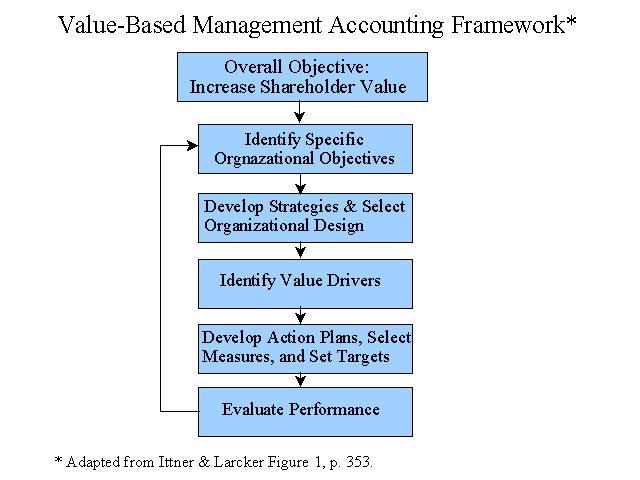
The value-based management accounting framework builds upon prior practices outlined above and its purpose is to create long-term shareholder value. While this framework varies from company to company, there are 6 general steps. The following illustration was adapted from figure 1 (Value-based management accounting framework), page 353.
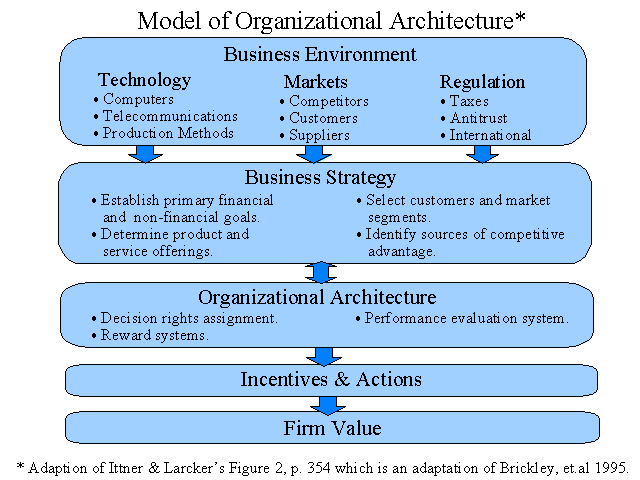
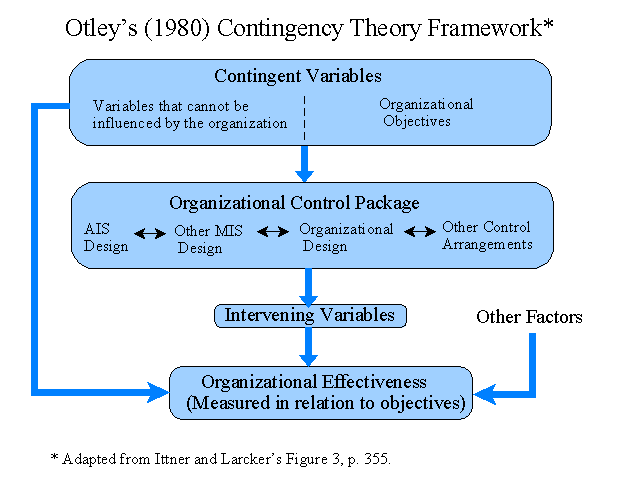
The value-based management accounting framework captures many of the concepts and linkages in contingency theories, principle-agent models and economics-based organizational design frameworks. Some of these concepts are illustrated in the two graphics below developed from Ittner and Larcker's Figures 2 and 3.
Findings
The following sections provide a condensed synopsis of the authors’ findings as well as any limitations or future research opportunities that they identified.
1 - Research related to the choice of objectives in VBM programs - Studies and Main Points
Copeland et al, 1996. Stern et al, 1995. KPMG Consulting, 1999.- To have congruence between organizational goals and shareholder goals, primary objectives must specify measures of economic value such as EVA & Cash Flow ROI. These measures are more closely aligned to changes in shareholder wealth & should replace traditional accounting measures for goal setting purposes.
Anctil, 1996. Rogerson, 1997. Reichelstein, 1997. - Residual income-based measures such as EVA can assure goal congruence between principal and agent.
Milunovich & Tseui, 1996. Lehn & Makhiga, 1997. - Market value was more highly correlated with EVA than ROE, EPS, and other traditional measures.
O'Byrne, 1996 - Best model found to predict market value used EVA after controlling for industry and capital for each firm. In the same paper, the best model for predicting market value using net operating profit after tax found no additional benefit by controlling industry and firm capital.
Chen & Dodd, 1997 - "Although the EVA measures outperform accounting earnings in explaining stock returns, the earnings measures provide significant incremental explanatory power above EVA (p. 359).”
Biddle, 1997 - "Traditional accounting measures generally outperform EVA in explaining stock prices. While EVA measure's capital charges and adjustments for accounting "distortions" have some incremental explanatory power over traditional accounting measures, the contribution was not economically significant (p. 359)."
Gjesdal, 1981. Paul, 1992. - Stock returns are irrelevant objectives.
Zimmerman, 1997 - While corporate EVA may be aligned with stock price, divisional EVA may not be an indicator of value creation.
Garvey and Milbourn, 2000 - "The correlation between performance measures and stock returns is a useful input into the choice of internal objectives (p. 360)."
Wallace, 1997 - Compared to companies who did not adopt residual income-based compensation measure, firms who did adopt these measures "decreased new investments, increase payouts to shareholders though share repurchases, and utilize assets more intensively, leading to significantly greater change in residual income (p. 360). Also, found that stock market participants responded favorable to the adoption of these types of compensation plans, but evidence was actually weak.
Hogan & Lewis, 1999 - Extends (Wallace, 1997) to investigate performance over a 4-year period, instead of 1. After introducing past profitability into their analysis, they conclude that economic value plans offer no benefit above traditional plans.
Limitations and/or Future Research:
1. Studies usually obtain their data from a consulting company who does not adjust
public financial data needed to derive approximate economic profits. As such, the
benefits of EVA may be understated. Also, it's questionable whether conclusions
should be drawn about EVA from companies who have not implemented EVA systems.
2. Research needs to focus on EVA for something besides executive compensation, such as for goal setting or capital budgeting.
3. Studies tend to focus on EVA as an economic value measure, but there are others such as Cash Flow ROI.
These alternative measures should be investigated.
4. Should the maximization of shareholder wealth be the main focus or are other stakeholders more important?
2 - Strategy Development and organizational design choices - Studies and Main Points
Briskly etal, 1995. Milgrom & Roberts, 1995. - Support the idea that step 2 in the VBM model should be to develop a strategy and an organizational design to accomplish strategy.
Miles & Snow, 1978. Porter 1985. - Many studies look at firm strategy as somewhere between being the low cost leader to being the first to market innovator. Additional strategies include differentiation based on quality, customer service, market niche, and customization. Some firms' strategy is merely imitation.
Fisher, 1995 - Environmental uncertainty and competitive strategy are related and there is more uncertainty with an innovative strategy than with a cost leadership position.
Daniel & Reitsperger, 1991; Banker et al. 1993, Young & Selto, 1993. Abernethy & Lillis 1995. Ittner & Larcker, 1995 & 1997. Perera etal 1997. Sim & Killough, 1998. Scott & Tiessen, 1999. - Instead of looking at corporate wide or business unit strategy, some studies looked at operational strategies such as JIT, TQM, and flexible manufacturing systems.
Vancil 1978 - "Diversification strategies are positively associated with the number of functions performed by a profit center and the degree to which profit center managers have control over the assigned costs of centralized operations (p. 364)".
Milgrom & Roberts, 1995. Wruck & Jensen, 1994. - To successfully adopt advanced manufacturing strategies, firms must at the same time change the organization's design and management's processes.
Abernethy & Lillis, 1995. Selto etal, 1995. Scott & Tiessen, 1999. - Results were mixed as to the relation between organizational design and manufacturing strategies.
Brickley etal 1997a. Milgrom & Roberts, 1995. - Objectives, strategies, and organizational designs should be decided simultaneously.
Dent, 1990. Langfield-Smith, 1997. - Accounting systems may cause the strategy rather than the other way around.
Limitations and/or Future Research
1. The authors do a factor analysis on a questionnaire they administered
regarding strategy proxies. As a result, they say that researchers "need to
incorporate constructs that capture multiple strategic dimensions, and to
examine their individual and joint effects on managerial accounting practices and firm performance.
2. Should objectives, strategies, and organizational design be decided simultaneously rather than sequentially as shown in Figure 1?
3. What is the direction of causality among accounting system design, strategy, objectives, and organizational designs?
4. How to organizational objectives affect strategy and organizational design?
5. What other factors affect organizational design?
3 - Identification of value drivers - Studies and Main Points
Foster & Gupta, 1990 - A cross-sectional data analysis does not provide strong evidence that "complexity or efficiency-related variables explain overhead costs (p. 368)."
Banker etal, 1995. Banker & Johnston, 1993. - Complexity variables were strongly associated with overhead.
Anderson, 1995. Platt, 1996. Ittner et al, 1997. Fisher & Ittner, 1999. - Relationship found between overhead and non-volume cost drivers, but incremental value of the measures was small.
Noreen & Soderstron, 1994. Maher & Marais, 1998. - ABC systems that assume costs are strictly linear in proportion to their drivers overstate relevant costs.
MacArthur & Stranahan, 1998 - A hospital's complexity was jointly determined with the level of overhead costs needed to support the complexity.
Data etal, 1993. - Interdependencies among cost drivers are investigated. Supervision, maintenance and scrap costs were simultaneously determined at a plant that was studied.
Ittner etal, 1997 - Manufacturing measures generally corresponded to (Cooper & Kaplan's 1991) cost hierarchy; but activities for these hierarchies are not independent.
Porter, 1985. Riley, 1987. Shank & Govindarajan, 1994. Shields & Young, 1995. - Research that extends ABC to focus on structural drivers of overhead as well as executional drivers.
Kaplan & Norton, 1996. Banker etal, 2000. Behn & Riley, 1999. Larcker, 1998b. Foster & Gupta, 1997. Chenall & Langfield-Smith, 1998. Ittner etal, 2001. - Balanced scorecard research.
Limitations and/or Future Research
1. To what extent, if any, does the linear assumption of ABC and other such costing systems harm decision-making?
2. Research should be undertaken to determine the direct and indirect effects of cost drivers on overhead.
3. What factors moderate the effects of cost drivers on overhead?
4. How and when do structural and executional drivers affect the value chain? How do they interact? What and when are there tradeoffs?
5. Research should study interaction between nonfinancial value drivers.
6. Does understanding cost drivers lead to better decision-making? This has already been studied from the perception of managers so should look at it a different way.
7. Existing studies "examine only one of many potential non-financial value drivers (p. 373)".
8. "Non-financial value driver studies also ignore contingent factors, even though it is likely that issues such as strategy, competitive environment, and customer requirements moderate the relation between these drivers and economic performance, and may explain the mixed results in prior studies (p. 373)."
9. What affect does IT have on the identification & importance of value drivers?
10. How do companies develop business models & how to models vary based upon strategy, firm objectives, and organizational structure?
11. Does performance increase by using balance scorecard and other value driver techniques?
4 - Develop Action Plans, Select Measures, and Set Targets - Studies and Main Points
Klammer, 1973. Haka etal, 1985. - "Found no evidence that more sophisticated capital budgeting techniques improve performance (p. 376)."
Haka, 1987 - "Shareholder returns are higher when discounted cash flow techniques are used in predictable environments and are accompanied by the use of long-term reward systems and decentralized capital budgeting processes. Other factors such as firm strategy and environmental diversity have no significant impact on DCF effectiveness (p. 376)."
Larker, 1981 - "Results suggest that non-financial and external information are important in capital budgeting (p. 376)".
Carr & Tomkins, 1996 - Successful companies focus on competitive issues, value chain considerations, and fundamental cost drivers more than they focus on financial calculations.
Numerous studies - "This set of studies generally supports theories that the choice of performance measures is a function of the organization's competitive environment, strategy, and organizational design, but the performance effects of these choices remains uncertain (p. 379)."
Bushman etal, 1996. Ittner etal, 1997. Ely, 1991.Lambert & Larcker, 1987. Sloan, 1993. Lewellen etal, 1987. Gaver & Gaver, 1993. Bizjak et al, 1993. Clinch, 1991. - Research involving types of performance measures used for compensation.
Busman etal, 1995. Keating, 1997. Ittner & Larcker, 2001. - "Examine organizational level at which performance criteria are measured (p. 380)."
Wallace, 1997. Hogan & Lewis, 1999. Wallace, 1998. - Mixed results on EVA based compensation.
Merchant & Manzoni, 1989. Murphy, 1999. Indejejikian et al, 2000. - Little research done on target setting, except when used as a focus for setting compensation.
Limitations and/or Future Research
1. Some of the authors mentioned above tend to use subjective measures and their studies also lacked statistical testing.
2. Most studies examine only a limited number of uses for performance measures.
3. "the studies do not investigate the consistency in performance measures used for different purposes or the alignment between the measures and the firm's specific value drivers (p. 382)."
4. The studies "overlook the quality of information used for decision-making and control, even though information system characteristics are likely to influence decision-making quality and the incentive effects of control systems (pg. 382)."
5. Possible research questions posed by the authors (p. 384) - Do the same contingency factors influence the performance measures chosen for different purposes? Does consistency in the measures used for various purposes improve performance? Are some performance measure choices more important than others? Are greater measurement gaps associated with lower organizational performance?
6. Other than employee motivation, what reasons are there for implementing performance evaluation and reward systems?
7. Need novel sources of data as most studies use publicly available information and surveys.
8. The authors note good future research topics - "(1) Role & benefits of real option techniques for investment justification as opposed to DCF (2) How performance measures defined in different dimensions should be combined (3) What are the benefits from including EVA measures in compensation plans? (4) research on setting of performance topics (p. 390-392)."
5 & 6 - Evaluate Performance & Reassess Objectives and Plans - Studies and Main Points
Smith, 1993. Myers et al, 1991. Gordon & Smith, 1992. - "The benefits from formal review and reconciliation procedures vary depending on a variety of contextual factors (p. 392)."
Lorange & Murphy, 1984. Goold & Quinn, 1993. Fiegener, 1997. Ittner & Larcker, 1997. - "Strategic control system studies indicate that the advantages of formal processes for determining whether a strategy is being implemented as planned and assessing whether the strategic results are those intended can actually be counter-productive in some environments (p. 393)."
Limitations and/or Future Research
1. In what scenarios are frameworks such as the balanced scorecard process relevant?
2. Are all 6 steps in the VBM framework necessary?
3. What is the role of formal vs. informal controls in implementing and monitoring VBM systems.
4. Is there enough substantive differences between newer techniques such as ABC, balanced scorecard, and EVA or to justify their study or are they merely fads comparable to traditional accounting techniques?
The authors wrap up their review of the literature with suggestions for future research. Suggestions include: (1) motivate studies by theory, not fads, (2) increase rigor, and (3) produce better model specification. Finally, the authors call for greater integration between financial and managerial accounting research.
__________________________________
This paper provides the basis for an interesting controversy related to management accounting research. See Zimmerman (2001) and the articles that follow as indicated below.
Articles related to this issue in the order that they were published:
Ittner, C. D. and D. F. Larcker. 2001. Assessing empirical research in managerial accounting: A value-based management perspective. Journal of Accounting and Economics (32): 349-410.
Zimmerman, J. L. 2001. Conjectures regarding empirical managerial accounting research. Journal of Accounting and Economics (32): 411-427. (Summary).
Hopwood, A. G. 2002. If only there were simple solutions, but there aren't: Some reflections on Zimmerman's critique of empirical management accounting research. The European Accounting Review 11(4): 777-785. (Summary).
Ittner, C. D. and D. F. Larcker. 2002. Empirical managerial accounting research: Are we just describing management consulting practice? The European Accounting Review 11(4): 787-794. (Summary).
Luft, J. and M. D. Shields. 2002. Zimmerman's contentious conjectures: Describing the present and prescribing the future of empirical management accounting research. The European Accounting Review 11(4): 795-803. (Summary).
Lukka, K. and J. Mouritsen. 2002. Homogeneity or heterogeneity of research in management accounting? The European Accounting Review 11(4): 805-811. (Summary).
For a paper analyzing value based management see Ashton, R. H. 2007. Value-creation models for value-based management: Review, analysis, and research directions. Advances in Management Accounting (16): 1-62. (Models of value creation including the balanced scorecard, the Baldrige quality award criteria, the Deming management method, the service-profit chain, and the Skandia intellectual capital model are compared).
Other related summaries:
Foster, G. and S. M. Young. 1997. Frontiers of management accounting research. Journal of Management Accounting Research (9): 63-77. (Summary).
Jonsson, S. 1998. Relate management accounting research to managerial work! Accounting, Organizations and Society 23(4): 411-434. (Summary).
Jonsson, S. and N. B. Macintosh. 1997. CATS, RATS, and EARS: Making the case for ethnographic accounting research. Accounting, Organizations and Society 22(3-4): 367-386. (Summary).
Kasanen, E., K. Lukka and A. Siitonen. 1993. The constructive approach in management accounting. Journal of Management Accounting Research (5): 243-264. (Summary).
Luft, J. and M. D. Shields. 2003. Mapping management accounting: Graphics and guidelines for theory-consistent empirical research. Accounting, Organizations and Society 28(2-3): 169-249. (Summary).
Martin, J. R. Not dated. What is contingency theory? Management And Accounting Web. Contingency Theory
Otley, D. and A. Fakiolas. 2000. Reliance on accounting performance measures: Dead end or new beginning. Accounting, Organizations and Society 25(4-5): 497-510. (Summary).
Shields, M. D. 1997. Research in management accounting by North Americans in the 1990s. Journal of Management Accounting Research (9): 3-61. (Summary).