Summary by Chi Doan
Master of Accountancy Program
University of South Florida, Summer 2003
Japanese Management Main Page |
Target Costing Main Page
Intense competition and pressure from customers to reduce prices has forced many companies to reduce their costs to survive. These companies have found that most costs are committed once production begins, and, therefore, the costs must be reduced earlier in the product life cycle, particularly while the product is in the planning and design stages.
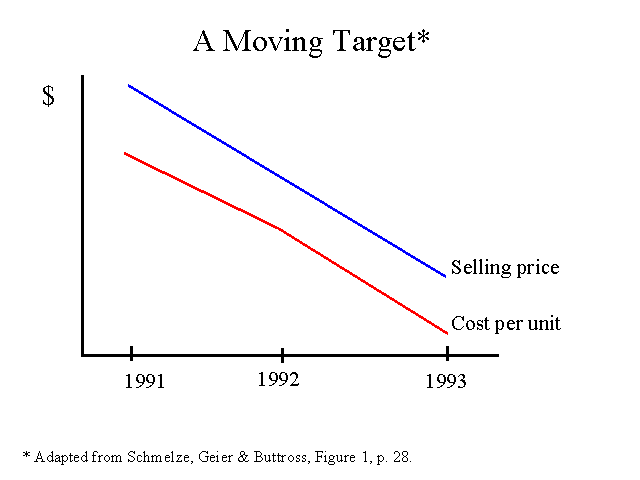
Target costing differs from “cost-plus” costing. Rather than the selling price being a function of estimated costs, the target cost is a function of the selling price and a desired profit. The idea is to specify the price first and then subtract out a desired profit to arrive to a target cost before designing the product. The authors note that ITT cannot use cost-plus pricing because prices are set by the market and continuously driven down as indicated in the graphic illustration below.
To attain target costs, once the target cost is computed, it is assigned to final assembly, subassemblies, and components before design can begin. After the product is designed, estimated costs of production are compared with target costs. If the estimated costs are higher than the target costs, the company sets out to find ways to achieve its target through value engineering.
Value engineering is a team effort from all departments. An improvement in value is where the functionality or quality are held constant while decreasing cost, or where functionality or quality are increased while cost is held constant. Information from a teardown analysis of a competitor’s product can provide ITT with information related to improvements in value and for determining a competitor’s costs.
Once the product reaches production, cost maintenance is practiced. Cost tracking sheets are used in the cost targeting area to keep track of the “targets” and to compare the targets with actual costs.
According to the authors, target costing is a bottom-up, team oriented philosophy that requires senior management support, cross-functional teams, cost targets, competitive analysis, value engineering, partnerships with suppliers and applying pressure on everyone on the value chain to reduce costs.
_____________________________________________
Related summaries:
Berliner, C., and J. A. Brimson, eds. 1988. Cost Management for Today's Advanced Manufacturing: The CAMI Conceptual Design. Harvard Business School Press. (Short Summary or Concepts). (Long Summary).
Cokins, G. 2002. Integrating target costing and ABC. Journal of Cost Management (July/August): 13-22. (Summary).
Cooper, R. and R. Slagmulder. 2003. Interorganizational costing, Part 1. Cost Management (September/October): 14-21. (Summary).
Cooper, R. and R. Slagmulder. 2003. Interorganizational costing, Part 2. Cost Management (November/December): 12-24. (Summary).
Dummer, W., M. Masters and D. Swenson. 2015. Delivering customer value through value analysis. Cost Management (March/April): 17-24. (Summary).
Imai, M. 1986. Kaizen: The Key To Japan's Competitive Success. New York: McGraw-Hill Publishing Company. (Summary).
Martin, J. R., W. K. Schelb, R. C. Snyder, and J. C. Sparling. 1992. Comparing the practices of U.S. and Japanese companies: The implications for management accounting. Journal of Cost Management (Spring): 6-14. (Summary).
Monden, Y. and J. Y. Lee. 1993. How a Japanese auto maker reduces costs. Management Accounting (August): 22-26. (Summary).
Sakurai, M. 1989. Target costing and how to use it. Journal of Cost Management (Summer): 39-50. (Summary).
Sakurai, M. 1995. Past and future of Japanese management accounting. Journal of Cost Management (Fall): 21-30. (Summary).
Spear, S. and H. K. Bowen. 1999. Decoding the DNA of the Toyota production system. Harvard Business Review (September-October): 97-106. (Summary).
Takeuchi, H. 1981. Productivity: Learning from the Japanese. California Management Review (Summer): 5-18. (Summary).
Tanaka, T. 1993. Target costing at Toyota. Journal of Cost Management (Spring): 4-11. (Summary).
Tanaka, T. 1994. Kaizen budgeting: Toyota's cost-control system under TQC. Journal of Cost Management (Fall): 56-62. (Summary).
Wheelwright, S.C. 1981. Japan - Where operations really are strategic. Harvard Business Review (July-August): 67-74. (Summary).