Summary by Melissa Dondero
Master of Accountancy Program
University of South Florida, Summer 2003
ABC Main Page | Target Costing Main Page
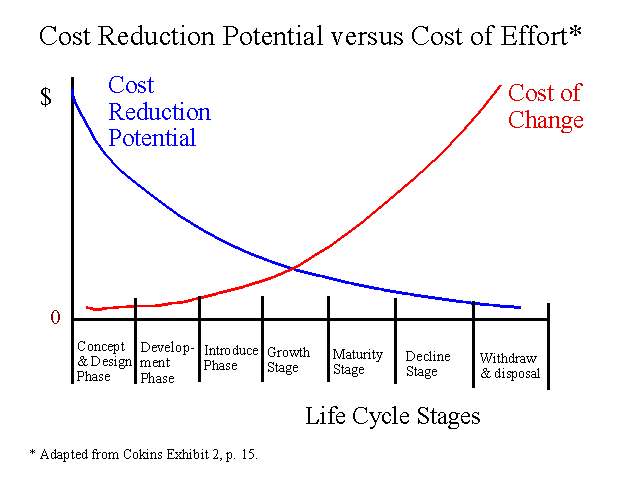
The purpose of this article is to describe target costing and show how ABC data can help suppliers and product designers translate product features into future product costs. Companies need to be equipped with accurate cost modeling techniques in order to manage their costs and assure an acceptable profit margin. As competition increases, new-product innovations must outpace product obsolescence. Most of a product’s costs are determined during the product design stage. Managing the cost of a product already in production can be achieved only by minimizing unfavorable cost variances from the product’s standard cost and by applying process improvements. After a new product is launched, the potential to reduce costs from the product’s perspective rapidly falls as indicated in the graphic illustration below. Costs must be managed early on in a product’s life cycle. Target costing and ABC data can be used to achieve this.
What is Target Costing?
Target costing is a cost modeling technique that determines what price consumers are willing to pay for a product, and then works backwards to determine profit margins and allowable costs. This planned target cost becomes a calculated number that the operating costs cannot exceed once the product design is released. Therefore, target costing is applied at the beginning of a product’s life cycle during the concept and design phase. This technique is in contrast to the traditional cost-plus markup method that is commonly used by manufacturers. It is easier and much less expensive to design costs out of a product rather than figure out how to eliminate them after the product is in production (See the graphic illustration above).
Target Costing Steps
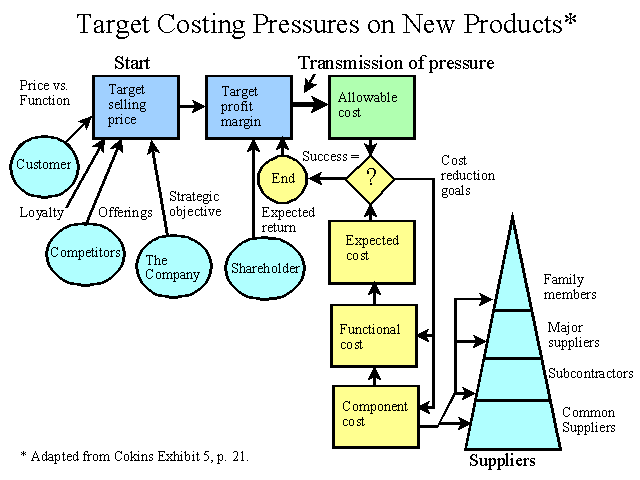
1. Determine target selling price – As the first step, the company determines what the market is willing
to pay for a product. Three main players are taken into consideration: customers, competitors, and a company’s
senior management. The company must understand the customer’s perceived value of a product as well as their
attitude for purchasing products. The company must take into account competitors alternative and substitute products.
This is because customers are shoppers and will shop around for the best price and value. Senior management must
define and adjust strategies to meet the company’s objectives.
2. Determine target profit margin – Profit margins must be set to satisfy the expectations of both the
company and its investors. Two approaches can be used to determine the desired profit margin:
baseline experiences and capital budgeting using lifecycle analysis.
3. Calculate the allowable product cost – The maximum allowable product cost is calculated as the net
difference between the target selling price and the target profit margin. In order for target costing to work, the maximum allowable product cost
must not be exceeded. If the maximum allowable product cost is exceeded there will be undesirable outcomes. First, the company will increase the price of the product in order to
maintain the desired profit margin. This will decrease sales volume and the optimal sales-price combination will not be
achieved. Second, investors will be dissatisfied. See the illustration below for a graphic view of the target costing concept.
Target Costing and ABC Data
Target costing places pressure in a feed-forward mode meaning workers must strive for a more economical design. In contrast, traditional costing places pressure in a feedback mode meaning workers need to achieve more effective and efficient production processes. Traditional managerial accounting uses ABC data to provide feedback. ABC data can also be used to provide feed-forward data that can be used for target costing. ABC provides data on cost centers, which product-related costs are traced to. ABC uses activity-driver quantity measures to transmit a component’s usage on the equipment costs. ABC data can be used to cost the components that comprise a product. This is known as feature-based costing. In feature-based costing, the driver is now thought of as a feature equivalent, rather than based on another measure such as time. It is a conversion of the time measure to make the component into the types of features that require the time. These feature-based costs can be used to project costs of a proposed new product, hence making it useful for target costing.
Example
The following example shows how ABC data can be used to project the costs of a proposed product component.
Circuit board A requires 60 holes to be punched in it and three passes through a treatment device. Each hole-punch takes 6 minutes and each board-treatment takes 12 minutes. For the month of June, the hole-punching machine cost $100,000 and processed 8,000 minutes worth of boards or $12.50 per minute ($100,000 / 8,000 minutes) as the activity-driver rate. The board-treatment machine incurred a cost of $400,000, and had 40,000 minutes of board work, or $10.00 per minute ($400,000 / 40,000 minutes. Board A’s hole-punching standard is 6 minutes. Board A’s board-treatment standard requires 12 minutes. If the board had only these two components, the board would cost without any indirect support costs $195.00 as show in the table.
Assume that 80,000 holes are punched in a month. Thus, each hole costs $1.25 ($100,000 / 80,000 holes). Presume there were 10,000 boards passed through the board-treatment machine for the 40,000 minutes. That equates to $40.00 for each board-pass ($400,000 / 10,000 board-passes). Now board A can be recalculated based on feature quantities rather than time as seen in the table below.
A proposed new circuit board B requires 30 holes punched and 4 passes through the treatment machine. As shown in the table, the cost of board B using feature-based costing would be $197.50. The difference between ABC and feature-based costing is that the activity-driver rate is based on a component feature, not time. Feature-based costing data can be used to project the cost of the proposed new board B, as computed in the table.
| ABC Board A |
Feature-Based Costing Board A |
Feature-Based Costing Board B |
|
| Hole-punching time | $12.50 * 6 minutes = $75.00 | 60 holes * $1.25 per hole = $75.00 | 30 holes * $1.25 per hole = $37.50 |
| Board-treatment time | $10.00 * 12 minutes = $120.00 | 3 passes * $40.00 per pass = $120.00 | 4 passes * $40.00 per pass = $160.00 |
| Total Cost | $75.00 + $120.00 = $195.00 | $75.00 + $120.00 = $195.00 | $37.50 + 160.00 = $197.50 |
_____________________________________________
Related summaries:
Anderson, S. W., J. W. Hesford and S. M. Young. 2002. Factors influencing the performance of activity based costing teams: A field study of ABC model development time in the automobile industry. Accounting, Organizations and Society 27(3): 195-211. (Summary).
Argyris, C. and R. S. Kaplan. 1994. Implementing new knowledge: The case of activity-based costing. Accounting Horizons (September): 83-105. (Summary).
Baxendale, S. J. and P. S. Raju. 2004. Using ABC to enhance throughput accounting: A strategic perspective. Cost Management (January/February): 31-38. (Summary).
Carter, T. L., A. M. Sedaghat and T. D. Williams. 1998. How ABC changed the post office. Management Accounting (February): 28-32, 35-36. (Summary).
Cokins, G. 1999. Using ABC to become ABM. Journal of Cost Management (January/February): 29-35. (Summary).
Cooper, R. 1990. Implementing an activity-based cost system. Journal of Cost Management (Spring): 33-42. (Summary).
Cooper, R. 1996. Activity-based management and the lean enterprise. Journal of Cost Management (Winter): 6-14. (Summary).
Cooper, R. and R. S. Kaplan. 1992. Activity-based systems: Measuring the costs of resource usage. Accounting Horizons (September): 1-13. (Summary).
Cooper, R., and R. S. Kaplan. 1998. The promise - and peril - of integrated cost systems. Harvard Business Review (July-August): 109-119. (Summary 1, Summary 2).
Corbett, T. 2000. Throughput accounting and activity-based costing: The driving factors behind each methodology. Journal of Cost Management (January/February): 37-45. (Summary).
Dummer, W., M. Masters and D. Swenson. 2015. Delivering customer value through value analysis. Cost Management (March/April): 17-24. (Summary).
Gosselin, M. 1997. The effect of strategy and organizational structure on the adoption and implementation of activity-based costing. Accounting, Organizations and Society 22(2): 105-122. (Summary).
Hughes, S. B. and K. A. Paulson Gjerde. 2003. Do different cost systems make a difference? Management Accounting Quarterly (Fall): 22-30. (Summary).
Ittner, C. D., D. F. Larcker and T. Randall. 1997. The activity-based cost hierarchy, production policies and firm profitability. Journal of Management Accounting Research (9): 143-162. (Summary).
Jones, T. C. and D. Dugdale. 2002. The ABC bandwagon and the juggernaut of modernity. Accounting, Organizations and Society 27(1-2): 121-163. (Summary).
Kaplan, R. S. 1990. The four stage model of cost systems design. Management Accounting (February): 22-26. (Summary).
Kaplan, R. S. 1998. Innovation action research: Creating new management theory and practice. Journal of Management Accounting Research (10): 89-118. (Summary).
Kaplan, S. E. and J. T. Mackey. 1992. An examination of the association between organizational design factors and the use of accounting information for managerial performance evaluation. Journal of Management Accounting Research (4): 116-130. (Summary).
Kee, R. C. 2001. Implementing cost-volume-profit analysis using an activity-based costing system. Advances in Management Accounting (10): 77-94. (Summary).
Keys, D. E. 1994. Tracing costs in the three stages of activity-based management. Journal of Cost Management (Winter): 30-37. (Summary).
Keys, D. E. and R. J. Lefevre. 1995. Departmental activity-based management. Management Accounting (January): 27-30. (Summary).
Krumwiede, K. R. 1998. ABC: Why it's tried and how it succeeds. Management Accounting (April): 32-34, 36, 38. (Summary).
Landry, S. P., L. M. Wood and T. M. Lindquist. 1997. Can ABC bring mixed results? Management Accounting (March): 28-30, 32-33. (Summary).
Mangan, T. N. 1995. Integrating an activity-based cost system. Journal of Cost Management (Winter): 5-13. (Summary).
Martin, J. R. Not dated. Chapter 7: Activity Based Product Costing. Management Accounting: Concepts, Techniques & Controversial Issues. Management And Accounting Web. Chapter7.htm
Martin, J. R. Not dated. Product life cycle management. Management And Accounting Web. PLCSummary.htm
Mecimore, C. D. and A. T. Bell. 1995. Are we ready for fourth-generation ABC? Management Accounting (January): 22-26. (Summary).
Palmer, R. J. and M. Vied. 1998. Could ABC threaten the survival of your company? Management Accounting (November): 33-36. (Summary).
Ruhl, J. M. and B. P. Hartman. 1998. Activity-Based Costing in the Service Sector. Advances in Management Accounting (6): 147-161. (Summary).
Sakurai, M. 1989. Target costing and how to use it. Journal of Cost Management (Summer): 39-50. (Summary).
Sandison, D., S. C. Hansen and R. G. Torok. 2003. Activity-based planning and budgeting: A new approach. Journal of Cost Management (March/April): 16-22. (Summary).
Troxel, R. and M. Weber. 1990. The evolution of activity-based costing. Journal of Cost Management (Spring):14-22. (Summary).
Turney, P. B. B. 1990. Ten myths about implementing an activity-based costing system. Journal of Cost Management (Spring): 24-32. (Summary).
West, T. D. and D. A. West. 1997. Applying ABC to healthcare. Management Accounting (February): 22, 24-26, 28-30, 32-33. (Summary).
Zeller, T. L. 2000. Measuring and managing e-retailing with activity-based costing. Journal of Cost Management (January/February): 17-30. (Summary).