Summary by James R. Martin, Ph.D., CMA
Professor Emeritus, University of South Florida
Behavioral Issues Main Page | Performance
Measures Main Page | Teamwork Main Page
The purpose of this paper is to develop and test a model that addresses the following questions.
1. Should team performance be measured, and if so, how?
2. Is it important to integrate team performance into individual compensation?
3. What role does participation in setting performance targets play?
4. Does employing team performance measures improve team performance? (p. 264)
The basis of the model is the link between teams and complexity. After establishing this link, the authors develop nine hypotheses related to teams, participation in setting performance targets, performance measurement, compensation, and team performance.
Why Teams?
The section includes a discussion of the literature related to teams and the need for teams when complex tasks are required. This includes comments related to different types of tasks ( pooled, sequential, and reciprocal) and both intra-departmental and inter-departmental teams. This section establishes the link between complexity and teams, and provides the basis for the model development.
The Model
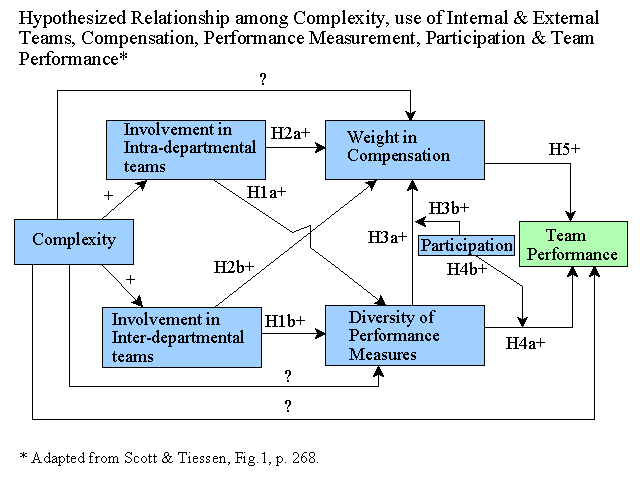
The model is illustrated in an adaptation of Figure 1 below.
The hypotheses that appear in the graphic illustration are provided below.
H1a: The diversity of team performance measurement is positively associated with greater involvement in intra-departmental teams.
H1b: The diversity of team performance measurement is positively associated with greater involvement in inter-departmental teams.
H2a: The weight given team performance in an individual's compensation is associated with greater involvement in intra-departmental teams.
H2b: The weight given team performance in an individual's compensation is associated with greater involvement in inter-departmental teams.
H3a: The weight of team performance in an individual's compensation is associated with the use of diverse team performance measures.
H3b: The weight of team performance in an individual's compensation is greater if team performance measurement is accompanied by greater participation in setting performance targets.
H4a: Team performance is better when performance measures are more diverse and include both financial and non-financial measures.
H4b: Team performance is better if performance measurement is accompanied by greater participation in setting performance targets.
H5: Team performance is better the greater the weight team performance is given in compensation.
Sample and Method
The sample included 248 completed surveys (out of 193 from twelve for-profit organizations and 390 from 15 not-for-profit organizations). The measurements used are indicated in the table below adapted from Table 1 on p. 273.
| Adaptation of Table 1: Variable Names & Definitions | ||
| Complexity Variables | Task complexity | Perrow's technology, aggregate of eight (5-point) items ranging from most routine and certain to least routine and certain. |
| Reciprocal | Proportion of a department's work that passes to another department and then returns. | |
| Hierarchical flatness | Degree to which an organization's hierarchy is vertical. Measured as the inverse of the number of levels in the organization divided by the log of the number of employees. | |
| Place-in-hierarchy | Respondent's relative place in hierarchy, measured as the respondent's level divided by the total number of levels. | |
| Proportion of time spent in teams variables |
Intra-departmental | Proportion of the respondent's time spent working in teams consisting of members drawn exclusively from his/her own department. |
| Inter-departmental | Proportion of the respondent's time spent working in teams consisting of members drawn from at least one other department external to the respondent's own department. | |
| Team performance measurement variables |
Measure 012 | Respondent's teams have no performance measures (0), at least one financial or one non-financial performance measure but not both (1), at least one financial and one non-financial performance measure (2). |
| Measure 6 | Number of performance measurement categories (0-6) used in respondent's teams (financial, productivity, quality, service, innovation, personnel). | |
| Participation in setting performance targets variables | Part | Average participation across all performance measures used in the respondent's teams based on a five-point scale ranging from almost never, to almost always. |
| Part (H/L) | The above divided into high/low at mean response level. | |
| Partnon | Average participation across all non-financial performance measures used in the respondent's teams. | |
| Partin | Participation in setting financial performance measures in the respondent's teams. | |
| Compensation variables | Compensate | Proportion of respondent's compensation attributable to team performance. |
| Team Performance Variables | Performance | Performance of respondent's teams, five-point scale ranging from far below to far above expectations, mid-point is met expectations. |
The statistical method used is referred to as simultaneous multivariate path analysis. According to the authors, "Path analysis has the advantage of estimating all the relationships indicated in Fig. 1 simultaneously" (p. 275). Two models were used. The first model uses an interval scale performance measurement variable in interaction with participation. The second model uses discrete combinations of performance measurement and high versus low participation.
Results
The results are presented in Table 4, p. 278. Panel A shows the results for the interval scale. Panel B shows the results for the discrete combinations of performance measurements and high versus low participation. The authors state the following in reference to Figure 1 and Table 4. "When variables appear at a node they are referred to as dependent variables, and the R2 at the end of the row corresponds to the percentage of the variance of each node that is explained by the paths leading to it."
Results
H1a: The diversity of team performance measurement is positively associated with greater involvement in intra-departmental teams. - Strongly Supported
H1b: The diversity of team performance measurement is positively associated with greater involvement in inter-departmental teams. - Strongly Supported
H2a: The weight given team performance in an individual's compensation is associated with greater involvement in intra-departmental teams. - Strongly Supported
H2b: The weight given team performance in an individual's compensation is associated with greater involvement in inter-departmental teams. - Strongly Supported
H3a: The weight of team performance in an individual's compensation is associated with the use of diverse team performance measures. - Supported
H3b: The weight of team performance in an individual's compensation is greater if team performance measurement is accompanied by greater participation in setting performance targets. - Supported
H4a: Team performance is better when performance measures are more diverse and include both financial and non-financial measures. - Supported
H4b: Team performance is better if performance measurement is accompanied by greater participation in setting performance targets. - Weakly Supported
H5: Team performance is better the greater the weight team performance is given in compensation. - Supported
Discussion - Questions and Findings
The authors discuss the findings in terms of the original questions and indicate that their study "provides a wide scope for future work." I have briefly summarized their discussion below.
1. Should team performance be measured, and if so, how?
Teams are formed in response to complexity and require both financial and non-financial measures to adequately capture performance.
2. Is it important to integrate team performance into individual compensation?
Comprehensive performance measurements and linking team performance to compensation enhances performance.
3. What role does participation in setting performance targets play?
Most of the influence of participation is related to participation in setting non-financial measures.
4. Does employing team performance measures improve team performance?
When team performance is measured more comprehensively, includes participation in setting performance targets, and includes team performance into compensation, team performance is enhanced.
________________________________________________
Related summaries:
Anderson, S. W., J. W. Hesford and S. M. Young. 2002. Factors influencing the performance of activity based costing teams: A field study of ABC model development time in the automobile industry. Accounting, Organizations and Society 27(3): 195-211. (Summary).
Hertenstein, J. H. and M. B. Platt. 1998. Why product development teams need management accountants. Management Accounting (April): 50-55. (Summary).
Johnson, D. W., G. Maruyama, R. Johnson, D. Nelson and L. Skon. 1981. Effects of cooperative, competitive, and individualistic goal structures on achievement: A meta-analysis. Psychological Bulletin (89): 47-62. (Summary).
Katzenbach, J. R. and J. A. Santamaria. 1999. Firing up the front line. Harvard Business Review (May-June): 107-117. (Summary. The authors discuss five unique practices used by the Marine Corps).
McNair, C. J. 1990. Interdependence and control: Traditional vs. activity-based responsibility accounting. Journal of Cost Management (Summer): 15-23. (Summary).
Rigby, D. K., J. Sutherland and H. Takeuchi. 2016. Embracing agile: How to master the process that's transforming management. Harvard Business Review (May): 40-50. (Summary).
Staats, B. R. and D. M. Upton. 2011. Lean knowledge work: The "Toyota" principles can also be effective in operations involving judgment and expertise. Harvard Business Review (October): 100-110. (Summary).
Towry, K. L. 2003. Control in a teamwork environment: The impact of social ties on the effectiveness of mutual monitoring contracts. The Accounting Review (October): 1069-1095. (Towry discusses Social Identity Theory and how it can be applied to vertical and horizontal incentive systems). (Summary) and
Wisner, P. S. and H. A. Feist. 2001. Does teaming pay off? Strategic Finance (February): 58-64. (Summary).