Provided by James R. Martin, Ph.D., CMA
Professor Emeritus, University of South Florida
Data Mining Main Page | AIS
MIS Main Page | Software Main Page
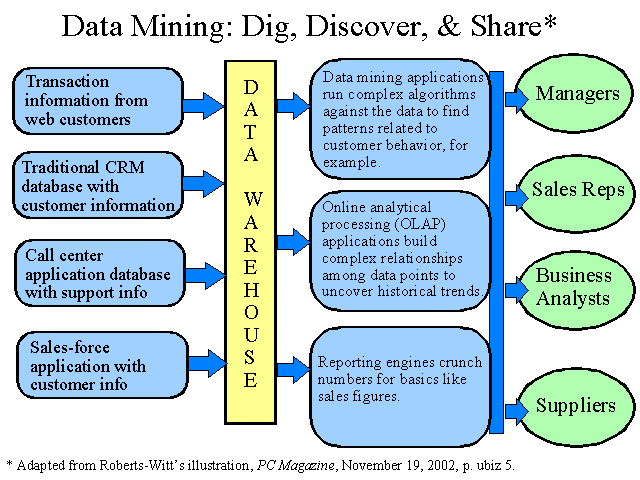
Data mining is part of a group of concepts or techniques related to business intelligence, or e-business intelligence. Data mining involves obtaining information from a variety of sources that is stored in a data warehouse. This information becomes the input for various applications that uncover relationships and trends related to customers and processes. Online analytical processing (OLAP) allows a user to view data from many different angles to uncover correlations and relationships, somewhat like a Rubik's cube (Roberts-Witt, Gold diggers 2001). These results are then used by managers and others to make better decisions. The emphasis is on data sharing where the web allows various types of information to be accessible to the masses. Managers, customers, suppliers and partners can ask the data warehouse questions about various aspects of the business through query and reporting applications. The illustration below provides a graphic view of the data mining concept.
Three important considerations include: clean data, security and scalability (Roberts-Witt, Gold diggers 2001). Where thousands of people are accessing a system, the data must be accurate and free of errors and inconsistencies. Special attention must be given to establishing who has access rights to the data and to enforcing those rights. The infrastructure must be in place including web servers, report servers, databases and networks to support scalability.
Examples:
Starbucks uses data mining to reduce insurance claims. The data is analyzed to uncover locations, floor designs and time patterns where customers slip and fall more frequently from coffee spills. (Roberts-Witt, Gold diggers 2001).
Dow Jones Interactive Wall Street Journal uses data mining to better understand how the site is performing by correlating the log and click-stream information generated with the customer files. (Roberts-Witt, Data mining: What lies beneath? 2002).
The Royal Dutch/Shell Group operates in 135 countries with 90,000 employees and 1,700 separate operating companies. Shell's data mining project allows the company to find more meaning in its' data to help negotiate better contracts and identify products that are doing well or declining on a global basis. (Roberts-Witt, Data mining: What lies beneath? 2002)
Harrah's mines its' rich database to develop compelling customer incentives. (Loveman, Diamonds in the data mine, 2003). Some other applications of data mining include: 1) Simulating and optimizing supply chain flows, reducing inventory and stock-outs, 2) Identifying customers with the greatest profit potential, 3) Identifying the price that will maximize yield or profit, 4) Selecting the best employees for tasks or jobs, 5) Detecting and minimizing quality problems, 6) Proving a better understanding of the drivers of financial performance including nonfinancial factors, 7) Improving the quality, efficacy and safety of products and services. (Davenport, Competing on analytics 2006).
From the intelligence perspective, the National Research Council ranked data mining technology with antibiotics, vaccines, imaging and other technologies in the fight against terrorism. Text mining, video mining, audio phone mining and e-mail mining could all become important in the area of homeland defense (Roberts-Witt, Data mining: What lies beneath? 2002).
There are four paradigms of science: 1) Theory, 2) Experimentation, 3) Computation and simulation, and 4) Data mining. The next scientific revolution involves using the fourth paradigm, deep-data-mining tools to solve the worlds problems in astronomy, oceanography, healthcare, water management, and climate change. (Hey, The next scientific revolution 2010).
_____________________________________________
Related summaries:
Appelbaum, D., A. Kogan and M. A. Vasarhelyi. 2017. An introduction to data analysis for auditors and accountants. The CPA Journal (February): 32-37. (Summary).
Appelbaum, D., A. Kogan, M. Vasarhelyi and Z. Yan. 2017. Impact of business analytics and enterprise systems on managerial accounting. International Journal of Accounting Information Systems (25): 29-44. (Summary).
Gregg, A. 2017. Start-ups embrace cryptocurrency to raise needed capital: 'Initial coin offerings' let companies raise money without ceding control. The Washington Post (December 4): A13. (Note).
Roberts-Witt, S. L. 2002. Data mining: What lies beneath? Finding patterns in customer behavior can deliver profitable insights into your business. PC Magazine (November, 19): iBiz 1-6. (Note).
Tschakert, N., J. Kokina, S. Kozlowski and M. Vasarhelyi. 2017. How business schools can integrate data analytics into the accounting curriculum. The CPA Journal (September): 10-12. (Summary).
Williams, S. 2011. 5 Barriers to BI success and how to overcome them. Strategic Finance (July): 26-33. (Note).