Summary by Eileen Fried
Master of Accountancy Program
University of South Florida, Summer 2003
Investment Management Main Page | Strategy Main Page
“In financial terms, a business strategy is more like a series of options than it is like a series of static cash flows” (90, 2). A strategy is generally comprised of a sequence of major decisions or options. Luehrman suggests that a company can more effectively execute their strategies through active management of these options by evaluating them not only on the basis of discounted cash flows, but also by giving strong consideration to the timing of their investments.
Luehrman uses two metrics to measure options and plot them comparatively on a rectangular field he calls an “Option Space”. The metrics are:
1. Value-to-cost metric – the value of the underlying assets we intend to build or acquire divided by the present value of the expenditure required to build or buy them (91). This is the horizontal axis.
If the value-to-cost ratio is between zero and one, it means the cost of this option is more than the value we will generate from it.
If the value-to-cost ratio is greater than one, it means the value generated is greater than the cost.
2. Volatility metric – measures how much things can change before an investment decision must finally be made (91). This is the vertical axis.
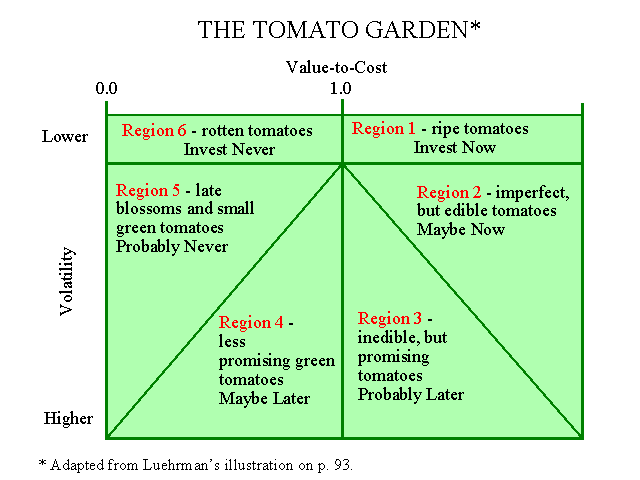
In the article, Luehrman likens his “Option Space” to a tomato garden; the thought being that in a tomato garden not all the tomatoes are ripe at the same time, some are ready to pick right now, some are rotten and should be discarded, and some with the proper attention will be ready to harvest at a later date. The same holds true for evaluating your investments. In traditional evaluation of investments, the decision has been limited to yes/no “ripe or rotten” based solely on net present value. The argument here is that an investment with a negative net present value may still be good, but perhaps it’s just not the right time or you don’t have all the information you need to make the proper decision. If you can delay until the proper time, you’ve saved yourself money, idol assets or the potential of discarding a good investment because of incomplete information.
The “Option Space” is divided into six regions with definitions as to the types of options that fall into that region and managerial guidance on how to handle them. See the chart below:
Regions 6 and 1 – These two regions are the now or never areas, where either all the unknowns about an investment have been determined or your time to decide is up. If the investment has a value-to-cost greater than one, you should invest, if below one, no.
Regions 2 and 3 – Investments in these regions are currently showing a value-to-cost greater than one, but it is still not time to “harvest” or invest. The line dividing region 2 and 3 equates to the net present value (NPV) of the option. In region 2, the NPV is greater than 0, in region 3 the NPV is less than zero. This line would normally be curved if you were to plug in actual values; the curves have been removed to simplify the chart.
Regions 4 and 5 – Are less promising, because they have a value-to-cost ratio of less than one. Unless this can be improved upon before time runs out, they would not be pursued.
The natural movement of an option within the Option Space over time with no other change is upward (i.e., time is running out) and to the left – the value-to-cost metric decreases over time with all other variables constant. Managers should nurture the investments in regions 3 and 4 to attempt to increase their value or reduce their cost, thus improving their locations within the Option Space.
As stated earlier, a business strategy is like a series of options or major business decisions. Plotting related options within the Option Space will help managers understand where they need to focus their attention to continue to optimize a particular strategy. This technique includes more analysis than the conventional NPV evaluation. It also requires attention. Just like a tomato garden, for the best results, you need to be constantly monitoring and re-evaluating where your options are in the Option Space for the best harvest.
_____________________________________________
Related summaries:
Christensen, C. M. 1997. Making strategy: Learning by doing. Harvard Business Review (November-December): 141-142, 144, 146, 148, 150-154, 156. (Summary).
Clinton, B. D. and A. H. Graves. 1999. Product value analysis: Strategic analysis over the entire product life cycle. Journal of Cost Management (May/June): 22-29. (Summary).
De Geus, A. 1999. The living company. Harvard Business Review (March-April): 51-59. (Summary).
Fonvielle, W. and L. P. Carr. 2001. Gaining strategic alignment: Making scorecards work. Management Accounting Quarterly (Fall): 4-14. (Summary).
Gosselin, M. 1997. The effect of strategy and organizational structure on the adoption and implementation of activity-based costing. Accounting, Organizations and Society 22(2): 105-122. (Summary).
Iansiti, M. and R. Levien. 2004. Strategy as ecology. Harvard Business Review (March): 68-78. (Summary).
Kaplan, R. S. and D. P. Norton. 1996. Using the balanced scorecard as a strategic management system. Harvard Business Review (January-February): 75-85. (Summary).
Kaplan, R. S. and D. P. Norton. 2000. Having trouble with your strategy? Then map it. Harvard Business Review (September-October): 167-176. (Summary).
Kaplan, R. S. and D. P. Norton. 2001. Transforming the balanced scorecard from performance measurement to strategic management: Part I. Accounting Horizons (March): 87-104. (Summary).
Kaplan, R. S. and D. P. Norton. 2001. Transforming the balanced scorecard from performance measurement to strategic management: Part II. Accounting Horizons (June): 147-160. (Summary).
Kaplan, R. S. and D. P. Norton. 2004. Measuring the strategic readiness of intangible assets. Harvard Business Review (February): 52-63. (Summary).
Kim, W. C. and R. Mauborgne. 1997. Value innovation: The strategic logic of high growth. Harvard Business Review (January-February): 103-112. (Summary).
Kim, W. C. and R. Mauborgne. 1999. Creating new market space: A systematic approach to value innovation can help companies break free from the competitive pack. Harvard Business Review (January-February): 83-93. (Summary).
Kim, W. C. and R. Mauborgne. 2002. Charting your company's future. Harvard Business Review (June): 77-83. (Summary).
Langfield-Smith, K. 1997. Management control systems and strategy: A critical review. Accounting, Organizations and Society 22(2): 207-232. (Summary).
O'Clock, P. and K. Devine. 2003. The role of strategy and culture in the performance evaluation of international strategic business units. Management Accounting Quarterly (Winter): 18-26. (Summary).
Porter, M. E. 1980. Competitive Strategy: Techniques for Analyzing Industries and Competitors. The Free Press. (Summary).
Porter, M. E. 1987. From competitive advantage to corporate strategy. Harvard Business Review (May-June): 43-59. (Summary).
Porter, M. E. 1996. What is a strategy? Harvard Business Review (November-December): 61-78. (Summary).
Porter, M. E. 2001. Strategy and the internet. Harvard Business Review (March): 63-78. (Summary).
Simons, R. 1995. Control in an age of empowerment. Harvard Business Review (March-April): 80-88. (Summary).