Summary by Corinne Rakocy
Master of Accountancy Program
University of South Florida, Summer 2003
Behavioral Issues Main Page | Change
Management Main Page | Strategy Related Main Page
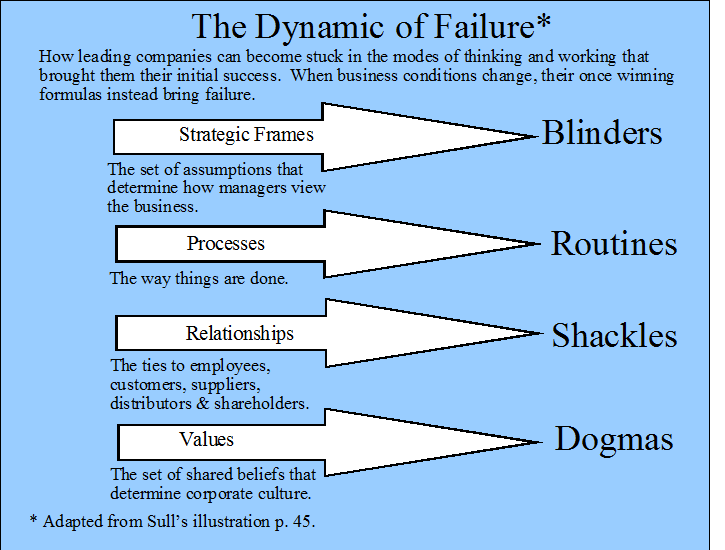
Why is it that some companies are able to keep pace with a changing business environment while others cannot? Is it that companies just stand by idly, taking no actions to keep their businesses alive? Donald Sull does not believe that is the case at all, in fact, he believes quite the opposite. Sull believes that many companies fail to adapt to changing business environments because of active inertia. What does he mean by this? Active inertia is when a company uses the same patterns and ideals that have motivated actions in the past in an attempt to adapt to the changing environment. The company is taking actions to try and evolve with the business world, but does so in a way that is actually more detrimental than helpful because the company strategy has not materially changed.
Firestone Tire & Rubber is a perfect example of active inertia. For years Firestone was the leading tire manufacturer in the United States. Firestone built strong relationships with the Detroit Big Three automakers and grew steadily for years. In fact, Firestone grew so steadily that they saw their only challenge as keeping up with the growing demand for their product. Like all good things, Firestone’s steady growth did not last forever. In the early 1970s, the French tire company Michelin entered the U.S. market with a new, more efficient tire design. Firestone had known about Michelin and the advantage they had in the tire market for years because of the great success Michelin had in Europe. Firestone had even taken steps to develop its own radial tire to compete with Michelin. Unfortunately for Firestone, the steps taken were not enough. The investment of manufacturing the new tire design was a good one, but the new design needed a new production method and Firestone did not change its production processes. The new tire design required a higher quality than that of the older design and with out a new process this quality would not be achieved. Also, Firestone took too long in closing plants creating the older and almost obsolete tire design, thereby creating more costs and fewer revenues. By the end of the decade, Firestone was forced to let the foreign company Bridgestone take control. Firestone’s problem was not that it did not take action, but that it took the wrong actions. Firestone exhibited each of the four hallmarks of active inertia.
Strategic Frames become Blinders.
Strategic frames are the sets of assumptions manages make about the business world; they help managers answer complex strategic problems by giving them a framework to begin with. Strategic frames can be very beneficial in allowing managers to find solutions to difficult tasks, but they can also hinder. When managers find the same frames working over and over they begin to believe that those frames are the solutions, the only things that matter. However, when an environment changes, the strategic frames need to change also. Many mangers have problems identifying this because they have used the same ones successfully for so long. Take Firestone as an example. The managers at Firestone had always considered its main competitors to be domestic companies like Akron. When Michelin entered the U.S. market, the managers at Firestone had a hard time recognizing it as a major competitor because of its French origin. The managers had their minds set that the only competitors that could really be a threat were domestic. They were using outdated frameworks about competitors causing the company to be blinded instead of enlightened to the competitive measures that needed to be taken.
Processes Harden into Routines.
Companies often find it hard to change processes that have worked for many years, but sometimes that is the one thing that is really needed. Sticking with the same business processes within a changing environment is like digging your self into a hole or getting stuck in a rut on the road to continued success. Long used processes become comfortable and routine, but routine is not good for innovations because it keeps companies from looking for a better solution. Firestone had this exact problem with the new radial tire design. The radial design required much different processes to manufacture than the old bias tires. Many of the old plants could not be effectively used for the processes needed to manufacture the new tire design, but Firestone was not ready to get rid of the plants or the processes used on the old tires. Why, because the old process was routine. It worked for their fathers and it would work for them. Managers became narrow minded due to comfort and routine keeping them from adapting to the changing environment.
Relationships Become Shackles.
Relationships always have been and will be an important part of a successful business, but sometimes these relationships can run too deep creating inflexibility for the company. Apple Computer found this out first hand when the innovative engineers that contributed to the technical advances of Apple in the early days refused to change any of their ways. The business environment was changing due to the fast pace of technological advances of the eighties and nineties, but the engineers at Apple were not willing to adapt from the free style atmosphere they had enjoyed in the early days to the strategic atmosphere needed to service in the quickly evolving business tech. Environment.
Values Harden into Dogmas.
Values are the inspirations of businesses. They let the customers know what the company is all about and unify the employees of the company. Firestone’s values were loyalty to the company and commitment to the community. These values start out as pure and great things for a company, but as the company grows and matures these values can move from being a positive thing to rigid rules that bind the company. Firestone found that sometimes the best thing for the company could go against the very values that the company was founded on. The plants used to manufacture the obsolete bias tire needed to be closed so that resources could be used to stay competitive within the market. Closing those plants and taking away jobs would go against the values of Firestone by hurting the community it is supposed to be committed to. Instead of doing what was best for the company, which in the long run would help the communities, Firestone stuck to the old values and ended up hurting itself and the community more in the end.
Many companies suffer from active inertia because they are stuck in the past. These companies can see that problems are on the way and step into action. The mistake these companies make is that not enough thought is put into the actions taken. Companies need to stop and ask themselves “What hinders us?” to focus on the real issues (50). Also, companies need to make the transitions slowly. Too much change at once can cause just as many problems as not enough. The past needs to be built on as a foundation as the company changes in an evolving business environment.
_______________________________________________
Related summaries:
Abernethy, M. A. and P. Brownell. 1999. The role of budgets in organizations facing strategic change: An exploratory study. Accounting, Organizations and Society 24(3): 189-204. (Summary).
Abrahamson, E. 2000. Change without pain. Harvard Business Review (July-August): 75-79. (Summary).
Beer, M. and N. Nohria. 2000. Cracking the code of change. Harvard Business Review (May-June): 133-141. (Summary).
Beynon, R. 1992. Change management as a platform for activity-based management. Journal of Cost Management (Summer): 24-30. (Summary).
Blake, R. R. and J. S. Moulton. 1962. The managerial grid. Advanced Management Office Executive 1(9). (The Grid).
Bonabeau, E. 2004. The perils of the imitation age. Harvard Business Review (June): 45-47,49-54. (Summary).
Coutu, D. L. 2002. The anxiety of learning. Harvard Business Review (March): 100-107. (Summary).
Gladwell, M. 2002. The Tipping Point: How Little Things Can Make a Big Difference. Back Bay Books. (Summary).
Hammer, M. 1990. Reengineering work: Don't automate, obliterate. Harvard Business Review (July-August): 104-112. (Summary).
Malone, D. and M. Mouritsen. 2014. Change management: Risk, transition, and strategy. Cost Management (May/June): 6-13. (Summary).
Pascale, R., M. Millemann and L. Gioja. 1997. Changing the way we change. Harvard Business Review (November-December): 127-139. (Summary).
Porter, M. E. 1996. What is a strategy? Harvard Business Review (November-December): 61-78. (Summary).
Rafii, F. and L. P. Carr. 1997. Why major change programs fail: An integrative analysis. Journal of Cost Management (January/February): 41-45. (Summary).