Summary by Kent Jones
Master of Accountancy Program
University of South Florida, Summer 2002
Japanese Management Main Page | JIT Main Page
Traditional accounting systems were designed to support inventory push manufacturing environments (forecasting demand, developing production plans and establishing target inventory levels). Traditional accounting systems lacked the ability to coordinate production flows and manage cycle times. Global competition and increased demand volatility have caused a need to look at alternative ways of improving manufacturing efficiency. Just in time (JIT) is a demand pull methodology that is designed to react quickly to demand fluctuations reducing both inventory maintenance levels and opportunity costs. JIT relies on an accounting system that integrates the physical control system with a cycle time (CT) system. This article specifically, attempts to identify accounting system characteristics required to facilitate cycle time management.
JIT places new demands on management accounting and internal controls. For example, an accounting system must be able to address questions regarding the change in profit relative to the change in cycle time. Additionally, operational and financial controls under a traditional system are very limited. A physical control system that coordinates production flow and minimizes in-process accumulations, such as a kanban system (described below), is one example.
Cycle Time or CT System
A CT system is a set of activities that together make up a production operation. In a CT system an activity consumes resources over a specific period of time to perform a specific task. Two basic measurements are required. First, production is organized into cells (cost centers) that consist of an activity or group of similar activities. Costs are measured, not allocated, at the cell level. Second, time measurements must be taken enabling cost/time-unit of each activity. Advantages of this type of accounting system include:
Flexibility - because the measurements are detailed, they can be aggregated in numerous ways to support various constituencies within the organization.
Cost standards at the activity level can be established making it possible for variance analysis at the activity level. This in turn enables the isolation of potential problems at the activity level.
Traditional accounting reports can still be generated.
CT System Illustration
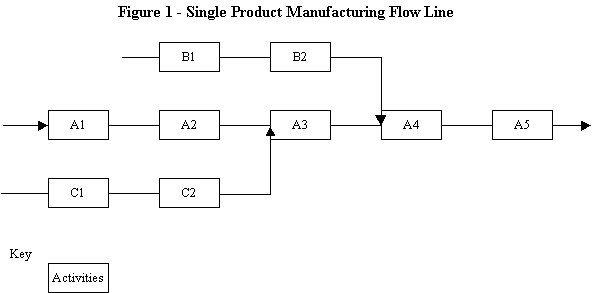
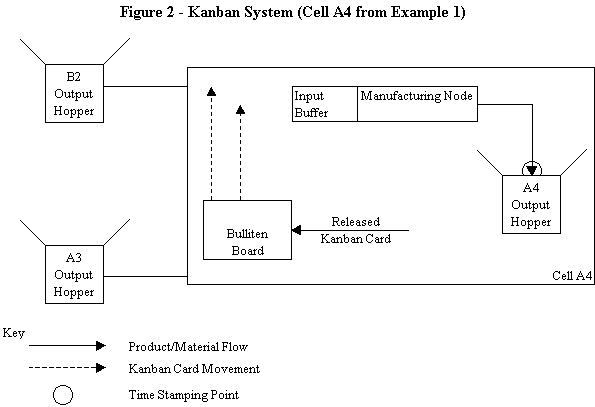
Figure 1 was adapted from the article to explain how a CT system works within a JIT environment. Figure 2 was adapted from the article to explain the integration of a physical control system with a CT system and their measurement requirements.
Referring to Figure 1, each box is a cell performing a specific production task that when combined produces a finished product. Each cell produces batches of units utilizing either materials or labor or both. A cell produces units until its hopper is filled. A downstream cell requests units from the upstream cell on a just in time basis. Delays in cycle time can be caused by the following:
Physical controls that are too tight.
Processing inefficiencies.
Upstream or downstream delays.
Figure 2 provides a blow up of cell A4 and cells B2 and A3 that feed cell A4 (from Figure 1). It also shows how a kanban system is used to coordinate and measure production flow from cell to cell. Because JIT is a demand-pull system, cell A4 requests inputs in batches of units from cells B2 and A3 as needed. The requests are made by the use of kanban cards (or electronic messages) that signal to the feed cells a need for another batch of units. The card is attached to the batch, and time, quantity and other relevant data is stamped on the card. Cell A4 processes the units and when it completes it’s work on the units they are then moved to cell A4’s output hopper. The kanban card is time stamped again with other relevant information and the cycle repeats, but only if the output hopper is not full.
Following are some explanations regarding the system:
Feed hoppers cannot be empty for transfer to take place.
Only one pair of kanban cards and a fixed size hopper per cell.
Hopper size determines in-process accumulation per cell.
Integration of the physical control system (kanban system) and cycle time system creates a very useful database of information.
Yield variances require modifications to the input buffer. Yield variances are time fluctuations within a cell that the input buffer is designed to dampen reducing the impact to cycle times. An exception card can be added to the kanban system to request additional inputs to overcome large yield variances.
Time Measurements
The following time measurements can be made based on the data collected from the kanban cards:
Wait time in cell A4 as a result of delays from cell A3.
Wait time in cell A4 as a result of delays from cell B2.
Wait time in cell A4 as a result of delays from both cells A3 and B2.
Wait time in cell A4 because A4’s hopper is full and cell A5 has not taken delivery of additional units from A4.
The first three are caused by upstream delays and can be measured directly from the time stamp measures. The last is caused by downstream delays and can be computed as the residual of total shift time - work time - sum of other three wait times.
Cost Measurements
Costs are accumulated for each cell similar to a traditional accounting system. Each cell can be considered a cost center. The result is that rates per unit of time can now be computed.
Variance Analysis
Variance analysis of a CT system enables the following level of analysis:
Total variance = Price or Spending variances + Waiting time variances + Efficiency variances
= (ST)(ACR-SCR) + (AWT)(ACR) + (AT-ST)(ACR)
Price or Spending variances = (ST)(ACR-SCR)
Upstream & downstream waiting time variances = (AWT- SWT)(ACR) = (AWT)(ACR)
Variances within a cell or Efficiency variances = (AT-ST)(ACR)
where,
AT = Actual
work time.
AWT = Actual wait time.
TT = Total time = AT + AWT.
ST = Standard work time.
SWT = Standard wait time = 0
TST = Total standard time = ST + SWT.
ACR = Actual cost rate = actual cost/total time.
SCR = Standard cost rate = standard cost/total
standard time.
Labor Variance Analysis
A simple example to show the advantages of a CT system over a traditional accounting system is summarized in the table below. Two cases are presented with the only difference being the actual work time for a shift of work (i.e. Case I – 5.33 hours vs. Case II – 8 hours). In a traditional system a $32 variance is attributed to labor inefficiency for both cases. This is due to a traditional systems inability to capture actual work time. However, in a CT system, actual work time is captured. Case I attributes the $32 variance to wait time (delays) in the system, whereas Case II attributes the $32 variance to labor inefficiency. The CT system is able to isolate problems in the system better.
| Comparison of Traditional Accounting System and Cycle Time System | ||||
| Case I | Case II | Measure | Explanation | |
| TT = | 8 | 8 | hours | Total time |
| AT = | 5.33 | 8 | hours | Actual work time |
| ST = | 5.33 | 5.33 | hours | Standard work time |
| ACR = | 12 | 12 | $ per hour | Actual cost rate |
| SCR = | 12 | 12 | $per hour | Standard cost rate |
| Traditional System | Case I | Case II | Measure | Formula |
| Labor Efficiency Variance | 32 | 32 | $ | (8-5.33)(12) |
| Price or Spending Variance | 0 | 0 | $ | (5.33)(12-12) |
| Cycle Time System | Case I | Case II | Measure | Formula |
| Labor Efficiency Variance | 0 | 32 | $ | Case
I = (5.33-5.33)(12) Case II = (8-5.33)(12) |
| Price or Spending Variance | 0 | 0 | $ | (5.33)(12-12) |
| Wait Time Variance | 32 | 0 | $ | Case
I = (8-5.33)(12) Case II = (8-8)(12) |
Material Variance Analysis
Within a JIT environment, material variances originate as follows:
Material price changes.
Quality of materials is inferior.
Physical controls are not adequate to handle yield variances.
A traditional accounting system is capable of identifying a price change. Inferior quality materials require either additional work time or materials. A CT system’s labor efficiency variance isolates the need for additional work time, whereas a material usage variance isolates the need for additional materials. The use of exception cards enables the classification of wait time into two categories:
Wait time from upstream or downstream delays.
Wait time associated with yield fluctuation losses.
The CT system clearly enables management to better isolate problems, relate cycle times to manufacturing costs and understand the impacts to profits. This leads to better planning and improvement in manufacturing efficiencies.
____________________________________________
Note: The variances in this paper are confusing because they are not calculated in the usual way. There are three differences. Spending variances are usually based on actual total time, not standard time. Efficiency variances are usually based on standard rates, not actual rates. Idle time or waiting time is usually part of the efficiency variance, i.e., part of total time as noted in this paper.
Related summaries:
Baggaley, B. and B. Maskell. 2003. Value stream management for lean companies, Part I. Journal of Cost Management (March/April): 23-27. (Summary).
Baggaley, B. and B. Maskell. 2003. Value stream management for lean companies, Part II. Journal of Cost Management (May/June): 24-30. (Summary).
Borthick, A. F., P. L. Bowen, and M. C. Sullivan. 1998. Controlling JIT II: Making the system monitor itself. Journal of Cost Management (July/August): 33-41. (Summary).
Carr, L. P. and C. D. Ittner. 1992. Measuring the cost of ownership. Journal of Cost Management (Fall): 42-51. (Summary).
Carr, L. P., W. C. Lawler and J. K. Shank. 2002. Reconfiguring the value chain: Levi's personal pair. Journal of Cost Management (November/December): 9-17. (Summary).
Castellano, J. F. and R. Burrows. 2011. Relevance lost: The practice/classroom gap. Management Accounting Quarterly (Winter): 41-48. (Summary).
Clinton, B. D., and H. Ko-Cheng. 1997. JIT and the balanced scorecard: Linking manufacturing control to management control. Management Accounting (September): 18-24. (Summary).
Crusoe, J., G. Schmelzle, and T. E. Buttross. 1999. The hidden costs of adopting JIT manufacturing. Journal of Cost Management (December): 23-26. (Summary).
Davenport, T. H. and J. Glaser. 2002. Just-in-time delivery comes to knowledge management. Harvard Business Review (July): 107-111. (Summary).
Deluzio, M. C. 1993. Management accounting in a just-in-time environment. Journal of Cost Management (Winter): 6-15. (Summary).
Deluzio, M. C. 1993. The tools of just-in-time. Journal of Cost Management (Summer): 13-20. (Summary).
Foster, G. and C. T. Horngren. 1987. Cost accounting and cost management in a JIT environment. Management Accounting (June): 19-25. (Summary).
Fullerton, R. R. 2003. Performance measurement and reward systems in JIT and non-JIT firms. Cost Management (November/December): 40-47. (Summary).
Fullerton, R. R. and C. S. McWatters. 2002. The role of performance measures and incentive systems in relation to the degree of JIT implementation. Accounting, Organizations and Society 27(8): 711-735. (Summary).
Goodson, R. E. 2002. Read a plant - fast. Harvard Business Review (May): 105-113. (How the rapid plant assessment (RPA) process can tell you if a factory is truly lean in as little as 30 minutes. The process includes two tools: The RPA rating sheet includes 11 categories for assessing leanness, and the RPA questionnaire includes 20 yes or no questions). (Summary).
Kalagnanam, S. S. and R. M. Lindsay. 1998. The use of organic models of control in JIT firms: Generalising Woodward's findings to modern manufacturing practices. Accounting, Organizations and Society 24(1): 1-30. (Summary).
Kapanowski, G. 2016. Lean fundamentals for accountants. Cost Management (January/February): 5-14. (Summary).
Lee, J. Y. and J. K. Winch. 1998. From push to pull: Management's control system modification for manufacturing change. Advances in Management Accounting (6): 75-92. (Summary).
Lessner, J. 1989. Performance measurement in a just-in-time environment: Can traditional performance measurements still be used? Journal of Cost Management (Fall): 23-28. (Summary).
Martin, J. R. Not dated. Lean concepts and terms. Management And Accounting Web. LeanConceptsandTermsSummary.htm
Martin, J. R. Not dated. Profit Beyond Measure graphics and notes. Management And Accounting Web. JohnsonBromsGraphicsNotes.htm
Martin, J. R. Not dated. What is lean accounting? Management And Accounting Web. LeanAccounting.htm
Martin, J. R. Not dated. Chapter 8: Just-In-Time, Theory of Constraints, and Activity Based Management Concepts and Techniques. Management Accounting: Concepts, Techniques & Controversial Issues. Management And Accounting Web. Chapter8.htm
McIlhattan, R. D. 1987. How cost management systems can support the JIT philosophy. Management Accounting (September): 20-26. (Summary).
Patell, J. M. 1987. Adapting a Cost accounting system to just-in-time manufacturing: The Hewlett-Packard Personal Office Computer Division. Accounting & Management Field Study Perspectives, edited by William J. Bruns, Jr. and R. S. Kaplan. Harvard Business School Press: 229-267. (Summary).
Pickering, M. 2017. Implementing lean management reporting in lean enterprises. Cost Management (January/February): 28-36. (Summary).
Swenson, D. W. and J. Cassidy. 1993. The effect of JIT on management accounting. Journal of Cost Management (Spring): 39-47. (Summary).
Vollmann, T. 1990. Changing manufacturing performance measurements. Proceedings of the Third Annual Management Accounting Symposium. Sarasota: American Accounting Association: 53-62. (Summary).