Summary by Jason Burkett
Master of Accountancy Program
University of South Florida, Summer 2003
ABM Main Page | Benchmarking Main Page
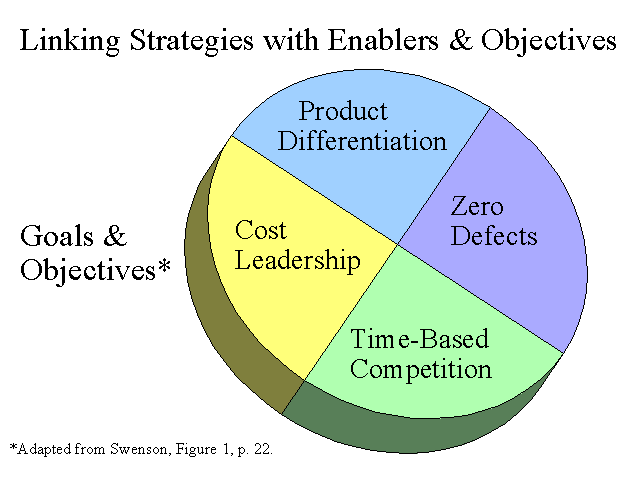
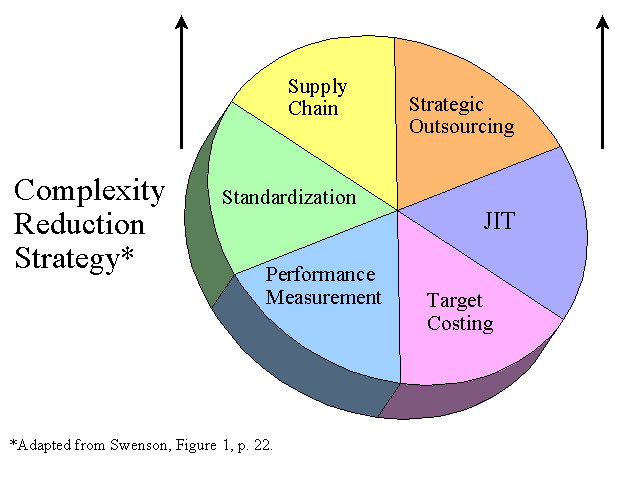
Competition is intense in the air conditioning industry, and as the industry leader, Carrier works to maintain its position through innovation, high quality, and time-based competition. Accomplishing these goals does not come without cost, and Carrier has implemented a series of techniques that support their fundamental initiative of reducing complexity. These techniques are JIT, product/process standardization, strategic outsourcing, supply chain management, target costing, and performance measurement.
While Carrier was implementing these changes in their manufacturing facilities, its parent company, United Technologies, still had a heavy focus on financial data and little emphasis on the development of a cost accounting system. Thus, Carrier began using activity-based cost management to provide all the information necessary to quantify the benefits of complexity reduction. In this system, costs of manufacturing are classified as one of four types: unit-related, batch-related, product-related, or structural. Batch-related and product-related costs are signs of complexity, and Carrier has developed performance measures, both financial and non-financial, to measure the reduction of these costs. Examples of these measurements are included in the Table below.
| Measure | Purpose | Objective |
| Percentage of components that are standard | Are we purchasing components at low costs due to the market pressure on suppliers? | To generate cost reductions by using standard components |
| Percentage of purchased parts that are certified | Are we confident in our suppliers? | To encourage actions which will eliminate incoming inspection of material |
| Number of process types | What is our degree of process proliferation? | To reduce process-sustaining cost |
| Percentage of suppliers up on EDI | What percent of suppliers use EDI technology? | To use EDI technology to reduce lead times |
| Percentage of components that are purchased | What is our degree of vertical integration? | To encourage more strategic outsourcing |
How the Initiatives are Used to Reduce Complexity
Just-In-Time-processes are simplified and streamlined. ABCM was used to identify material handling as a major cost driver and the implementation of JIT lowered these costs and even helped in avoiding a physical expansion of the plant despite taking on new products.
Carrier also tapped into the workers as a source of improvement by making them responsible for workflow, quality, and throughput, as well as handling problems. This has allowed supervisors more time to better monitor and manage financial results.
Standardization - Carrier has divided the standardization process into two programs, one targeting new products and the other targeting existing products. Both seek to encourage using common parts and processes.
Strategic Outsourcing - Carrier’s main expertise is in designing air conditioning products; taking on all of the processes involved in manufacturing these products leads to too much complexity. Using ABCM, the costs of many support activities were quantified and it was found that outsourcing some activities was much more cost efficient than doing them in-house.
Supply-chain management - Supplier relationships have been strengthened, and suppliers no longer strictly supply Carrier with components. One supplier, for example, staffs the service warehouse, purchases parts, and schedules service, all more cost effectively than if Carrier did this itself. ABCM helps Carrier consider the true costs of an activity, and not just focus on the obvious costs.
Target costing - Carrier uses target costing to set product costs, and the use of standard parts and processes is key in meeting the target costs that have been established.
Performance Measures - Carrier has created an “activity dictionary” that managers use to develop benchmarks for process costs. ABCM is also used to determine profitability for each product. When a product is determined to be unprofitable, it is either discontinued or moved to another location, creating a sense of competition among the plants.
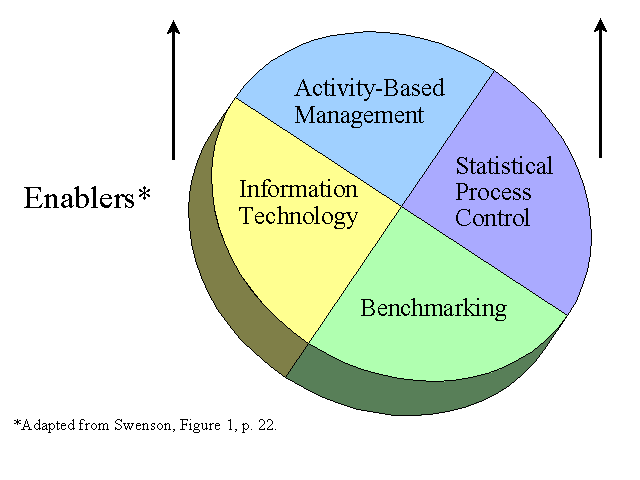
ABCM is an important function for Carrier’s improvements, because as Swenson states, “until the improvements are quantified they are not acted upon.” ABCM is the tool that Carrier relies upon to help provide it with the hard data to determine if an improvement should be made. See below for a graphic view of how ABCM and other enablers support Carrier's complexity reduction strategy which supports the higher level goals, objectives and competitive strategies of the organization.
_____________________________________________
Related summaries:
Berliner, C., and J. A. Brimson, eds. 1988. Cost Management for Today's Advanced Manufacturing: The CAM-I Conceptual Design. Boston: Harvard Business School Press. (Short Summary or Concepts.) (Longer Summary.)
Beynon, R. 1992. Change management as a platform for activity-based management. Journal of Cost Management (Summer): 24-30. (Summary).
Campi, J. P. 1992. It’s not as easy as ABC. Journal of Cost Management (Summer): 5-11. (Summary).
Coburn, S., H. Grove and C. Fukami. 1995. Benchmarking with ABCM. Management Accounting (January): 56-60. (Summary).
Cokins, G. 1999. Using ABC to become ABM. Journal of Cost Management (January/February): 29-35. (Summary).
Cooper, R. 1996. Activity-based management and the lean enterprise. Journal of Cost Management (Winter): 6-14. (Summary).
Cooper, R., and R. S. Kaplan. 1998. The promise - and peril - of integrated cost systems. Harvard Business Review (July-August): 109-119. (Summary 1, Summary 2).
Hammer, M. 1990. Reengineering work: Don't automate, obliterate. Harvard Business Review (July-August): 104-112. (Summary).
Hammer, M. 2001. The superefficient company. Harvard Business Review (September): 82-91. (Summary).
Hughes, S. B. and K. A. Paulson Gjerde. 2003. Do different cost systems make a difference? Management Accounting Quarterly (Fall): 22-30. (Summary).
Johnson, H. T. 1989. Professors, customers, and value: bringing a global perspective to management accounting education. Proceedings of the Third Annual Management Accounting Symposium. Sarasota: American Accounting Association: 7-20. (Summary).
Keys, D. E. 1994. Tracing costs in the three stages of activity-based management. Journal of Cost Management (Winter): 30-37. (Summary).
McGowan, A. 1999. Impacts of ABCM on job performance and environment. Journal of Cost Management (March/April): 32-36. (Summary).
Pryor, T. 1997. Making new things familiar and familiar things new. Journal of Cost Management (Winter): 38-42. (Summary).
Reeve, J. M. 1996. Projects, models, and systems -Where is ABM headed? Journal of Cost Management (Summer): 5-16. (Summary).
Sandison, D., S. C. Hansen and R. G. Torok. 2003. Activity-based planning and budgeting: A new approach. Journal of Cost Management (March/April): 16-22. (Summary).
Sweeney, R. B. and J. W. Mays. 1997. ABM lifts bank's bottom line. Management Accounting (March): 20-22 and 24-26. (Summary).
Swenson, D. 1997. Best practices in activity-based management. Journal of Cost Management (November/December): 6-14. (Summary).